No-KYC Virtual Cards in 2026: What's Real, What's Risky
By Marcus Lindqvist, Compliance Specialist · Updated 2026-08-26
TL;DR A truly anonymous, zero-verification virtual card doesn't exist at any real scale in 2026 - card networks and issuers operate under AML rules that require some identity check. What does exist is the "low-KYC" middle ground: fast onboarding, minimal data collection, and quick funding, without pretending to be untraceable. This guide explains what a no KYC virtual card can and can't do, the real risks (frozen funds, sudden shutdowns, no chargeback protection), and how to evaluate providers like WaldenPay on fees, coverage, and speed instead of vague anonymity promises.Search "no kyc virtual card" and the results all look the same: a listicle of five or six providers, a handful of affiliate links, and a promise that sounds too good to hold up. Most people typing that phrase aren't trying to dodge the law. They just want a card that's quick to set up, doesn't demand a passport scan for a $200 top-up, and doesn't leak their spending habits to five different data brokers. That's a fair thing to want. It's just not the same thing as "fully anonymous," and mixing the two up is where people end up disappointed.
This guide separates the two. It walks through what's actually available in 2026, why "no-KYC" and "low-KYC" aren't interchangeable, and how to judge a provider on fees, supported cryptocurrencies, and funding speed instead of marketing copy. For a deeper regulatory breakdown, see the pillar guide on no KYC crypto cards and what's real vs. risky.
What people actually mean when they search "no KYC virtual card"
Almost nobody wants zero accountability. They want three specific things: speed (a card ready in minutes, not after a week of document uploads), privacy (not handing over a driver's license photo to load $50), and simplicity (skip the credit check, the SSN request, the proof-of-address utility bill).
That's a reasonable ask. A crypto card without verification, in the strict sense, would mean no name, no email, nothing tying the card to a person at all. In practice, that product doesn't exist for a card that actually works at scale - one that loads funds, settles on Visa or Mastercard rails, and lets you tap to pay at a coffee shop. Something in that chain always needs a minimal identity signal, even if it's just an email address and a device fingerprint rather than a passport scan.
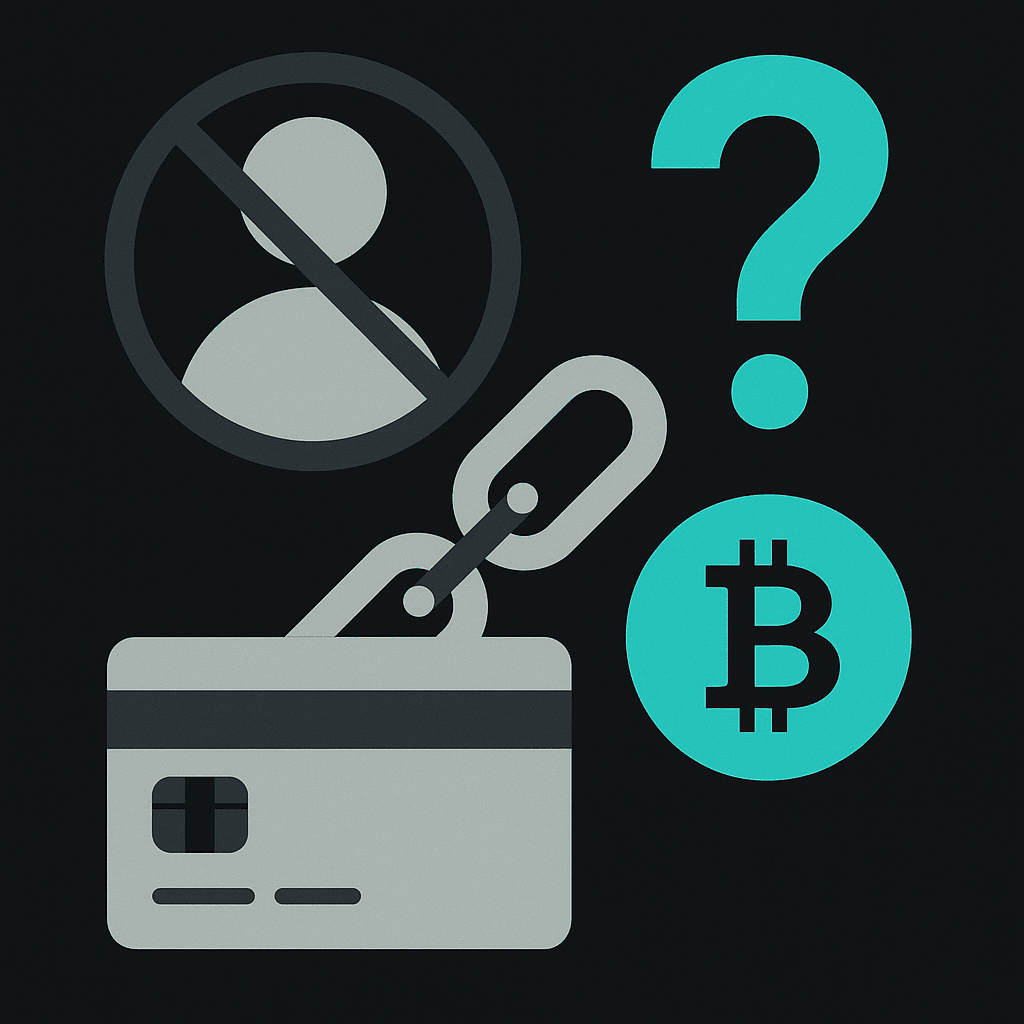
Why a true no-KYC virtual card doesn't really exist in 2026
Card issuers don't operate in a vacuum. Visa and Mastercard require their issuing partners to follow anti-money-laundering rules, and those rules don't carve out an exception for "the customer paid in crypto." A genuinely no-KYC crypto credit card - one that extends real credit with zero identity check - isn't a realistic product category this year. It never really was; it just used to be easier to fake.
Physical card issuance is one of the most reliable triggers for full verification. The moment a provider ships plastic to a mailing address, that address, and usually a name attached to it, becomes part of the compliance record. Virtual-only cards have more room to move, but "more room" isn't the same as "none."
A few years ago, virtual cards without proper KYC were genuinely easier to get. That window has narrowed steadily because of AML enforcement, tighter card network rules, chargeback and fraud losses that push issuers to add friction, and regulators leaning harder on the fintech companies sitting between crypto and card rails. The honest answer today, as several industry write-ups have put it, is that there isn't a "best no kyc crypto card" with zero verification and full functionality. What's realistic instead is a low-KYC or tiered-KYC card: start spending with minimal information, then verify further only if volume or limits push past a threshold.

The risk side nobody puts in the listicle
The problem with chasing a fully anonymous crypto card isn't just that it's hard to find. It's that the ones claiming to offer it tend to sit in gray regulatory territory, and that comes with real consequences.
- Sudden shutdowns. Providers operating without clear licensing can disappear overnight, taking loaded balances with them.
- Frozen funds. Even when a platform doesn't vanish, it can freeze an account mid-transaction if its own banking or card-issuing partner gets nervous.
- Forced KYC after the fact. Several "no-KYC" brands market themselves that way, then require verification once you try to withdraw or once your volume crosses a quiet internal limit.
- No dispute resolution. Fraud protection and chargeback rights generally assume a verified account. Skip verification and you often skip the protection too.
- Legal exposure. Depending on where you live, using a card product that's misrepresenting its compliance status can create problems that have nothing to do with what you actually spent the money on.
Two examples that keep coming up in independent reviews illustrate the pattern. xKard markets itself as no-KYC, but tracking site KYCnot.me rates it poorly and documents user reports of frozen funds and forced KYC after sign-up. Bing Card once advertised a no-ID virtual tier; KYCnot.me now lists it at Level 4, meaning KYC is mandatory, and an independent domain scanner flags it as high-risk. Neither is a case of a good product losing its edge - both look like marketing outrunning reality.
The primary risks of a no-KYC crypto card aren't hypothetical: legal exposure, permanent loss of funds if the platform shuts down, fraud with no dispute path, and zero consumer protection if something goes wrong.A note on "untraceable." Untraceable crypto card myths persist because they're appealing, but every card transaction touches a card network, a merchant acquirer, and usually a blockchain record on the funding side. "Privacy-focused" is achievable. "Untraceable" is a marketing word, not a technical one, and WaldenPay doesn't claim it - use of any crypto card remains subject to AML and regulatory requirements.
Low-KYC vs. no-KYC: why the lighter option usually wins
Here's the part most comparison articles skip: a low-KYC virtual card and a no-KYC virtual card aren't two flavors of the same thing. They sit on opposite sides of a reliability line.
A no-KYC provider is betting it can stay under the radar of card networks and regulators indefinitely. Some manage it for a while. But the model is inherently unstable, and the cost of that instability lands on the user - in the form of a frozen balance or a dead app with no support line.
A KYC-free virtual card that's honest about it will usually turn out to be either extremely limited (low balance caps, prepaid-only, no card-to-card transfers) or short-lived. A low-KYC or tiered-KYC card takes a different bet: ask for the minimum needed to satisfy the issuer's obligations - typically an email, sometimes a phone number - and only step up verification if usage patterns call for it. That's the model that tends to survive past its first year.
A practical decision framework
Instead of ranking providers by how loudly they claim "no verification," it helps to score them on things that actually determine whether the card still works next month.
- Regulatory posture. Does the provider disclose which entity issues the card and under what compliance framework? Vague answers are a red flag.
- Funding speed and coverage. How many cryptocurrencies and networks are supported, and how long does a top-up actually take to post?
- Fee transparency. Is the fee a flat number, or does it scale with volume and get disclosed up front? "Low fees" with no schedule isn't really an answer.
- Data minimization. Does onboarding ask for a home address and a selfie for a $20 card, or just an email to get started?
- Failure mode. What happens if a top-up is short, late, or sent on the wrong network? Does the provider refund it, or does the balance just disappear into support-ticket limbo?
| Criteria | Full anonymity promise | Low-KYC / privacy-focused card |
|---|---|---|
| Verification required | Claims none, often reverses later | Minimal upfront, tiered by limit |
| Longevity | Frequent shutdowns, frozen accounts | Operates under disclosed compliance rules |
| Fee clarity | Often hidden or bundled into spread | Published schedule, e.g. 5% down to 3% by volume |
| Dispute protection | Usually none | Standard card network protections apply |
| Underpayment / wrong network handling | Rarely addressed | Tracked and refunded per provider policy |
Where a compliant middle ground actually looks like
WaldenPay is a useful example of the low-KYC approach rather than the no-KYC one, and it's worth being direct about that distinction. It doesn't claim to be an anonymous crypto card, and it isn't a bank. What it offers is minimal-friction onboarding - a virtual card issued in minutes, funded with 135+ cryptocurrencies across 35+ networks including USDT, USDC, BTC, ETH, SOL, TRX, and LTC - alongside a fee structure that's published rather than buried somewhere in the fine print.
The top-up fee starts at 5% and drops automatically as 30-day card spend increases: 4.75% past $2,000, 4.5% past $5,000, 4.25% past $10,000, 4% past $25,000, 3.5% past $50,000, and 3% past $100,000, with individual pricing above $250,000 a month. There's a one-time $10 card issue fee and no monthly maintenance charge; registration, balance checks, and support don't cost anything. The dashboard shows the current fee tier, 30-day spend, and how far away the next discount is, so there's no guessing or applying for a better rate.
Cards work with Apple Pay and Google Pay, or directly online and in-store anywhere the network is accepted - across 150M+ merchants. A Telegram bot handles ordering, recharging, balance checks, and transaction alerts for anyone who'd rather manage a card without opening a browser. And for peer-to-peer moves, the Send to Friend feature transfers funds instantly and fee-free between WaldenPay users using just an email address - no wallet address, no on-chain transaction, with a name preview and password confirmation before anything moves. None of that amounts to anonymity. It amounts to a card that's fast to get and doesn't over-collect personal data, while still sitting inside AML and regulatory requirements. More detail on how the onboarding and funding flow works is on the how it works page, and the full fee breakdown lives on pricing.
For anyone weighing this against fully anonymous claims elsewhere, the related reads on what's actually possible with anonymous crypto payment cards and crypto cards without KYC, real vs. risky go deeper into the regulatory mechanics behind why full anonymity keeps failing at scale.
Who this actually fits
Freelancers getting paid in crypto by overseas clients want a card that doesn't need weeks of onboarding before their first payment lands. Digital nomads want something that works whether they're in Lisbon or Bangkok without re-verifying every time they change country. Entrepreneurs funding ad accounts want predictable fees, not a surprise deduction buried in a spread. Privacy-conscious spenders just want a provider that isn't harvesting more data than the transaction requires.
None of those goals need a KYC-free virtual card that might vanish in six months. They're served better by a low-KYC virtual card built to last - one that treats privacy as a design principle rather than a marketing hook. If ad-account funding specifically is the use case, the guides on fixing a declined Facebook ads card with a crypto card and using a virtual card to fund TikTok ad campaigns cover that angle in more depth.
FAQ
Is there a real no KYC virtual card in 2026?
Not one that works reliably at scale with real card network rails. What exists instead are low-KYC or tiered-KYC cards that ask for minimal information upfront - often just an email - and only require more verification if spending or transfer limits increase.
Why do so many "no-KYC" providers stop working?
Most operate in gray regulatory territory without a clear issuing partner or licensing structure. When card networks or banking partners tighten enforcement, these providers either get cut off or forced to add verification retroactively, sometimes freezing balances in the process.
Is a privacy-focused crypto card the same as an anonymous one?
No. A privacy-focused crypto card minimizes the data it collects and doesn't sell or over-share it, but it still operates under AML and regulatory requirements. An anonymous card would mean zero identity link at all, which isn't a viable product for a functioning Visa or Mastercard-rail card today.
What should someone check before choosing a low-KYC provider?
Fee transparency (is there a published schedule or just a vague "low fees" claim), supported cryptocurrencies and networks, how top-ups are handled if underpaid or sent on the wrong network, and whether the provider discloses its compliance framework rather than staying deliberately vague.
Can a no-KYC crypto debit card protect against fraud?
Generally not well. Dispute resolution and chargeback protections are usually tied to verified accounts. A card that skips verification entirely tends to skip that protection too, leaving the user with no recourse if something goes wrong.
Want speed and privacy without the anonymity myths?
WaldenPay issues a virtual card in minutes, funded with 135+ cryptocurrencies across 35+ networks, with fees that drop automatically as spend grows - no applications, no guesswork, and onboarding that stays light while staying compliant.
Get your WaldenPay card