Agentic Payment Card: How AI Agents Pay in 2026
By James Whitfield, Payments Specialist · Updated September 21, 2026

An agentic payment card is a card credential used within a system that lets software initiate purchases under human-defined authorization and controls. It isn't necessarily a special prepaid product. A virtual card supplies a way to pay; it doesn't, by itself, give an AI agent permission to spend or enforce purchasing policies.
The useful distinction is between choosing a purchase and executing an authorized payment. An agent might identify a paid dataset, compare subscription options, or request additional compute. Separate software should check the merchant, amount, budget, and approval requirements before any payment instruction reaches a provider. A human or business remains accountable.
WaldenPay's crypto virtual card illustrates the funding side: it's a crypto-funded prepaid virtual card platform, not a verified agent-authorization service. Cryptocurrency converts to card balance at loading time. Its published features don't establish permission for unattended agent checkout, merchant-specific controls, or an agent payment integration. Use is subject to AML and regulatory requirements.
This guide covers supervised purchasing, funding, technical architecture, costs, safeguards, and accountability. The practical starting point is a permitted purchase with a clear spending boundary, not a model holding unrestricted payment credentials. Automation should follow evidence that the workflow can enforce that boundary.
What Is an Agentic Payment Card?
Delegated purchasing lets software act within authority granted by a person or business. An assistant that recommends a subscription hasn't made a payment. An application that can submit an approved order and initiate payment has crossed into execution, even when a human must approve that particular purchase first.
The card credential versus the control layer
The credential identifies the payment instrument. Depending on provider permissions and the intended use, that instrument can be prepaid, debit, or credit. Virtual issuance can make provisioning convenient, but instant availability isn't what makes a payment agentic. Nor does this category require the removal of verification or human approval.
A functioning arrangement separates several responsibilities:
- AI agent: interprets a task and proposes a purchase, including its purpose and expected cost.
- Purchasing application: manages the order, connects to permitted merchant interfaces, and tracks the result.
- Payment credential: identifies the card or token used to initiate payment.
- Funding source: supplies a prepaid balance, deposit-account funds, or an approved credit facility.
- Authorization controls: determine permitted merchants, amounts, timing, and approval requirements.
- Accountable owner: grants authority, reviews exceptions, and handles subscriptions, disputes, and recordkeeping.
These responsibilities needn't belong to the same provider. But their boundaries must be explicit: an application's budget setting is ineffective if another execution path can spend without checking it.
Raw card numbers, CVVs, and expiration dates shouldn't enter model prompts, conversation histories, or general-purpose agent memory. Where supported, a restricted payment service should hold credentials or use provider-issued tokens. The model submits a structured request; trusted software checks permission and executes through an approved interface. Tokens also need scope controls: replacing a card number doesn't automatically restrict spending.
What makes a payment agentic
The defining feature is delegated decision-making connected to authorized execution. A system may select an approved resource and purchase it within a budget, while escalating unfamiliar merchants or recurring commitments to a person. Supervision doesn't disqualify the workflow; it's often the appropriate boundary.
Useful capabilities include:
- Suitable provisioning: credentials available before the approved task requires them, through a supported process.
- Enforceable policies: spending caps, merchant restrictions, and transaction-frequency limits wherever the integration actually supports them.
- Readable transaction records: order references, payment status, and receipts that the purchasing application can reconcile.
Network initiatives illustrate the direction, not universal availability. As of July 2026, Mastercard had introduced Agent Pay for Machines in June for permissioned, orchestrated machine-speed transactions. Visa's reported June 10, 2026, ChatGPT integration described agent purchases with user-set limits. Google had announced an open agentic-payments standard at NRF on January 11, 2026. None of those developments establishes that every card or merchant supports unattended purchasing.
Provider permission and a tested execution path still matter more than an "AI-ready" label. A network's acceptance footprint isn't a guarantee that a particular automated transaction will be approved.

Where Crypto AI Fits: Agents, Tokens, and Payment Funding
Crypto AI covers several different activities. Some projects issue tokens associated with AI infrastructure or services. Trading software submits market orders under configured rules. Purchasing agents acquire resources needed for a task. Cryptocurrency can also serve simply as the asset used to fund a payment balance, without controlling any purchasing decisions.
Those categories aren't interchangeable. An AI-related token doesn't establish payment authorization, reliable earnings, or a supported card integration. Trading permissions don't authorize software to buy subscriptions, and a purchasing agent doesn't need a speculative token to operate. The supporting guide to crypto AI tokens and agents explains token categories, trading bots, and how those activities differ from spending. That distinction matters when evaluating a product: token ownership, purchasing authority, and available funds are separate questions.
An agentic payment card workflow can use a crypto-funded balance without creating a blockchain transaction at checkout. With WaldenPay, supported cryptocurrency converts to card balance when loaded; subsequent card spending uses card rails. That funding step doesn't make an agent autonomous or grant execution permission. Crypto AI technologies still need a purchasing application, enforceable controls, and an accountable owner before they can safely participate in a payment workflow.
Who Needs Delegated Spending, and Who Doesn't?
Repeated, predictable purchases can justify payment engineering. Occasional purchases often don't: a person completing checkout may be simpler than maintaining credentials, policies, exception handling, and reconciliation software.
An agent can also complete useful tasks without its own card. Existing merchant billing, account credits, or a purchasing queue may already provide the necessary payment mechanism. Requiring approval for a new commitment doesn't make the rest of the workflow pointless.
- Developers buying approved services. Software may need paid API access or additional compute. Existing metered billing may cover usage; a new supplier or subscription should trigger a separate authorization decision.
- Research teams managing paid resources. A research agent may identify datasets, journal access, or data feeds. Delegation fits when permitted suppliers, licensing requirements, and budget ownership are clear. Otherwise, the agent should prepare a purchase request.
- Businesses supervising procurement. Repeat purchases of approved tools can follow established policies. Recurring subscriptions require attention to renewal terms, cancellation responsibility, and total commitments, not merely the initial charge.
And separate cards per agent are an architectural choice, not a universal requirement. They may improve attribution, but they don't make accounting automatic or eliminate overspending. Shared payment infrastructure can instead tag purchases by project, task, and owner, provided the control layer enforces the correct budget.
A practical decision rule is straightforward: if existing billing already pays for approved usage, adding card checkout may create complexity without solving a problem.

Cards, Merchant Billing, Wallets, and Human Approval
The payment method should follow the supplier relationship and the permitted execution path. An agent requesting a purchase isn't the same as an agent authorized to execute it. That distinction applies whether settlement uses a card, an existing account, or a blockchain wallet.
Card-based checkout
Cards can suit purchases from merchants that support the relevant card type and checkout flow. Credentials should remain with a restricted execution service rather than the model. The application needs to distinguish an order request, an authorization, and a completed purchase; a timeout doesn't establish that payment failed.
An agentic payment card integration also needs confirmation that automated use is permitted. Authentication challenges may require a person, and prepaid-card acceptance isn't universal. Refunds and dispute processes depend on the transaction and applicable terms; reversal shouldn't be assumed. As of July 2026, the CFPB's prepaid card consumer guidance explains relevant consumer protections and product considerations, rather than certifying any agent workflow.
Merchant accounts or prepaid service credits
Existing billing can be the least complicated route for repeat API or compute usage. The agent uses an authorized service account, while the merchant bills under an established agreement or deducts credits. This avoids introducing checkout into every task.
But an account credential can itself create spending exposure. The application should restrict service access, monitor usage, and confirm whether provider-side limits actually stop consumption. Prepaid credits are generally tied to a particular service; expiration, refunds, and transferability require checking the supplier's terms. No card per agent is necessary if attribution and authorization work at the account or project level.
Direct on-chain payments
A wallet-based flow may fit a service that explicitly accepts the chosen asset and network. Custody becomes central: either a service controls signing keys or a trusted signing component enforces policy. The language model shouldn't receive private keys or unrestricted signing access.
Address validation, network selection, confirmation tracking, and refund arrangements need explicit handling. A confirmed transfer typically can't be canceled through a card-style dispute process. Sending funds also doesn't prove that the purchased service was delivered.
Human-completed checkout
Manual execution fits unfamiliar suppliers, unusual commitments, and purchases that require human authentication or judgment. An agent can prepare a cart or order summary, while a person checks the merchant, amount, recurrence, and terms before paying.
The approval must match the actual purchase. If the merchant or price changes, the earlier approval shouldn't silently authorize the revised order.
| Approach | When it may fit | Permissions to confirm | Main operational burden |
|---|---|---|---|
| Card checkout | Approved purchases through supported checkout | Provider and merchant permit the intended automated flow | Credential isolation, authentication, uncertain charges |
| Merchant billing or credits | Repeat usage with an established supplier | Account access, service scope, billing authority | Usage controls, commitments, project attribution |
| On-chain payment | Services accepting a specified asset and network | Signing authority, destination, amount, asset | Key custody, confirmations, refund coordination |
| Human checkout | Occasional or exceptional purchases | Named approver accepts the actual order | Review time and receipt capture |
Integration effort should include exception handling, not just the successful payment call. Before execution, the application needs an authorized request. Afterward, it needs evidence linking the payment result to the order and the responsible owner.
How an Agent Purchase Moves From Request to Receipt
A delegated purchase starts with an authorized task and ends with matched payment, order, and delivery records. The model can propose what to buy, but a separate application should decide whether the purchase is permitted and whether a restricted payment service may execute it.
A funded card alone doesn't establish that permission.
For an agentic payment card workflow, the useful unit of control is the purchase request: a record containing the responsible owner, merchant, item, quantity, total, purpose, and approval requirements. Instructions such as "obtain the required dataset" need to become a specific proposal before any payment credential becomes usable.
- Task request: The owner defines the business objective, permitted purchase scope, and budget.
- Proposed purchase: The agent identifies an item and records its merchant, final price, delivery terms, and any recurring commitment.
- Policy evaluation: Application code checks the proposal against approved merchants, spending limits, duplicate requests, and prohibited purchase types.
- Required human approval: An authorized reviewer accepts the actual proposal whenever policy requires it. Material changes invalidate that approval.
- Secure credential access: A restricted payment service or approved integration obtains the necessary credential. The model receives neither raw card details nor general access to the credential store.
- Merchant checkout: The integration submits the approved order through a permitted checkout flow, preserving identifiers needed to investigate its result.
- Authorization response: The application records approval, decline, or uncertainty. An interrupted connection isn't proof that no charge occurred.
- Fulfillment confirmation: The merchant's order status and delivery evidence establish whether the purchased item or service actually arrived.
- Reconciliation: The application matches the purchase request, approval, payment record, receipt, and fulfillment result, keeping unresolved differences open.
Authorized task -> purchase proposal -> policy check -> approval if required -> restricted payment service -> merchant checkout -> authorization result -> fulfillment check -> reconciliation
A hypothetical dataset purchase
Suppose a research agent needs a downloadable dataset from an approved supplier. It proposes a single purchase within its assigned budget. The application rejects subscriptions, verifies the supplier, and routes the dataset's license terms to the owner because licensing requires human review.
After approval, the payment service submits the unchanged order. If checkout returns an authorization approval but the download never becomes available, the task remains unresolved. The agent shouldn't buy another copy merely because its first retrieval attempt failed.
And authorization isn't settlement. Authorization generally indicates approval to proceed and may reserve funds; capture and settlement concern completing the financial transaction. Neither establishes successful delivery. An order can be authorized while fulfillment is pending, and a receipt still needs to match the item actually received.
Mini-Glossary
Agentic Token: As of July 2026, Mastercard's term describes a tokenized credential extending its Digital Enablement Service, announced with Agent Pay on April 29, 2025. It shouldn't be treated as a generic feature of every virtual card.
Machine-to-machine payments: Payments initiated between automated systems under delegated authority. Human review may be absent from individual executions, but responsibility and exception handling still need assigned owners.
How to Set Up an Agentic Payment Card Workflow
Implementation should begin with a written purchasing policy, not a card number. The operator needs evidence that the intended automation is permitted, that payment credentials stay outside the model's reach, and that ambiguous outcomes stop additional spending until reviewed.
Define permitted purchases and the responsible owner
The policy should name an accountable person and specify eligible goods, suppliers, purposes, and recurring commitments. "Purchase research tools" is too broad. "Purchase approved datasets from listed suppliers, with license review before payment" creates a decision that software and a reviewer can evaluate.
Every request should carry its owner's identity and policy version. Otherwise, an audit may show what happened without showing which authority permitted it.
Confirm provider and merchant permission for automation
The operator should check both payment-provider terms and merchant rules for the intended integration. Permission to hold a virtual card doesn't necessarily include unattended checkout, browser automation, credential sharing, or resale.
Authentication also needs a documented path. An online transaction may invoke 3-D Secure authentication; an agent shouldn't attempt to bypass the challenge. If the permitted flow needs human participation, checkout must pause for that participation or stop.
Select the payment approach
The team should choose among supported card checkout, merchant billing, an authorized wallet integration, and human checkout based on the purchase itself. Recurring supplier usage may fit merchant billing better than repeated storefront purchases. Occasional orders with changing terms may remain human-operated.
A provider's partner API isn't sufficient evidence of agent support. Required endpoints, permissions, transaction visibility, and exception behavior need confirmation before integration work begins.
Establish secure credential storage
A restricted payment service should hold or access credentials through an approved storage and processing arrangement. The model submits a structured purchase request, not arbitrary payment instructions containing card data.
Prompts, chat transcripts, agent configuration files, and model-accessible environment variables shouldn't contain raw credentials. Logs should retain safe identifiers rather than sensitive authentication data. A secrets vault doesn't provide meaningful isolation if the model can freely query it.
Implement application-side spending policies
Deterministic code should enforce transaction ceilings, cumulative budgets, approved suppliers, and recurring-payment rules before execution. Pending requests and reserved amounts need to count against available purchasing authority so concurrent tasks can't each spend the same allocation.
These are application controls, not assumed card features. WaldenPay's verified product facts don't establish native agent budgets, merchant-category restrictions, agent credential scopes, or automated freeze endpoints. Any provider-enforced controls must be confirmed separately.
Add approval gates
Review should be mandatory for exceptions such as a new merchant, changed total, subscription, unfamiliar delivery destination, or unusual terms. The reviewer needs the actual order details, not merely the agent's summary.
Approval should attach to a specific proposal. If its material terms change, the application should require a fresh decision rather than reuse stale permission.
Test failure cases before live purchasing
A provider sandbox is preferable where available. Otherwise, testing should use an explicitly permitted, tightly controlled purchase with an authorized owner and documented recovery process, without assuming the payment will be refundable.
Tests should cover declines, authentication challenges, duplicate submissions, checkout timeouts, changed totals, missing receipts, and delayed fulfillment. A timeout after submission should enter an unresolved state, not trigger an automatic replacement purchase.
Launch with supervised operation
Initially, a human should review each proposed purchase and its outcome. Unattended execution should expand only after the team demonstrates that controls work under failure, not just successful checkout.
- Permission: Provider and merchant rules support the intended flow.
- Isolation: The model cannot retrieve payment credentials.
- Enforcement: Budget and approval checks block prohibited requests.
- Recovery: Uncertain payments cannot trigger blind retries.
- Traceability: Requests, approvals, orders, and payment records remain linked.
- Emergency stop: An authorized operator can disable new payment execution.
Review transactions and enforce stop conditions
For an agentic payment card deployment, reconciliation should continue after checkout. Credential exposure, unexplained charges, policy-service failure, or an unavailable approver should stop affected execution. Open payment uncertainty should block retries for that purchase until an authorized reviewer resolves it.
How Crypto Funding Becomes a Spendable Card Balance
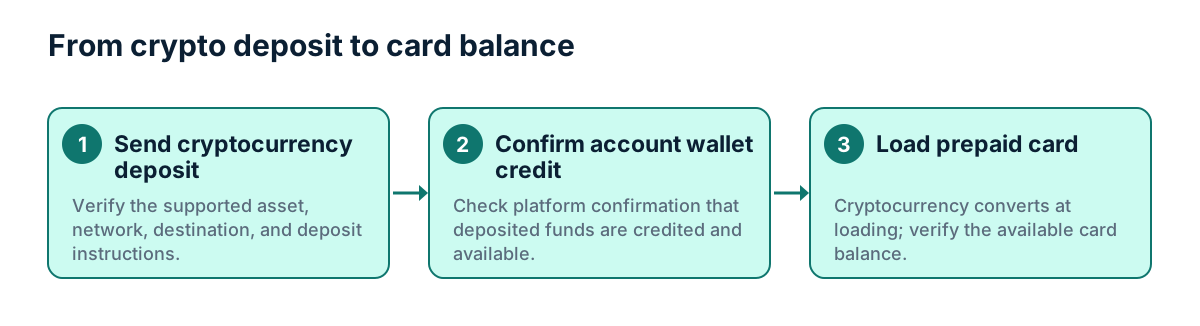
Crypto-funded spending separates the blockchain deposit from the money available on a prepaid card. A deposit reaching an account wallet doesn't, by itself, prove that a card has been loaded or that a merchant purchase can proceed.
WaldenPay provides a concrete example: it supports funding with 135+ cryptocurrencies across 35+ networks, including USDT, USDC, BTC, ETH, SOL, TRX, and LTC. Its account wallet provides unique deposit addresses per supported network. Cryptocurrency converts to card balance at loading time.
| Stage | What it represents | Evidence needed before proceeding |
|---|---|---|
| Cryptocurrency deposit | A transfer on the selected blockchain network | Correct asset, network, destination, and applicable deposit instructions |
| Account wallet | Funds credited within the platform account | Platform confirmation that the deposit is credited and available |
| Loaded prepaid card | Card balance available for attempted purchases | Successful loading and the displayed available card balance |
Check the network before sending
The person funding the account should verify the supported asset and network together, copy the address from the authenticated account, and follow any additional deposit instructions shown. A familiar token name isn't enough to establish that a particular network is supported for that deposit.
Before card loading, the operator should verify the credited balance inside the platform rather than rely solely on a sending-wallet notification. Blockchain confirmation, platform crediting, and card loading are distinct events; none should be assigned an invented completion deadline.
Load the card and verify its balance
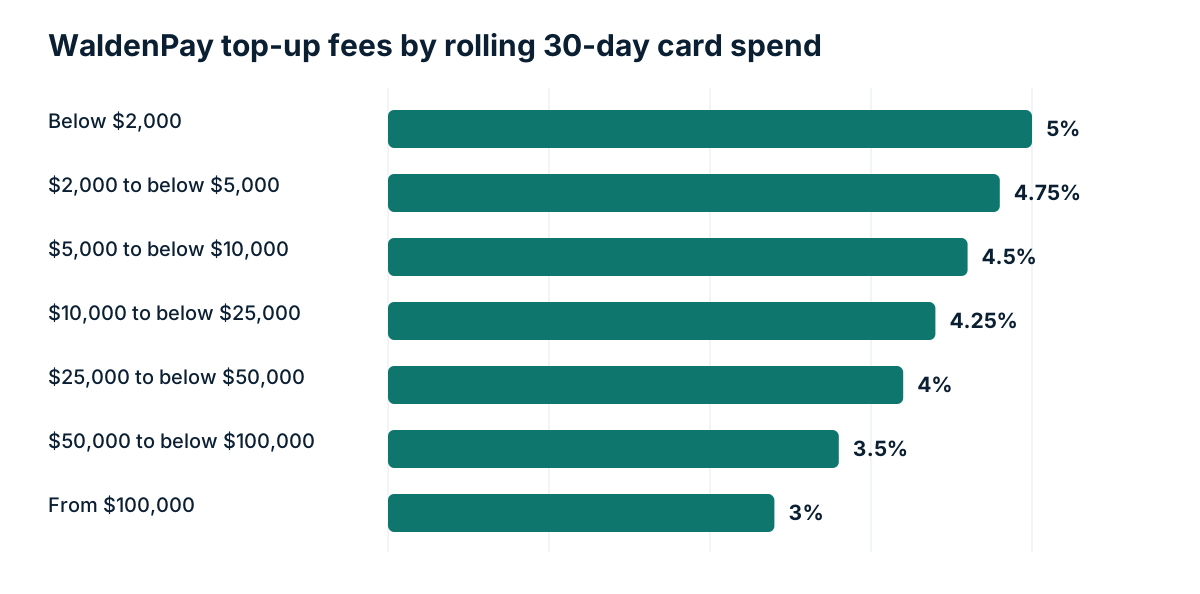
WaldenPay's minimum card top-up is $50, and the card is issued instantly after funding. It has a $10 one-time card issue fee, no monthly maintenance fee, and a top-up fee starting at 5%, with automatic volume discounts down to 3% based on rolling 30-day card spend.
The operating budget should therefore be based on the displayed available card balance, not the original cryptocurrency transfer amount. An agentic payment card application should wait for confirmed funding status before authorizing a purchase.
WaldenPay is a prepaid card product on Visa/Mastercard rails, with acceptance at 150M+ merchants worldwide and Apple Pay and Google Pay support. That reach doesn't guarantee an individual transaction: merchant prepaid-card policies, authentication, available balance, and other payment checks still apply.
Keep funding authority separate from purchasing authority
WaldenPay's Telegram bot lets an operator order and recharge cards, check balances, and receive transaction alerts. It doesn't establish programmable agent top-ups or permission to automate a merchant's checkout.
Signup requires an email only, with no identity documents for standard use. But privacy-focused doesn't mean anonymous or untraceable: use remains subject to AML and regulatory requirements. WaldenPay is operated by BlueHouse Software B.V., Rotterdam, Netherlands, through a licensed partner model; crypto funding doesn't remove financial intermediaries.
The crypto card comparison table provides another checkpoint when evaluating funding methods, supported networks, and verification requirements. Automation permission still requires its own review.
Budgets, Permissions, Approval Gates, and Emergency Stops
An agentic payment card workflow needs enforceable spending authority outside the model: permitted purchases, reserved budgets, approval requirements, and a shutdown path. Instructions in a prompt aren't payment controls. The application must reject prohibited actions even when an agent produces a persuasive explanation.
The controls below are application design patterns, not documented WaldenPay features. Provider-native restrictions, token revocation, transaction notifications, and card-management endpoints require separate documentation and testing. An application's merchant allowlist doesn't become an issuer-enforced restriction merely because the application stores it.
Purchase scope: authorize a task, not unrestricted shopping
Permission should identify the purchasing principal, approved merchant account, product or service, business purpose, and expiration condition. A research task might authorize access to an approved dataset without authorizing subscriptions, extra seats, or related products suggested during checkout.
Merchant allowlists should use verified identifiers where available, rather than trusting a merchant name extracted from a webpage. Redirects, marketplace sellers, and payment intermediaries need explicit handling. If the application cannot establish that the destination matches the approved scope, execution should stop for review.
A provider-neutral policy record could contain these descriptive fields:
| Policy field | Meaning | Application enforcement |
|---|---|---|
| Principal and task | Accountable owner and approved objective | Reject requests unrelated to that task |
| Purchase scope | Approved merchant, account, item, and billing type | Compare the checkout proposal with the authorized scope |
| Budget and reservation | Transaction ceiling, cumulative allowance, and pending commitments | Reserve capacity before execution |
| Approval evidence | Approver identity and approved purchase details | Reject changed or previously consumed approval |
| Validity and revocation | Expiration condition and current authorization status | Recheck immediately before submission |
Cumulative budgets and concurrency-safe reservations
A per-purchase ceiling doesn't prevent several agents from exhausting a shared budget. The budget service should calculate available authority as the allowance minus completed spending and outstanding reservations. It must create each reservation atomically, so concurrent workers cannot both claim the same remaining capacity.
Reservations should progress through explicit states such as reserved, submitted, confirmed, failed, and unresolved. An uncertain checkout result belongs in unresolved status, not automatically back in the available budget. Otherwise, a timeout can release capacity while a real charge remains pending.
Duplicate prevention needs a stable purchase-intent identifier shared across retries and workers. Where a payment or merchant API documents idempotency, the application should use it. Internal deduplication still matters, and an idempotency key doesn't prevent purchases submitted through unrelated channels.
Human approval must bind to the actual purchase
An approval should capture the merchant, item, quantity, final total, billing terms, and policy version. A material change invalidates it. Approval to inspect a checkout page isn't approval to pay, and approval for an initial charge isn't permission for later upgrades.
And the approving person needs evidence independent of the agent's summary. A trusted checkout record or structured order preview helps expose mismatched prices and hidden renewal terms. Approval should expire and become unusable after the authorized purchase is submitted.
Recurring obligations need a separate authorization
Subscriptions and metered services create commitments beyond the initial checkout. Their policy should specify the owner, renewal conditions, usage ceiling, review date, and cancellation responsibility. A scheduled cancellation is only an intention until merchant-side confirmation exists.
Stopping an agent doesn't necessarily stop an existing subscription or running workload. Those obligations need their own monitoring and shutdown procedures.
Emergency shutdown must reach every execution path
A kill switch should block new proposals from reaching payment execution, invalidate unused approvals, stop queued work, and prevent new credential retrieval. Workers must check revocation again immediately before an irreversible action, not only when a task starts.
Provider-side suspension or credential revocation should be included only where supported and documented. Neither application shutdown nor card suspension should be treated as cancellation of submitted orders, settled charges, or merchant contracts. Recovery requires reconciliation before purchasing resumes.
Practical Purchase Scenarios and Their Failure Boundaries
Each walkthrough below is hypothetical, not evidence of a documented deployment. An agentic payment card can support an approved purchasing workflow, but the merchant's rules and the application's controls determine whether execution is appropriate.
Hypothetical: a research assistant purchases approved data
Trigger: A research task requires a paid dataset unavailable through existing access. Permission: The approved merchant, dataset, license, and task budget must match. Approval boundary: A subscription, changed license, or higher checkout total requires renewed authorization.
Receipt evidence: The record should include the order identifier, receipt, license terms, and confirmation that access was delivered. Likely failure: Checkout succeeds but the dataset remains inaccessible. The assistant should report the mismatch rather than buy access again. If recurring access is approved, cancellation requires separate confirmation.
Hypothetical: a development agent arranges compute access
Trigger: An approved job needs additional compute. Permission: The account, workload type, resource scope, and usage budget must be authorized. Approval boundary: Expanded resources or continuing charges outside the approved task require review.
Receipt evidence: Workload identifiers, usage records, billing statements, and shutdown confirmation connect the purchase to the job. Likely failure: Resources continue running after task completion. Metered services may accumulate usage through account billing rather than charge a card for every API call.
For AWS-specific evaluation, the AWS crypto payment guide provides a separate billing reference. As of July 2026, prepaid-card eligibility and automation permission for any proposed AWS workflow still require verification; this hypothetical doesn't establish either.
Hypothetical: an operations assistant proposes a software renewal
Trigger: An existing subscription approaches renewal. Permission: The assistant may retrieve usage and prepare a proposal for the approved vendor. Approval boundary: Seat changes, annual commitments, or new terms require the accountable owner's decision.
Receipt evidence: The approved quote, invoice, subscription period, and account status should reconcile. Likely failure: The assistant pays a manual invoice while an automatic renewal remains scheduled, creating a duplicate obligation.
Hypothetical ad-account funding and multi-agent software management follow the same pattern: delegated tasks don't authorize unrestricted replenishment or independent subscriptions. The guide to advertising payment cards funded with crypto addresses the funding context, not permission to bypass platform checks.
A separate product example exists: as of July 2026, Robinhood offers an Agentic Credit Card within the Robinhood Gold Card, created after connecting to the Robinhood Banking MCP. That product description doesn't validate these hypothetical deployments or establish capabilities for another provider.
What Agent Payments Cost: Card Funding and Software Operations
The supplied research doesn't establish a universal agentic-payment surcharge. A platform fee or processing price associated with a particular checkout arrangement cannot be applied to every AI-assisted purchase. Cost planning should separate the card, the purchased service, and the software that proposes, authorizes, executes, and reconciles spending.
Automation has its own operating bill.
Published card costs: WaldenPay as a funding example
WaldenPay charges a $10 one-time card issuance fee and $0 monthly maintenance. The minimum top-up is $50. Its top-up fee starts at 5% and falls automatically with qualifying rolling 30-day card spend. Registration, balance checks, and support are free.
| Rolling 30-day card spend | Top-up fee | Pricing basis |
|---|---|---|
| Below $2,000 | 5% | Starting tier |
| From $2,000 to below $5,000 | 4.75% | Automatic volume discount |
| From $5,000 to below $10,000 | 4.5% | Automatic volume discount |
| From $10,000 to below $25,000 | 4.25% | Automatic volume discount |
| From $25,000 to below $50,000 | 4% | Automatic volume discount |
| From $50,000 to below $100,000 | 3.5% | Automatic volume discount |
| From $100,000 | 3% | Automatic volume discount |
| $250,000+ per month | Individual pricing | Separately determined terms |
The discounts apply instantly without an application. The dashboard shows the current fee, rolling 30-day spend, and progress toward the next level. Funding a card isn't the same as spending from it: a large deposit alone doesn't establish eligibility for a higher spending tier.
For a hypothetical $2,000 amount subject to the top-up fee, 5% represents $100, while 3% represents $60. That $40 difference illustrates the fee calculation, not eligibility for the lower rate. The 3% tier requires the confirmed spending threshold. The funding screen should establish the actual deposit requirement and resulting card balance before submission.
Because the measurement window rolls, an operating forecast should use the applicable tier rather than assume the lowest rate indefinitely. The one-time issuance charge belongs in setup costs; top-up charges belong in ongoing funding costs.
Software operations are independently billed
An agentic payment card doesn't include the surrounding execution infrastructure merely because a model can request a purchase. The operator needs a separate cost inventory:
- Model usage: Planning, tool selection, checkout interpretation, and exception handling consume model resources under the selected vendor's terms.
- Hosting: Workers, queues, databases, and scheduled jobs support execution even when no purchase completes.
- Secure credential storage: Secrets management and tightly controlled retrieval belong outside the model's conversational context.
- Monitoring: Logs, alerts, audit records, and reconciliation jobs create their own operational requirements.
- Human review: Approval queues, uncertain transactions, and support cases require staff time.
No vendor prices are assumed here. An estimate should use the selected providers' documented billing units and the application's observed workload. Failed tasks still may consume model and hosting resources, so completed purchases alone are a poor denominator for measuring operating efficiency.
Separate funding movements from purchase expenses
A useful ledger distinguishes money loaded onto the card, fees paid to load it, merchant purchases, and independently billed software operations. Otherwise, a report can count the same money as an expense when funded and again when spent.
For metered services, usage commitments also need tracking before an invoice reaches the card. Cash remaining on a prepaid balance doesn't prove that the operating budget is uncommitted. Pending purchases, unresolved authorizations, and accrued service usage should remain visible alongside settled charges.
But a lower funding fee isn't a reason to manufacture spending. The practical comparison is the total cost of the authorized workload, including unsuccessful execution and review, rather than the fee tier in isolation.
What an Agentic Payment Card Cannot Guarantee
A usable payment credential establishes neither purchasing authority nor merchant consent to automated checkout. An agent still needs permission from the accountable cardholder, an allowed merchant workflow, and controls appropriate to the obligation being created.
WaldenPay is a prepaid virtual card on Visa/Mastercard rails, with stated acceptance at 150M+ merchants worldwide. That reach isn't a promise that a particular merchant, subscription, or automated purchase will accept it. Merchant and provider rules still apply, including prepaid-card restrictions and geographic eligibility.
Authentication can also interrupt execution. EMV 3-D Secure supports authentication for online card payments; holding card details doesn't remove a challenge or authorize an agent to answer on the cardholder's behalf. A card number alone doesn't establish verified agent identity or prove that a purchase falls within delegated authority.
Known limits differ from unconfirmed capabilities
WaldenPay's prepaid structure, $50 minimum top-up, and published fees are known product facts. Agent-specific credentials, native merchant allowlists, programmable approval gates, and automated card suspension aren't established by the supplied facts. Those capabilities require documentation, not assumptions based on the existence of a partner API.
WaldenPay isn't a bank account or a complete agent execution platform. Its prepaid balance is a spending resource, not evidence of a credit facility or savings product.
Declines require controlled handling. Insufficient available balance, authentication requirements, or merchant restrictions may stop a purchase. The application should preserve the result, notify the supervisor, and resolve uncertainty before retrying. Switching credentials to defeat a restriction isn't an acceptable fallback. The guide to ChatGPT payment declines provides related troubleshooting context; as of July 2026, any service-specific eligibility still requires confirmation.
And privacy doesn't mean anonymity. WaldenPay requires an email for signup, with no identity documents for standard use, but use remains subject to AML and regulatory requirements. Payment activity isn't untraceable, and delegated purchasing doesn't remove the responsible person's compliance obligations. Cards don't provide exemptions from taxes, sanctions, or verification requirements; qualified professionals should address legal and tax questions.
Developer Architecture: Keep the Model Outside the Payment Boundary
A spending system should let the model propose purchases while separate services determine whether those purchases are permitted. For an agentic payment card workflow, the infrastructure decision is therefore about enforceable boundaries, not simply access to card details.
Agent planner
The planner translates a task into a narrow, structured purchase request: request identifier, merchant identifier, item or service, quantity, maximum total, currency, purpose, expiration, and whether recurring billing is permitted. It shouldn't submit arbitrary checkout instructions as payment authority. Free-text explanations can accompany the request, but they mustn't change its enforceable fields.
The model proposes the purchase. It doesn't assign its own permissions.
Policy service
A separate service checks the request against approved merchants, remaining budgets, purchase categories, and approval requirements. It should reserve spending capacity before execution so concurrent requests can't each consume the same available budget. Missing fields, expired permissions, or an unavailable policy service should stop execution rather than trigger a permissive fallback.
Approval interface
Human approval belongs in a trusted interface showing the merchant, purchase, total ceiling, and recurring terms. Approval should bind to that specific request and its version. If checkout changes the seller, price beyond the authorized ceiling, or subscription terms, the existing approval shouldn't silently cover the revised purchase.
Payment adapter
The adapter translates approved requests into a documented, permitted payment flow. It should reject instructions lacking valid authorization and return structured outcomes rather than asking the model to interpret a checkout screenshot as proof of payment.
Idempotency links repeated submissions to the same purchase attempt where the integration supports it. An internal request identifier alone can't guarantee that a merchant won't charge twice; uncertain outcomes still require status checks before another submission.
Secrets store
Credentials belong in a restricted secrets store accessible only to the execution component that needs them. They shouldn't appear in prompts, retrieved documents, agent configuration visible to the model, or debugging transcripts. Access separation should prevent the planner from changing policy, retrieving payment secrets, or editing audit records.
Transaction ledger
The ledger should distinguish proposed, approved, submitted, unknown, declined, authorized, captured, refunded, and canceled states where observable. Each transition needs a timestamp, originating component, request identifier, and supporting evidence. Append-only audit records should preserve policy versions, approval decisions, merchant references, and subsequent corrections without storing card secrets.
Buying infrastructure can reduce implementation work if documented capabilities include permission checks, credential isolation, and usable transaction status. Building offers control over business rules but leaves the operator responsible for testing, monitoring, incident response, and integration maintenance. Neither choice proves that autonomous purchasing is permitted.
A funded virtual card can support supervised testing without proving programmatic control. WaldenPay supports funding with 135+ cryptocurrencies across 35+ networks, but funding support doesn't establish an agent execution integration. Its crypto card buyer's guide explains funding, fees, and wallet compatibility; developers still need separate confirmation of supported automation. Early prototypes can keep checkout human-operated while validating the planner and policy service.
Security Risks: Prompt Injection, Credential Exposure, and Overspending
The most important security boundary separates information about a purchase from permission to make it. An agentic payment card workflow fails that boundary when text encountered during research can alter budgets, retrieve credentials, or authorize checkout.
Untrusted purchase instructions
Merchant pages, tool responses, and retrieved documents can contain instructions aimed at the agent rather than the shopper. A listing might tell the system to ignore its budget, send billing details to another endpoint, or substitute a different seller. Even apparently helpful support text can attempt to redirect the task.
None of that content grants payment authority.
External content should remain labeled as untrusted input. The planner may extract product facts, but a separate policy service must validate the resulting request against operator-controlled rules. Seller identities and destinations should come from validated integration data where available, not solely from page text. A changed recipient or recurring-payment term should invalidate prior approval.
Secret exposure
Least privilege means granting each component only the access required for its role. A research agent doesn't need card credentials. A checkout executor doesn't need permission to raise budgets. A reporting service doesn't need access to either.
Logs need the same discipline as prompts. Request bodies, browser traces, screenshots, exception messages, and support exports can expose credentials even when the primary application hides them. Redaction should happen before storage, with access restrictions and retention rules covering the remaining records. Token references can reduce exposure, but their scope and usability still require protection.
The Payment Card Industry Data Security Standard addresses protection of payment card data. A secrets store alone doesn't establish compliance; operators should obtain qualified guidance on the requirements applicable to their implementation.
Abusive or erroneous transactions
A legitimate credential can still fund the wrong purchase. Duplicate tasks, stale prices, compromised approvals, and unnoticed renewals can create losses without any stolen card number. Spending reservations, recurring-charge tracking, and independent reconciliation address different parts of that problem.
The following distinctions keep recommended application safeguards separate from documented provider features. As of July 2026, WaldenPay's documented Telegram functions include balance checks and transaction alerts; those functions aren't evidence of an automated purchase-policy engine.
| Risk | Application safeguard | Provider feature boundary |
|---|---|---|
| Injected checkout instructions | Validate structured requests against independent policy. | A virtual card doesn't validate the agent's task intent. |
| Credential leakage | Isolate secrets and redact logs before storage. | Card issuance doesn't establish model-side credential isolation. |
| Concurrent overspending | Reserve budget and enforce aggregate limits. | A prepaid balance isn't a substitute for task-level budgets. |
| Unexpected activity | Review anomalies and pause further execution. | WaldenPay transaction alerts support monitoring, not proof of pre-purchase authorization. |
Anomaly review should examine changed destinations, repeated failures, unusual purchase frequency, and unexpected subscriptions. If policy checks, trusted approval, or reliable state tracking are unavailable, execution should fail closed and enter human review.
But an allowlisted merchant can still sell an unsuitable item, host misleading content, or deliver something different from the order. A compromised human account can also approve a harmful request. Controls reduce exposure; they don't guarantee correct purchases, delivery, or recovery. Emergency stops should disable new execution independently of the model, while preserving evidence for investigation.
Declines, Uncertain Charges, Refunds, and Reconciliation
A failed checkout screen isn't enough to classify a transaction. Operations should distinguish a confirmed decline from an unknown outcome, because a timeout can occur after a merchant has received the payment request.
For an agentic payment card, that distinction determines whether another attempt is safe.
Declines and authentication
A definite decline should stop the current attempt and record the available reason without inventing one. The operator can review balance, purchase details, and applicable merchant restrictions through supported channels. Repeated submission with altered details shouldn't be used to force acceptance.
If authentication requires an account holder's action, the workflow should pause and route it to that person through a trusted interface. The agent shouldn't guess answers, intercept verification messages, or bypass the challenge. Approval for a purchase doesn't replace required authentication.
Unknown outcomes and missing delivery
After a timeout, the system should check available merchant order records and payment status before retrying. Where no reliable status channel exists, the request should remain unresolved for human review. A local error doesn't prove that no charge occurred.
Payment success and fulfillment are separate states. A charged order without delivered access, goods, or services belongs in a fulfillment investigation, not an automatic repurchase loop. Subscriptions also need separate records for renewal dates, authorized terms, and cancellation requests.
- Contain: Pause retries and related purchase tasks.
- Identify: Preserve the request identifier, merchant order identifier, and available payment reference.
- Verify: Compare merchant status with card transaction records.
- Escalate: Route blocked authentication or conflicting evidence to a human.
- Reconcile: Match the receipt, amount, purchase details, and approval record before closing the incident.
Refunds and disputes
Refunds and disputes follow applicable merchant and provider procedures. Neither a favorable outcome nor a completion timeline should be assumed. A requested refund should remain distinct from a refund actually recorded in the account.
Reconciliation should link receipts, subscription records, card transactions, and internal approval logs. Missing receipts, changed totals, and unmatched charges belong in an exception queue. Corrections should preserve the original history rather than overwrite evidence of what happened.
Human Accountability, Privacy, and Payment Compliance
Authorized delegation starts with an identifiable account holder or organization granting a defined scope of spending authority. The software can select and submit purchases within that scope, but its activity still needs an accountable owner, an escalation path, and records explaining why each purchase was permitted.
An agentic payment card doesn't make the agent an independent account holder.
Separate infrastructure from software behavior
Payment infrastructure supplies credentials, transaction processing, and account services under applicable terms. The operator's software supplies task interpretation, purchase selection, permission checks, and monitoring. A provider's support for virtual cards doesn't establish approval for every automated use of those cards.
Merchant terms matter independently. Operators should confirm whether the intended purchasing method is supported, whether an account is required, and whether subscriptions or resale carry additional restrictions. If the permitted scope is unclear, supervised purchasing is preferable to assuming permission. Approval and acceptance remain uncertain even when a workflow follows its own rules.
Account responsibility and privacy
As of July 2026, WaldenPay is operated by BlueHouse Software B.V., Rotterdam, Netherlands, through a licensed partner model. It offers a virtual prepaid card, not a bank account. Signup requires an email only, with no identity documents for standard use; activity remains subject to AML and regulatory requirements.
That distinction matters operationally. Privacy-focused onboarding doesn't mean anonymity, untraceability, or exemption from later compliance requirements. Operators shouldn't design automation around avoiding verification, sanctions controls, geographic restrictions, or merchant rules. A workflow should pause when additional review is required.
Data minimization remains useful within those obligations. Purchase records can reference an authorized employee or service account without copying full credentials into every system. Access should be limited by role, while retention decisions should account for applicable business and compliance requirements rather than an assumption that less documentation is always better.
Records and professional review
Useful records include the authorizing party, approved purpose, permission scope, merchant, receipt, funding history, and any policy exceptions. Organizations should also record who can revoke access and who handles unresolved charges. These controls support investigation without predetermining legal liability.
Liability for an unauthorized or mistaken purchase depends on the facts, agreements, and applicable law. Calling an event an agent error doesn't establish that it qualifies as fraud or guarantees reimbursement.
For U.S. readers, as of July 2026, the IRS's digital asset tax guidance addresses reporting and recordkeeping considerations. Automated purchasing doesn't remove the need to evaluate relevant obligations. Qualified legal, tax, and compliance professionals should assess the particular arrangement, especially where crypto funding, business expenses, or cross-border activity are involved. Software architecture alone cannot settle those questions.
Common Mistakes That Make Automated Purchasing Unreliable
Operational reviews should look for mismatches between what the software assumes and what the payment system actually supports. These checks help locate the failing boundary before another live purchase occurs.
- Assuming a virtual card is programmable. Confirm documented execution and control capabilities before integration. The Developer Architecture section separates card access from an enforceable payment adapter.
- Confusing funding with authorization. Require an approved purchase request even when sufficient balance exists. Budgets, Permissions, Approval Gates, and Emergency Stops covers the separate permission layer.
- Leaving subscriptions outside budget tracking. Record recurring commitments and renewal terms alongside initial purchases. Reconciliation should compare subsequent charges against that continuing authorization.
- Treating merchant content as an instruction. Keep page text outside the policy authority boundary. The Security Risks section explains why retrieved content cannot expand permissions.
- Retrying an uncertain transaction. Check merchant and payment status before submitting again. Declines, Uncertain Charges, Refunds, and Reconciliation distinguishes a confirmed failure from an unresolved attempt.
- Logging secrets during debugging. Redact sensitive fields before storage and inspect browser traces and error exports. The Secrets Store subsection describes the necessary access separation.
- Skipping receipt reconciliation. Match the receipt, merchant order, card transaction, and approval record. A successful tool response isn't evidence that the correct purchase was delivered.
- Assuming Telegram or API access proves permission. Verify the documented scope and terms for the intended automation. As of July 2026, WaldenPay offers a Telegram bot and partner API, but their availability alone doesn't establish permission or technical support for autonomous checkout.
For each failed check, an operator should assign an owner and require evidence of correction before restoring automated execution. Tests should cover unavailable services, changed checkout terms, and conflicting transaction records, rather than only successful purchases. A workflow that stops safely under uncertainty is easier to operate than one that silently improvises.
What to Watch Next in Agent Payment Infrastructure
The next useful test for an agentic payment card is whether its documentation proves who authorized a purchase, what that authorization covered, and how execution stayed within it.
The 2026 title dates this guide's evaluation context. It doesn't imply universal availability, merchant acceptance, or a settled technical standard. Announcements can identify developments worth investigating, but production decisions need evidence for the particular product, integration, and purchasing task.
- Delegated authorization: Can a service distinguish permission to research an item from permission to buy it? Documentation should explain scope, expiration, revocation, and whether another agent may receive delegated authority.
- Transaction-bound credentials: Can payment authority be restricted to the approved merchant and purchase conditions? Evaluators should distinguish restrictions enforced by the payment system from instructions that software merely attempts to follow.
- Merchant recognition: Does the checkout explicitly support software acting for an identified customer? Ordinary card acceptance doesn't establish permission for automated purchasing.
- Portable audit evidence: Can authorization, policy decisions, payment references, and receipts be exported with consistent identifiers? Records should remain usable if an orchestration provider changes.
- Dispute responsibility: Who investigates an incorrect order, unauthorized execution, or missing delivery? A chargeback concerns a payment dispute; it isn't a universal remedy for an agent choosing poorly.
These are desirable capabilities, not claims that every available service provides them.
And a demonstration isn't sufficient evidence. Evaluation should request documented limitations, failed-transaction behavior, and contractual responsibility alongside successful checkout examples. Unanswered questions belong in the deployment risk register, with an owner responsible for resolving them.
How to Choose Between Manual, Supervised, and Automated Purchasing
Rare purchases or unclear integration support usually favor manual checkout. Frequent purchases justify evaluating automation only when merchant permission, approval requirements, and operational ownership are clear.
A practical decision tree starts with permission, then considers consequences. If automated access isn't confirmed, checkout should remain manual. If order preparation is supported but the commitment requires judgment, a supervised workflow lets software assemble the order while a person authorizes the final terms. Difficult-to-reverse purchases should retain human approval unless documented policy explicitly permits otherwise.
| Mode | Appropriate conditions | Human responsibility | Required evidence |
|---|---|---|---|
| Manual | Infrequent buying, unclear support, or unusual terms | Review and complete checkout | Merchant terms and purchase authorization |
| Supervised | Repeatable preparation with consequential final decisions | Approve the actual order before commitment | Supported preparation method and approval record |
| More automated | Frequent, narrowly defined purchases with documented permission | Own policies, exceptions, and incident response | Supported integration, enforced controls, and reconciliation tests |
But reversibility requires checking actual cancellation and refund conditions, not assuming that a digital order can be undone. Integration support must cover the proposed execution method, not merely the existence of an API.
Prospective payment providers should answer:
- Do the terms permit this specific delegated purchasing workflow?
- Which interfaces support execution, transaction status, and reconciliation?
- Where are spending restrictions enforced, and how is authority revoked?
- Which steps require human authentication or approval?
- Who handles duplicate charges, uncertain outcomes, and disputes?
Operational capacity is the final gate. Without an owner who can investigate alerts, stop execution, and reconcile records, supervised purchasing remains the safer operating choice.
Asset coverage and signup friction alone don't establish suitability. This is an architecture decision, not a card ranking: the appropriate setup is the least automated one that reliably serves the task within documented permissions.
Bottom Line: Prove Permission and Controls Before Automating Spend
A useful pilot begins with a narrow purchasing task and a written definition of permitted execution. The operator should identify the merchant, allowed purchase conditions, approval owner, and circumstances that require the workflow to stop.
Credentials should remain outside the model's context. Approval should apply to the actual order, and a material change should trigger renewed review. Before expanding scope, tests should show that the system can connect authorization, payment status, and receipt without treating an uncertain response as permission to retry.
An agentic payment card label doesn't replace that evidence.
WaldenPay may be considered as a crypto-funded prepaid virtual card component. Its verified funding support covers 135+ cryptocurrencies across 35+ networks, with cryptocurrency converted to card balance at loading time. Those features don't establish support for autonomous checkout, agent-specific controls, or any particular orchestration integration. Suitability for a proposed automated workflow needs confirmation from the relevant providers and merchant; acceptance and approval aren't guaranteed.
WaldenPay is privacy-focused, not anonymous, and use remains subject to AML and regulatory requirements. The existing WaldenPay product guide covers its complete features, fees, and limits.
Expansion should follow demonstrated permission, controlled execution, and reconciled outcomes, with a named human accountable for exceptions.
Frequently Asked Questions About AI Agents and Payments
What is an agentic payment card?
An agentic payment card is a card used within a workflow that lets an AI agent request or initiate purchases under delegated authority. The term describes the workflow, not necessarily a distinct card product or a credit card. Spending permissions, approval gates, and audit records must come from verified provider capabilities or the surrounding payment system.
Can AI agents make card purchases without human approval every time?
An agent can initiate purchases without case-by-case approval only where the account owner's authorization, payment integration, and merchant rules permit it. A separate control layer should enforce the permitted merchant, purchase amount, and purpose before submitting payment. Authentication challenges or purchases outside those permissions should stop the workflow for human review.
Can WaldenPay be used as a crypto card for AI agents?
WaldenPay can provide a crypto-funded prepaid virtual card, but its verified features don't establish support for autonomous agent purchasing. It offers a partner API and a Telegram bot, but neither should be assumed to provide agent-specific permissions, programmable spending restrictions, or automated checkout authorization. Any proposed integration needs confirmation of its supported operations and permitted use before deployment.
Does an AI agent need a crypto wallet or an AI token to pay?
Neither is inherently required for an agent to request a card purchase. Crypto AI and AI crypto technologies may support parts of a workflow, but holding a token doesn't grant purchasing authority or payment access. With WaldenPay, supported cryptocurrency converts to card balance at loading time, so the card purchase doesn't require the merchant to accept that cryptocurrency.
How is a crypto-funded card loaded before an agent purchase?
An authorized operator funds the card through the provider's supported loading process before allowing a purchase attempt. WaldenPay supports 135+ cryptocurrencies across 35+ networks, provides unique account-wallet deposit addresses per supported network, and has a $50 minimum card top-up. Cryptocurrency converts to card balance at loading time; an account-wallet deposit shouldn't be treated as proof that the card has sufficient spendable funds.
What fees apply to a crypto-funded agent payment workflow?
The total depends on the card provider and any software services used to run the agent. WaldenPay charges a $10 one-time card issue fee, no monthly maintenance fee, and a top-up fee starting at 5% that falls automatically to as low as 3% based on rolling 30-day card spend. Agent hosting, model usage, and orchestration costs need separate budgeting under their respective providers' published terms.
Should an AI agent receive the full card number and security code?
The safer design keeps payment credentials outside the model's context. The agent should submit a structured purchase request to a separate payment service that checks permission and handles credentials through an approved integration. Credentials should also stay out of prompts, conversation histories, screenshots, and ordinary application logs.
Is a prepaid balance enough to prevent an agent from overspending?
A prepaid balance can constrain available funding, but it isn't a complete spending policy. The workflow should also enforce purchase limits, cumulative budgets, permitted merchants, and approval requirements outside the model. And an emergency stop should block new payment submissions and automated reloads rather than merely instructing the agent to stop.
What should happen if checkout times out after payment submission?
The workflow should treat the payment as unresolved rather than immediately trying again. A timeout can leave uncertainty about whether an authorization or order succeeded, so reconciliation should check available merchant and payment records first. Where an integration supports idempotency, a stable request identifier helps prevent a retry from creating a duplicate operation.
Can an agent use a virtual prepaid card for subscriptions?
A virtual prepaid card may support a subscription where the merchant accepts that card type and recurring billing arrangement, but acceptance isn't guaranteed. Initial payment success doesn't guarantee that a renewal will succeed. The operator should track renewal dates, available balance, cancellation authority, and the merchant's billing terms rather than leaving those decisions entirely to the agent.
Are crypto-funded agent payments anonymous?
Crypto funding doesn't make card payments anonymous or untraceable. WaldenPay requires an email for signup and no identity documents for standard use, but its use remains subject to AML and regulatory requirements. Delegating a purchase to an agent doesn't remove the account holder's responsibility for authorized use and compliance.
Can a Telegram bot replace a dedicated agent payment integration?
A Telegram bot interface alone doesn't establish that a service supports unattended agent payments. WaldenPay's bot supports ordering and recharging cards, checking balances, and transaction alerts, but those functions don't establish programmable merchant controls or delegated checkout permissions. Automated use should proceed only through confirmed, permitted integration methods with credentials and payment authority kept outside the model.