Virtual Card for Media Buying: Crypto-Funded Ad Spend Guide 2026
By James Whitfield, Payments Specialist · Updated September 21, 2026
A funded card and a funded campaign aren't the same thing.
An advertiser can hold enough cryptocurrency to cover a campaign yet still face a billing problem: an unsupported payment method, an incorrect billing detail, or a charge that exceeds the available card balance. A crypto-funded card changes the funding source. It doesn't remove the advertising platform's payment rules or risk checks.
WaldenPay's crypto virtual card illustrates the model: cryptocurrency converts to card balance at loading time, and subsequent purchases use prepaid funds. The advertising platform receives a card payment, not cryptocurrency directly. Privacy-focused registration doesn't make spending anonymous; AML and regulatory requirements still apply.
This operational guide covers funding, budgeting, costs, reconciliation, and payment troubleshooting rather than ranking providers. It also separates verified capabilities from features that need confirmation, including multiple-card availability and team controls.
The crypto-funded advertising payment guide connects those decisions without treating any card as protection against account restrictions.
How virtual cards for media buyers turn crypto into ad spend
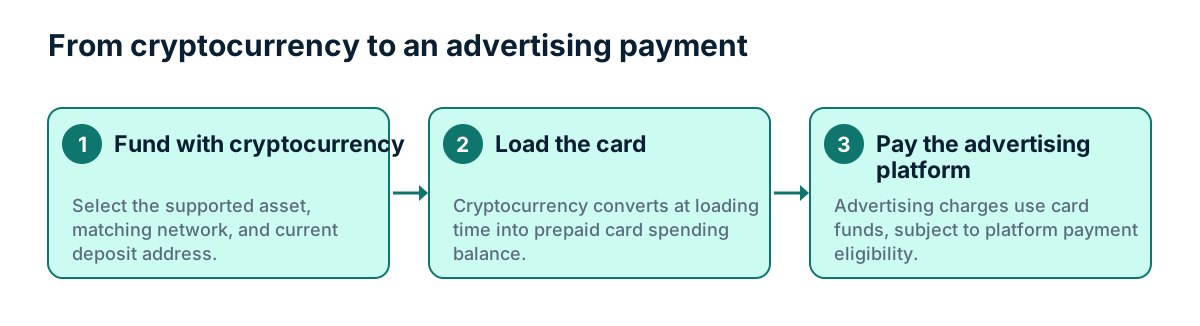
The useful mental model has three stages: cryptocurrency funding, card loading, and merchant billing. Each stage has its own status and records. A confirmed cryptocurrency deposit doesn't establish that funds are available on the card, and an available card balance doesn't establish that an advertising charge will succeed.
Cryptocurrency funding: select the asset and its network
For freelancers or agencies receiving cryptocurrency, a crypto-funded card can avoid the need to first move those funds into a conventional bank account for card funding. That can simplify the route from client receipts to operating expenses. It doesn't establish a universal speed advantage: deposit confirmation, provider processing, and payment eligibility remain separate considerations.
WaldenPay supports funding with 135+ cryptocurrencies across 35+ networks, including USDT, USDC, BTC, ETH, SOL, TRX, and LTC. Its account wallet provides unique deposit addresses per supported network. The sender must match the selected asset and network to the instructions shown for that deposit.
The network matters as much as the token name.
An advertiser holding USDT shouldn't assume that every USDT transfer route is interchangeable. The deposit screen should determine the supported route and destination. An address copied from an earlier transaction isn't a substitute for checking current instructions.
Card loading: cryptocurrency becomes prepaid spending balance
WaldenPay is a virtual prepaid card on Visa/Mastercard rails. It isn't a bank, a credit line, or an integration that enables an advertising platform to accept cryptocurrency directly. Cryptocurrency converts to card balance at loading time; later advertising charges draw on that balance.
The distinction follows the basic prepaid-card model: spending relies on funds loaded in advance rather than borrowed purchasing power. A campaign budget cannot create additional card balance, and a forthcoming client payment cannot cover a charge until usable funds are available.
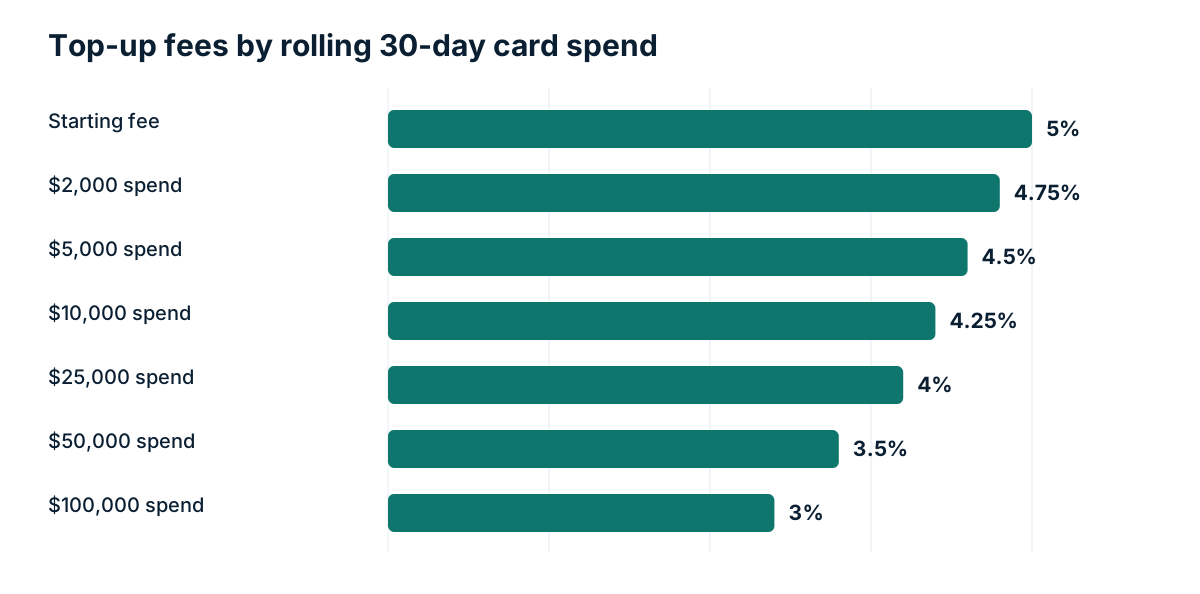
Cards are issued instantly after funding. WaldenPay charges a $10 one-time issue fee, a top-up fee starting at 5% and falling automatically to 3% with qualifying rolling 30-day card spend, and no monthly maintenance fee. The minimum top-up is $50. Registration, balance checks, and support are free.
Four amounts deserve separate labels in the advertiser's records:
- Account wallet balance: funds recorded in the WaldenPay account wallet, which shouldn't automatically be treated as card spending capacity.
- Available card balance: the amount currently available for card payments.
- Advertising budget: the advertiser's planned or configured spending allowance, not proof of payment.
- Platform billing balance: any prepaid credit or amount owed displayed by the advertising platform, interpreted according to that account's billing model.
The advertiser should follow the displayed loading process rather than assume automatic movement between these balances.
Merchant billing: the platform evaluates a card payment
Once loaded, the card supplies payment details for an eligible checkout. Apple Pay and Google Pay support is also available, but that doesn't establish compatibility with a particular advertising billing interface. The platform still determines which payment methods the account can use.
As of July 2026, advertisers evaluating Meta or Google should confirm the current requirements for their account's billing country and payment setup before committing funds. Network reach alone isn't sufficient evidence of eligibility.
The Facebook ads crypto-card guide adds platform-specific setup considerations. Its role is to support eligibility checks, not to turn a prepaid card into a guaranteed payment method.
When crypto funding fits better than bank or business-card funding
The strongest fit starts with funds the advertiser already holds in cryptocurrency and has authority to spend. A freelancer paid in USDC, an agency managing an authorized client budget, an e-commerce advertiser, or an entrepreneur funding campaigns from personal business resources may find prefunding practical.
But crypto versus prepaid isn't a clean product distinction. A crypto-funded card can itself be prepaid, as WaldenPay is. The meaningful comparison is where the money comes from, whether spending requires advance funding, and what administration the business needs.
| Decision | Crypto-funded prepaid fit | Reason to consider another product |
|---|---|---|
| Funding source | Available cryptocurrency earmarked for advertising | Operating funds already held in a bank account |
| Working capital | Campaigns can operate on prefunded balances | The business needs credit between client receipts |
| Team administration | Verified capabilities meet the actual workflow | Employee permissions or approval controls are essential but unconfirmed |
| Payment eligibility | The account's rules permit the card type | Merchant-confirmed compatibility requires a different product |
Agency use also requires clear ownership: who owns the funds, who authorizes loading, and which client's charges belong against the balance. A separate payment instrument doesn't replace that accounting.
The crypto, bank, and prepaid comparison develops these product-selection tradeoffs. Before comparing providers, the business should identify its nonnegotiable requirements; a credit need or missing employee control can outweigh the convenience of crypto funding.
What a virtual card for media buying must support
A useful requirements worksheet records evidence, not just feature names. Each requirement needs a confirmed answer, a place to verify it, and an operational consequence if the answer is no. For virtual cards for media buyers, unresolved billing eligibility matters more than an attractive feature list.
Funding, costs, and available funds
- Supported assets and networks: record the exact funding pair and current deposit instructions. WaldenPay's 135+ cryptocurrencies and 35+ networks provide broad choice, but every transfer still needs a matching route.
- Disclosed costs: record the $10 issue fee, $50 minimum top-up, current top-up percentage, and $0 monthly maintenance fee. Volume discounts depend on rolling 30-day card spend, not simply the amount deposited.
- Available balance: identify where the spendable card amount appears. A wallet receipt or campaign budget shouldn't be used as its substitute.
- Timing: distinguish deposit confirmation, completed loading, and card issuance. Instant issuance after funding isn't a promise that an entire funding-and-payment sequence finishes immediately.
WaldenPay's dashboard shows the current top-up fee, rolling 30-day spend, and progress toward the next discount level. Those are useful budgeting inputs; anticipated discounts shouldn't be applied before the account qualifies.
Eligibility is different from network reach
WaldenPay states acceptance at 150M+ merchants worldwide. That describes network reach, not guaranteed acceptance by every merchant or every billing account. As of July 2026, Google Ads, Meta, and TikTok compatibility should be checked against the applicable account's current payment requirements.
Merchant acceptance and issuer authorization are different checkpoints. A platform must permit the payment method, and an individual charge must also be authorized. Neither a recognized card network nor sufficient funds eliminates all reasons for a decline.
And a replacement number doesn't cancel a merchant's rules.
Separate verified tools from capabilities requiring confirmation
WaldenPay's Telegram bot supports card ordering and recharging, balance checks, and transaction alerts. These are verified operational tools. They don't establish bulk issuance, employee roles, or compatibility with every recurring advertising charge.
- Multiple cards: confirm availability, issuance conditions, and any applicable limits before planning one card per client.
- Spending controls: confirm card limits and whether configurable budgets or employee permissions exist.
- Billing behavior: confirm recurring-charge compatibility and business-use eligibility for the intended workflow.
- Records: confirm transaction-detail availability and export formats rather than assuming accounting integrations.
- Support and replacement: establish the support route and replacement process without assuming a response-time or reissuance guarantee.
Transaction visibility should let the operator connect a charge to its date, amount, status, and advertising account. If the available records don't support that connection, the business needs a supplementary ledger before scaling.
Card counts and BIN options shouldn't be treated as protection against interruptions. Payment separation can help organize records where supported, but it doesn't prevent linked-account reviews, override restrictions, or guarantee uninterrupted campaigns.
From crypto balance to a first advertising payment: the setup sequence
The first payment should follow a documented sequence, with a stopping point whenever eligibility or funding status is unclear. Loading a large campaign budget before resolving those uncertainties creates avoidable exposure. A cautious setup establishes whether the payment method fits before relying on it operationally.
-
Confirm account authorization and payment-method eligibility. The operator should have permission to manage both the advertising account and the funds being spent. As of July 2026, platform-specific eligibility should be checked in the relevant advertising account and current official billing guidance. The review should cover prepaid-card eligibility, billing country, and the available payment setup. Unclear rules are a reason to seek confirmation, not to disguise the card type.
-
Review costs and funding requirements. WaldenPay's published card costs are a $10 one-time issue fee and a top-up fee starting at 5%, with automatic volume discounts down to 3%. Monthly maintenance is $0, and the minimum top-up is $50. The advertiser should review the displayed amounts before confirming funding rather than assume the minimum top-up includes issuance or leaves a particular net spending balance.
-
Register and establish authorized access. Signup requires an email only, with no identity documents for standard use. That doesn't make the account anonymous or exempt it from AML and regulatory requirements; additional checks may apply. General FinCEN guidance on financial compliance provides US regulatory context, not a promise about an individual user's verification outcome. Access should remain under the control of the authorized account holder.
-
Select the supported asset and network. The advertiser should choose a funding route supported by both the sending wallet and the destination shown in WaldenPay. A familiar ticker isn't enough. For example, a USDT transfer must use the network specified for that deposit. The choice should be verified before any funds leave the sending wallet.
-
Verify the deposit instructions. The destination address, selected network, and any other displayed requirements should be checked together. WaldenPay provides unique account-wallet deposit addresses per supported network. The operator should retain the transaction identifier and internal reference linking the deposit to its owner or client budget, without exposing wallet credentials or private keys in accounting records.
-
Complete funding and card issuance. The advertiser should follow the displayed funding and loading steps, checking completion rather than treating an initiated transfer as available money. Cryptocurrency converts to card balance at loading time, and the card is issued instantly after funding. Any unclear or incomplete status should be resolved before proceeding to advertising billing.
-
Confirm the available card balance. The operator should record the loaded amount, disclosed fee, and balance shown as available for spending. The planned advertising payment must fit that available balance. Neither the account wallet balance nor an expected client receipt should be counted as card funds without completing the required process.
-
Enter truthful billing information and monitor the payment. Card details and billing information should match the legitimate account holder and business arrangement. After a permitted payment attempt, the operator should compare the platform's status with the card transaction record. A failure calls for checking the error, available funds, and eligibility before retrying. Changing numbers or repeatedly resubmitting a rejected method isn't a substitute for resolving the underlying issue.
The resulting record should connect the cryptocurrency deposit, card load, disclosed costs, and advertising payment. That connection makes subsequent budgeting and reconciliation materially easier.
Google Ads: eligibility checks before adding a crypto-funded card
A crypto-funded card submitted to Google Ads is still a card payment, not a cryptocurrency deposit to the advertising platform. For an eligibility review as of July 2026, the relevant question is whether the particular card fits the account's available payment methods and billing setup. Visa or Mastercard branding identifies the payment network; it doesn't establish that a prepaid virtual card will be accepted. WaldenPay's stated acceptance at 150M+ merchants isn't evidence of Google Ads approval, and no provider's general acceptance figure should replace an account-specific check.
Before committing campaign funds, the account owner should review the payment options displayed in the advertising account and the accompanying official requirements. The checks should cover permitted card types, billing country and currency, authorized billing information, and any verification requested during setup. Where prepaid eligibility remains unclear, clarification should precede funding rather than follow a rejection. The Google Ads crypto-card funding guide expands the platform-specific setup checks and explains the distinction between funding a card and funding an advertising account.
For teams comparing virtual cards for media buyers, available balance also matters, but it isn't a campaign spending cap. A prepaid balance constrains what the card can fund; it doesn't replace campaign controls or eliminate obligations already incurred. Alternative funding arrangements should be evaluated on documented eligibility and operational needs, not assumed superiority. A successful initial payment is useful evidence, but it doesn't guarantee that later charges or additional accounts will be approved.
Meta and Facebook Ads: prepaid-card fit without acceptance promises
A search for a crypto card for Facebook Ads usually describes an indirect route: cryptocurrency funds a card, and the advertising payment uses the card's balance. It doesn't mean Meta receives cryptocurrency. As of July 2026, the appropriate starting point is the specific advertising account's payment settings and current eligibility requirements, rather than a provider's claim that its cards are suitable for advertising. The account owner should establish whether the proposed card type is permitted before allocating campaign funds to it.
WaldenPay is a prepaid virtual card on Visa/Mastercard rails. It doesn't override a merchant restriction on prepaid cards, remove verification requirements, or guarantee payment approval. A prepaid card for Facebook Ads therefore needs the same practical scrutiny as any proposed billing method: legitimate authority to use it, accurate billing details consistent with the card provider's records, and enough available balance for the intended charge. WaldenPay is privacy-focused, not anonymous or untraceable, and its use remains subject to AML and regulatory requirements. Minimal signup information doesn't exempt an advertising account from its own verification obligations.
The Facebook Ads card selection guide provides a framework for comparing funding arrangements and checking fit without treating a product listing as proof of acceptance. A useful internal record identifies the account owner, authorized payer, expected billing obligations, and person responsible for replenishment. But a funded card isn't automatically a valid payment method. If eligibility is unresolved, holding the intended budget outside the card avoids committing more funds to an unconfirmed payment route.
TikTok Ads: confirm billing compatibility before funding campaigns
Using a virtual card for TikTok Ads means checking the card's compatibility with the advertising account before moving the campaign budget. The phrase "pay TikTok Ads with crypto" describes an indirect card-funding route in this context, not proof of native cryptocurrency acceptance. As of July 2026, the account's displayed payment options and current platform requirements should guide that decision. Neither a card number nor a successful cryptocurrency deposit establishes that an advertising charge will be accepted.
The practical checks are account eligibility, permission to use the billing method, accurate card and billing details, and sufficient available funds. The account owner should distinguish confirmed requirements from assumptions about other advertisers, countries, or account configurations. An agency's experience with one account isn't a reliable approval promise for another. And successful card funding only confirms that funds reached the card balance; it doesn't validate the merchant relationship. For virtual cards for media buyers, that distinction prevents a funding decision from getting ahead of a payment-eligibility decision.
The TikTok Ads card setup guide covers the platform setup sequence and detailed troubleshooting beyond these initial checks. Before a payment attempt, the operator should retain the relevant account requirements and confirm that the card balance reflects the intended load. If the platform rejects the method, the next step is to examine the stated reason and seek clarification where necessary. Additional funding, repeated submissions, or different card details aren't evidence that the underlying incompatibility has been resolved.
Ad-spend cost math: issue fees, top-ups, and volume discounts
An auditable funding model starts with published charges, not a comparison built from assumed bank fees or unverified card capabilities. For WaldenPay, the central calculation separates card issuance, each top-up fee, and the balance actually available for advertising payments. The applicable percentage depends on rolling 30-day card spend, so a forecast should use the current dashboard tier rather than a discount the business expects to reach later.
Published costs and the funding minimum
WaldenPay charges a one-time $10 card issue fee and $0 monthly maintenance. Registration, balance checks, and support are free. The minimum top-up is $50, and the standard top-up fee starts at 5%, with automatic volume discounts down to 3%.
The $50 minimum is a loading requirement, not an advertising platform's minimum payment or a promise about how much campaign activity that balance will cover. Likewise, free monthly maintenance doesn't make funding free. A buyer comparing virtual cards for media buyers should distinguish recurring overhead from the cost incurred whenever funds are loaded.
- Card creation: the $10 issue fee belongs in the initial funding budget, not every subsequent reload.
- Top-up: the applicable percentage should be recorded against the amount shown in the funding quote.
- Available campaign funds: the resulting usable card balance should be recorded separately from the amount committed to funding.
- Ongoing administration: monthly maintenance, registration, balance checks, and support carry no charge under the published terms.
A funding confirmation should preserve the quoted amount, percentage, fee amount, and resulting card credit. That record resolves whether a spreadsheet's input represents the amount being loaded or the total funding allocation; those aren't interchangeable labels.
Complete rolling 30-day spend discount table
Discounts apply automatically and instantly as the applicable spending tier is reached, with no application required. The dashboard shows the current fee, rolling 30-day card spend, and progress toward the next level.
| Rolling 30-day card spend | Top-up fee | Budgeting treatment |
|---|---|---|
| Below $2,000 | 5% | Standard published rate |
| $2,000 to below $5,000 | 4.75% | Automatic volume discount |
| $5,000 to below $10,000 | 4.5% | Automatic volume discount |
| $10,000 to below $25,000 | 4.25% | Automatic volume discount |
| $25,000 to below $50,000 | 4% | Automatic volume discount |
| $50,000 to below $100,000 | 3.5% | Automatic volume discount |
| $100,000 and above | 3% | Published discounted rate; individual pricing available at the level below |
| $250,000+ per month | Individual pricing | Requires the actual agreed price for forecasting |
The qualifying measure is card spend, not cryptocurrency deposited, wallet balance, or the amount scheduled in an advertising dashboard. Loading $5,000 doesn't by itself establish $5,000 of qualifying spending. A rolling window also differs from a calendar month: older spending moves outside the window as time passes, so a previously observed tier shouldn't be treated as permanent.
And a lower rate for a later top-up doesn't make an earlier load retroactively cheaper. Reconciliation should retain the actual fee shown for each funding event.
Worked fee illustrations
The following examples calculate the percentage fee on a hypothetical quoted top-up amount. They illustrate the fee component only; the funding screen remains the reference for the total required and resulting card balance. This avoids assuming whether a particular displayed amount includes or excludes the fee.
| Illustrative top-up amount | Applicable fee | Fee calculation | Fee amount |
|---|---|---|---|
| $500 | 5% | $500 x 0.05 | $25 |
| $500 | 3% | $500 x 0.03 | $15 |
| $5,000 | 4.5% | $5,000 x 0.045 | $225 |
| $5,000 | 3% | $5,000 x 0.03 | $150 |
For the hypothetical $500 load at 5%, the top-up fee is $25. If that funding event also involves creating a card, the fee component plus the one-time issuance charge totals $35. A later $500 load at the same rate has a $25 top-up fee without repeating the initial issue charge.
On a $5,000 fee base, the difference between 4.5% and 3% is $75. But the 3% calculation is relevant only when the account qualifies for that tier. A forecast that applies the lowest advertised percentage to every future load understates costs unless qualifying spend supports it.
Splitting the same total into smaller loads doesn't inherently reduce a percentage fee when the rate stays unchanged. The operational reason for smaller loads is limiting the balance committed at once, balanced against the need to keep upcoming charges funded.
Budgeting from crypto holdings to available campaign funds
Crypto holdings carry price exposure until they become card balance. With WaldenPay, conversion happens at loading time: the loaded balance no longer tracks the deposited coin's price. A subsequent move in BTC or ETH doesn't revalue that card balance, although purchases and other balance activity still change the amount available. Campaign budgeting should therefore distinguish crypto awaiting funding from funds already loaded.
Stablecoins don't remove every risk. A stablecoin's price peg describes its intended relationship to a reference asset, not a guarantee of uninterrupted value or access. Funding plans should allow for uncertainty before loading without turning the campaign budget into an investment recommendation. The useful operational question is how much spendable balance must be available when a legitimate charge arrives.
For teams using virtual cards for media buyers, a worksheet should keep each stage visible rather than treating the wallet, card, and advertising account as one pool.
| Worksheet field | What belongs in it | Decision it supports |
|---|---|---|
| Planned campaign spend | Approved advertising budget for the planning period | Whether intended activity fits the allocation |
| Known charges | Accrued obligations and scheduled payments visible in billing records | What needs funding before additional activity |
| Available card balance | Current spendable balance reported by the provider | Whether existing funds cover upcoming charges |
| Visible pending transactions | Unsettled amounts and whether they already reduce available balance | How to avoid counting funds or obligations twice |
| Applicable top-up fee | Current dashboard percentage and quoted fee amount | What funding will cost at the actual tier |
| Funds reserved for later | Unloaded assets assigned to future campaign needs | What remains outside today's spendable balance |
Pending amounts need careful treatment. If the displayed available balance already reflects a pending transaction, subtracting it again understates usable funds. If an accrued advertising obligation hasn't reached the card, ignoring it overstates the balance available for new activity. The worksheet should identify which record contains each obligation and when it was last checked.
A campaign budget, a payment threshold where applicable, and spendable card balance describe different things. The budget controls intended advertising activity. A payment threshold concerns when a charge may be triggered under the account's billing arrangement. Card balance describes available payment capacity. Increasing one doesn't automatically adjust the others or settle charges already owed.
Review timing should follow those obligations and the people available to act on them. If a charge may arrive before the next staffed review, the responsible operator should check funding beforehand. A standing reload trigger can be based on expected charges through the next review plus an explicitly approved reserve, rather than waiting for a decline. No universal cadence can be inferred from supposed fraud-model preferences.
Finally, campaign performance records should use consistent monetary units rather than a changing cryptocurrency quantity. Keeping original crypto amounts in the funding ledger preserves traceability, while separating loading costs from advertising charges keeps acquisition-cost and return-on-ad-spend calculations interpretable. Funds reserved outside the card remain future funding capacity, not money the advertising account can already charge.
Agency and team spending: separate ownership, budgets, and access
Agency spending needs a named budget owner before it needs another card number. Each client should authorize the agency's account management, payment arrangements, and spending scope. For agencies evaluating virtual cards for media buyers, the practical starting point is a ledger connecting each client, advertising account, funding source, and person responsible for reconciliation. Client funds shouldn't become an informal pool: using one client's unused balance to cover another client's campaign complicates authorization, accounting, and trust.
Separate cards per client or major campaign can help bookkeeping where the provider supports them and the merchant permits their use. Any shared funding arrangement also needs explicit authorization and client-level records; a shared wallet isn't automatically a team-spending product. A personal virtual prepaid card doesn't establish employee permissions, approval workflows, or corporate liability arrangements. Agencies needing those capabilities can use the crypto corporate cards buyer's guide to distinguish documented team controls from ordinary card features. WaldenPay's verified features shouldn't be read as promises of employee cards, bulk issuance, role-based access, or pooled balances.
Access should follow approved responsibilities rather than shared passwords. One person can own funding records, another review advertising charges, and an authorized manager approve budget changes using the team's established systems. Every top-up should carry a client or campaign reference. WaldenPay's Telegram bot provides balance checks and transaction alerts, but those functions don't replace reconciliation. And separate cards don't isolate advertiser identities or guarantee protection from holds; payment records remain connected to their owners and authorized uses.
BINs and card numbers: what changes and what doesn't
A Bank Identification Number, or BIN, is the identifying prefix of a payment card, commonly its first six to eight digits. It identifies the issuing institution or card program within the payment system. A newly issued card number may retain the same BIN as other cards from that program, so multiple card numbers don't necessarily mean multiple BINs.
Searches for a "crypto card with multiple BINs" often combine two different requirements: separate credentials for bookkeeping and access to different issuing programs. Neither establishes merchant acceptance. A provider's BIN offering also says nothing by itself about client authorization, team access controls, or the compatibility of a particular prepaid card with an advertising account.
There isn't a universal "best BIN for Facebook Ads crypto card." As of July 2026, any such claim should be assessed against current Meta billing requirements and the provider's documented card characteristics, rather than treated as an approval promise. WaldenPay doesn't make a verified claim of selectable or multiple BINs.
The multiple BINs technical explainer adds detail on the distinction between issuing prefixes and individual card numbers. Operationally, a different number can help identify spending in a ledger, but it doesn't conceal linked ownership, remove account restrictions, or create protection from enforcement. Any replacement should address a documented payment need, not attempt to bypass a merchant's rules.
When an advertising payment fails: diagnose before retrying
A failed payment needs a diagnosis before another funding decision. A card decline, pending authorization, provider restriction, and advertising-account restriction are different states. For teams using virtual cards for media buyers, treating all four as insufficient balance can leave extra money on a card without resolving the actual problem.
- Read the exact error. Record its wording, time, amount, and any reference number. Separate a billing message from an account-policy notification.
- Check funds and details. Compare the requested charge with available card balance, not crypto awaiting loading. Verify the card number, expiration date, security code, and truthful billing information.
- Inspect transaction status. A pending authorization isn't a settled charge or necessarily a decline. Compare the card record with the advertising billing record before treating the attempt as unpaid.
- Verify eligibility. Check whether the merchant permits that prepaid card for the account's country and billing arrangement, and whether the provider permits the intended purchase. Don't infer compatibility from a card-network logo.
- Contact the relevant support team. The card provider can investigate card-side status; advertising support can clarify billing eligibility or account restrictions. Share references through official channels, not full credentials.
As of July 2026, a crypto-funded card isn't an inherent fix for Facebook declines or Google Ads virtual-card errors. The Facebook Ads decline troubleshooting guide adds context for evaluating a payment-method change without assuming approval. Blind retries and rapid card cycling aren't a diagnosis. Replacement accounts intended to bypass enforcement are inappropriate; unresolved restrictions need the provider's or merchant's official review process.
Funding risks, card security, and the limits of payment separation
Crypto funding changes how money reaches a card. It doesn't change advertising eligibility, remove policy enforcement, or guarantee uninterrupted payments. WaldenPay is a virtual prepaid card service, so operating plans should account for deposit mistakes, compromised access, provider reviews, and merchant restrictions rather than assuming the funding route eliminates them.
Deposit safety starts before the transfer
WaldenPay supports 135+ cryptocurrencies across 35+ networks and provides unique account-wallet deposit addresses per supported network. That breadth makes selecting the correct network important. Before sending, the operator should compare the asset, sending network, receiving network, and destination against the current deposit instructions. An address copied from an old message or another client's funding record shouldn't substitute for the destination shown in the account.
The funding record should preserve the transaction identifier, original crypto amount, network, destination, and intended client allocation. Those details help investigate a missing deposit without confusing an on-chain transfer with a later card load. Everything loaded onto the card converts to card balance at loading time; crypto still held elsewhere isn't available card spending power.
If the destination or network doesn't match, the transfer should stop until support clarifies the instructions. A mistaken transfer shouldn't be assumed recoverable, and no recovery deadline or reimbursement guarantee should be built into a campaign schedule. Keeping future campaign reserves outside the immediate load is a budgeting choice, not evidence that funds held elsewhere have any particular protection.
Access security includes email and Telegram
The registered email account deserves the same care as payment credentials. Its owner should use a unique password, enable available multifactor authentication, review account-recovery settings, and remove access that no longer belongs to an authorized operator. These are precautions for the connected services, not claims that WaldenPay supplies a particular authentication feature.
WaldenPay's Telegram bot can order and recharge cards, check balances, and provide transaction alerts. The linked Telegram account therefore needs protected access and careful session management. Teams shouldn't distribute its login as a substitute for documented employee permissions. For virtual cards for media buyers, convenient messaging access still carries responsibility for protecting the account through which financial instructions are submitted.
Card numbers and security codes don't belong in shared campaign spreadsheets, screenshots, or support-group chats. Unexpected messages requesting passwords, wallet recovery phrases, or payments to "release" a card should trigger independent verification through the provider's established support channel. An unsolicited support identity isn't proof of authority. Suspected compromise calls for prompt contact with the relevant services, without assuming an undocumented card-freeze feature exists.
Service restrictions remain separate from funding
A successful deposit doesn't establish that an advertising merchant will accept the card. Nor does a previously successful charge promise continuity after an account review or a change in the permitted billing arrangement. If a restriction appears, the operator should establish whether it concerns the deposit, card service, transaction, or advertiser account before moving additional funds.
Separate payment credentials can make charges easier to attribute, but they don't guarantee isolation from holds affecting related activity. Advertising policy problems need the merchant's review process; provider restrictions need provider support. A documented contingency plan can identify an authorized alternative payment method and a person responsible for pausing spending when necessary. It must stay within merchant rules rather than depend on replacement identities or repeated card changes.
Privacy, verification, and lawful advertising payments
A privacy-focused card can reduce the need to provide personal bank-account details as the advertising payment method, but it doesn't make the advertiser anonymous. The useful distinction is between limiting unnecessary disclosure and concealing ownership. A business can pursue the former while keeping accurate billing information, authorized access, and records that explain where campaign funds came from.
Minimal signup doesn't remove compliance obligations
WaldenPay's standard signup requires an email only, with no identity documents for standard use. Use nevertheless remains subject to AML and regulatory requirements. Approval, ongoing availability, and freedom from additional checks aren't guaranteed. A light initial registration process shouldn't be interpreted as a promise that verification can never become necessary.
WaldenPay is operated by BlueHouse Software B.V., Rotterdam, Netherlands, through a licensed partner model. It isn't a bank. That operating description doesn't establish a particular advertiser's eligibility or replace the terms governing the card service. Agencies reviewing a provider should distinguish its operator, product type, and stated requirements rather than infer protections from the word "card."
The no-KYC crypto card explanation adds context for reading minimal-documentation claims without treating them as exemptions. For procurement purposes, virtual cards for media buyers should be assessed on documented registration requirements and permitted uses, not labels suggesting that compliance obligations disappear.
Payment separation can improve bookkeeping. It doesn't guarantee protection from holds or remove regulatory oversight.
Truthful records support authorized spending
Billing details should describe the actual authorized payer and business relationship. An agency managing a client's advertising account needs permission to act, a defined spending scope, and an agreed method for handling unused funds and disputed charges. A card held by an individual shouldn't be presented as a corporate team product merely because several employees work on the campaigns it funds.
Advertiser verification is a separate process from card registration. A merchant may require information about the advertiser or its business even when the payment provider's standard signup requires no documents. Neither successful card creation nor an earlier successful payment overrides those requirements. If requested information is unclear, the appropriate response is clarification through official support, not substituted identities or inaccurate addresses.
Source-of-funds records should connect crypto receipts to their legitimate purpose: client invoices, business revenue, or the owner's documented funding contribution. Teams should retain relevant transaction identifiers and approvals without spreading sensitive credentials across unnecessary systems. Access to those records can be limited to authorized staff while remaining available for legitimate accounting and compliance needs.
Privacy remains bounded by lawful use
The anonymous crypto cards explainer examines why privacy claims shouldn't be confused with untraceable card spending. Crypto funding doesn't authorize evasion of KYC or AML checks, sanctions, geographic restrictions, or merchant rules. And financial sovereignty doesn't remove responsibilities attached to client money or advertising activity.
For U.S. operators, the IRS explains that digital asset transactions can have tax consequences. Crypto-funded spending shouldn't be treated as invisible to bookkeeping or tax reporting. A qualified tax professional can assess the operator's circumstances; legal counsel can address uncertain client-funds arrangements. The practical objective is a payment trail that discloses no more than necessary while remaining truthful, authorized, and usable for reconciliation.
Reconcile deposits, card charges, client invoices, and disputes
A useful reconciliation trail connects the source of funds to the advertising invoice without treating every movement as another expense. For operators using virtual cards for media buyers, each deposit, card issuance, load, and advertising charge needs a distinct record linked to the same client or project.
The ledger can remain simple. A shared reference ties related entries together, while separate event types preserve the difference between moving money and spending it. Access should be restricted to authorized staff, and records should use a card identifier or last digits rather than full card credentials.
| Ledger field | What belongs in it | Reconciliation purpose |
|---|---|---|
| Client or project | Client identifier, campaign reference, approved budget | Assigns funding and costs to the correct engagement |
| Authorized account owner | Owner of the funding account and advertising account | Documents responsibility and authorization |
| Deposit asset and network | Asset, supported network, amount received | Matches the receipt to the funding instruction |
| Transaction reference | Blockchain reference where applicable; internal reference otherwise | Identifies the actual movement without inventing an on-chain record |
| Load date and fees | Date, recorded load amount, resulting card balance, disclosed fees | Separates available spending funds from funding costs |
| Card charge | Merchant, date, amount, transaction identifier, status | Tracks the advertising payment through resolution |
| Advertising invoice | Invoice identifier, billing period, associated charges | Connects payment records to the billed service |
| Reconciliation status | Matched, pending, disputed, refunded, or unresolved | Keeps exceptions visible until evidence supports closure |
An on-chain deposit has a blockchain transaction reference. An internal balance transfer doesn't: WaldenPay's Send to Friend is a ledger movement between users. A merchant card transaction belongs to a separate payment trail and should be matched through the available card transaction details and advertising invoice.
These aren't interchangeable receipts.
For campaign-cost tracking, a card top-up moves funds into spending capacity; its later advertising charge records the use of that capacity. Counting both as advertising expense doubles the apparent campaign cost. Disclosed card fees belong in a separate cost category, while an accountant should determine formal bookkeeping and tax treatment. Likewise, an advertising invoice and its matching card payment shouldn't become two separate expenses merely because both documents enter the system.
At each review, the operator compares opening balances, incoming funds, loads, fees, charges, and any posted credits with closing balances. Pending items remain identifiable rather than being forced into a completed match. Campaign performance reports sit alongside financial records, but they don't replace invoices or payment evidence.
For unresolved charges, the evidence file should retain deposit confirmations, load receipts, account notices, invoice copies, relevant campaign records, and support correspondence with case identifiers. A chargeback is a card-payment dispute mechanism, not a reversal of the original blockchain deposit. Any available dispute route, evidence requirement, or deadline needs confirmation through the appropriate provider.
If a card is restricted mid-campaign, clean records can support investigation; they don't guarantee reinstatement, a refund, or faster resolution. Businesses should preserve the trail for applicable reporting obligations and consult a qualified professional about crypto-related tax treatment.
From client payment to campaign budget: links and internal transfers
A client payment becomes an authorized campaign budget only after the agency identifies its purpose, confirms receipt, and allocates it to the correct engagement. Collecting funds and loading a card are separate steps, with separate records and costs.
WaldenPay's Collect Payments can support that first step. An authorized agency or freelancer creates a request for a fixed USD amount from $1 to $10,000, adds a description, and shares a payment link or QR code. The payer needs no WaldenPay account and can pay in 135+ cryptocurrencies across 35+ networks. The creator receives the exact requested USD amount in the account wallet; the payer covers the 0.2% conversion fee.
The description should identify the engagement without exposing confidential campaign details.
A request for $1,000, for example, carries a $2 payer-side conversion fee, while the creator receives $1,000 in the wallet. That receipt isn't a promise of $1,000 available for advertising: card funding still has its own disclosed top-up fee, and a newly issued card has a $10 issue fee. The funding confirmation should establish the resulting card balance before campaign commitments increase.
An operational sequence keeps the client payment connected to its intended use:
- Document authorization. The agreement identifies the client, authorized recipient, campaign purpose, and responsibility for disclosed costs. Uncertain client-funds arrangements belong with qualified legal counsel.
- Reference the invoice. The payment request description carries an invoice or project reference so a wallet receipt can be matched without relying on message history.
- Confirm completed receipt. The operator checks the payment status and credited wallet amount before marking the client invoice paid.
- Allocate the funds. The ledger distinguishes the approved advertising budget, service charges, and funding costs according to the agreement.
- Load and verify. The funding owner confirms card eligibility for the intended advertising account, reviews the applicable top-up fee, and verifies the available card balance.
Underpayments need their own status. Collect Payments tracks them and generates a fresh address for the remaining amount. Incomplete payments are automatically refunded to the payer's wallet. An agency shouldn't treat an initial partial payment as a completed campaign allocation or manually promise a refund schedule beyond the information available.
And an internal transfer isn't another client collection.
Send to Friend moves balance between WaldenPay users using the recipient's email address. It arrives in seconds, carries no transfer fee, and involves no blockchain transaction. The sender sees a recipient name preview and confirms every transfer with a password. Limits are $1 minimum, $10,000 per transfer, and $20,000 per rolling 24 hours.
For virtual cards for media buyers, that distinction matters operationally: a wallet transfer doesn't itself load the recipient's card or establish permission to spend client funds. The sender should verify the recipient's authority and retain the transfer reference against the project. Email-based movement is a funding tool, not a substitute for ownership records, access controls, or an approved campaign budget.
Scaling campaign funding without losing budget control
Higher campaign volume calls for tighter funding checkpoints, not assumptions about unlimited capacity. A freelancer and a growing agency can use the same basic process, but the agency needs explicit ownership of loading, monitoring, and exception handling before commitments expand.
Pre-spend review: authorize commitments before loading
The funding owner should compare confirmed available card balances with authorized advertising commitments, unresolved charges, and expected funding needs. Wallet receipts, pending deposits, and hoped-for refunds shouldn't be treated as immediately spendable card funds. A designated backup needs documented authority rather than informal access to another person's credentials.
Capacity requires its own verification.
Card load limits, transaction limits, multiple-card availability, and service capacity must be confirmed for the intended use. A published discount tier doesn't establish any of those capabilities. Neither the $10,000 Collect Payments request ceiling nor Send to Friend's $10,000 transfer and $20,000 rolling 24-hour limits define a card's purchasing capacity.
WaldenPay's dashboard shows the current top-up fee, rolling 30-day card spend, and progress toward the next discount level. The fee starts at 5%, falls to 4.75% at $2,000, 4.5% at $5,000, 4.25% at $10,000, 4% at $25,000, 3.5% at $50,000, and 3% at $100,000. Individual pricing is available at $250,000+ per month.
Those discounts apply automatically without an application. The funding owner should check the displayed fee before each planned load rather than assuming an earlier tier still applies as spending moves through the rolling window. Pricing eligibility isn't a credit facility or approval for a larger transaction.
Active-campaign check: monitor balances and exceptions
A practical review compares actual card charges with the campaign plan and identifies the next funding decision. WaldenPay's Telegram bot supports balance checks, recharges, and transaction alerts, but alerts don't replace a review of payment status and advertising delivery.
- Balance mismatch: The operator checks pending activity and recorded fees before authorizing another load.
- Unexpected charge: The reviewer matches the merchant entry to the advertising invoice and authorized account.
- Payment interruption: The funding owner records the error, available balance, affected account, and support case before deciding on further action.
Support escalation should identify an owner, the evidence already supplied, the latest response, and the next review point. Repeated retries or additional loads shouldn't become substitutes for diagnosis. If a payment remains unresolved, any campaign adjustment should follow the client's authorization and the advertising account's permitted controls.
Period-end reconciliation: close records before raising budgets
The reviewer matches deposits, internal transfers, card loads, fees, advertising charges, and credits to each client ledger. Exceptions remain open with an assigned owner; expected refunds aren't silently netted against completed spend.
For teams operating virtual cards for media buyers, the next budget increase should depend on delivery needs, confirmed capacity, and reconciled funding records. A lower top-up fee can improve the cost of planned spending, but unnecessary advertising still costs money. Growth decisions belong to campaign economics and client approval, not the distance to another discount tier.
Common mistakes that make crypto-funded ad spend harder to manage
Most avoidable problems start with a category error: network reach becomes assumed approval, wallet funds become assumed card balance, or a funding movement becomes campaign expense. A short pre-funding checklist can catch those errors before they affect delivery.
- Confusing network acceptance with platform approval. The operator checks eligibility for the actual advertising account and billing arrangement. Broad Visa/Mastercard reach doesn't guarantee acceptance of a particular prepaid card.
- Assuming crypto funding changes the card type. WaldenPay is a virtual prepaid card. The funding asset doesn't remove merchant restrictions or make the product a credit card.
- Choosing a network by habit. The sender matches the asset, supported network, and deposit address before sending. Any sending-side network cost needs checking separately; remembered comparisons between networks aren't a reliable funding rule.
- Budgeting only for media. The allocation includes the $10 card issue fee where applicable and the displayed top-up fee, starting at 5% and falling to 3% with volume discounts. WaldenPay has no monthly maintenance fee; its minimum top-up is $50.
- Chasing an unverified promotion. The reviewer uses published standing costs and confirmed offer terms, rather than assuming an introductory price applies indefinitely.
- Treating wallet receipts as loaded funds. The campaign owner verifies the card balance after loading, rather than scheduling spend against a payment request or internal transfer receipt.
- Equating new numbers with new BINs. A different card number doesn't establish a different BIN, issuer profile, or approval outcome.
- Retrying unresolved declines. The operator records the failure and investigates before another attempt. A fresh card isn't a way around merchant checks.
- Mixing client records. Each engagement retains separate authorization and ledger references. Multiple cards, if available, don't replace accounting separation or eliminate shared operational dependencies.
- Spending to reach a discount. Campaign increases require a business reason and authorization. A lower loading fee doesn't justify unwanted advertising.
- Confusing privacy with anonymity. Privacy-focused payment separation doesn't remove AML, regulatory, or applicable reporting requirements.
And none of these corrections depends on adding more cards. Clear funding ownership and accurate status records usually come first.
What to watch next in crypto-funded advertising payments
Product changes deserve a fresh eligibility review before additional budget moves. A card that suited an earlier campaign isn't evidence that every later account, billing arrangement, or transaction will qualify.
For agencies evaluating virtual cards for media buyers, the useful watchlist concerns verifiable capabilities rather than predictions about adoption:
- Payment-method eligibility. The operator rechecks current published requirements for the intended advertising account and confirms whether its prepaid-card arrangement remains permitted.
- Published costs and funding support. Reviews cover issue and top-up fees, supported assets and networks, deposit instructions, and any changed limits before the next funding decision.
- Transaction visibility. Reporting should distinguish pending activity, completed charges, fees, refunds, and internal transfers clearly enough to support reconciliation.
- Verified team controls. Agencies should evaluate documented permissions, ownership records, and auditability rather than infer business controls from consumer convenience features.
- Reporting integrations and authorized automation. Exportable records, invoice matching, and permissioned funding workflows are capabilities worth investigating, with actual availability and scope confirmed first.
WaldenPay's partner API doesn't, by itself, establish advertising integrations, autonomous budget controls, or bulk-card infrastructure. An agency considering automation should confirm the documented functions, authorization requirements, failure handling, and support arrangements before connecting operational budgets.
Current card funding also says nothing about future native crypto acceptance by advertising platforms. Crypto funds the card balance at loading time; the advertising payment remains a card transaction.
So each review should retain dated terms, confirmed capabilities, and unresolved questions. Product announcements can prompt investigation, but campaign commitments need evidence of present functionality.
Bottom line: validate the payment fit before moving the budget
The go/no-go decision for virtual cards for media buyers should rest on documented billing compatibility, available funds, and accountable spending.
- Confirm authorized use and merchant eligibility. The advertiser must have permission to fund the account, and its billing rules must permit the card type. Network reach doesn't guarantee acceptance. WaldenPay use remains subject to AML and regulatory requirements.
- Calculate disclosed costs. WaldenPay charges $10 for card issuance, a top-up fee starting at 5% and falling to 3% through automatic rolling 30-day card-spend discounts, and no monthly maintenance fee. Budget against the currently applicable tier.
- Verify funding and limits. Check the deposit network, funding status, available card balance, and applicable limits before scheduling spend. WaldenPay's minimum top-up is $50. Confirm funding timing rather than assuming an initiated deposit is spendable.
- Assign reconciliation ownership. Name the person responsible for matching deposits, loads, advertising charges, and client allocations. Verify multiple-card availability, permissions, reporting fields, and replacement procedures rather than assuming agency controls exist.
- Monitor an initial legitimate payment. Confirm its status in both billing records before committing additional funds. Investigate declines before retrying; replacing a card doesn't resolve merchant restrictions.
WaldenPay fits buyers who already hold crypto and want a prepaid spending route: crypto converts to card balance at loading time. It doesn't provide credit. Buyers needing borrowing capacity, verified team controls, or a different permitted card type should consider alternatives. There's no universal best choice.
And working abroad doesn't make billing eligibility location-independent. A crypto funding source doesn't remove geographic restrictions or fraud checks.
For funding mechanics, the walkthrough on USDT card deposits and loading and the guide to spending Tether through a prepaid card provide further context. The guide to crypto cards for international payments addresses broader cross-border planning; merchant eligibility still needs separate confirmation.
Related reading
- Best Card for Digital Marketing Ads in 2026: Crypto vs Bank vs Prepaid - A 2026 comparison of crypto virtual cards, bank debit and credit cards, prepaid cards, and virtual business cards for digital marketing ads
- Best Crypto Card for Facebook Ads in 2026 (Guide) - Bank cards get frozen mid-scale, but a stablecoin-funded card removes that single point of failure. Here's how to choose the best crypto car
- Crypto Card with Multiple BINs: What It Means in 2026 - BIN diversity on a crypto card can reduce regional and issuer-level declines, but it won't fix risk flags, merchant blocks, or network limit
- Crypto Corporate Cards for Teams: 2026 Buyer's Guide - A practical 2026 guide to rolling out a crypto corporate card for team spending, covering per-user issuance, volume-based fees, reconciliati
- Facebook Ads Card Declined? Fix It with a Crypto Card (2026) - Diagnose why Facebook keeps declining your ad payment card and see how a stable, reloadable crypto-funded virtual card can fix common declin
- Google Ads Payment Crypto Card: Fund Ad Accounts in 2026 - How to fund Google Ads campaigns with a crypto-loaded virtual card in 2026, including verification steps, common account holds, and realisti
- Virtual Card for TikTok Ads: Fund Campaigns with Crypto (2026) - How to fund TikTok ad campaigns with a crypto-backed virtual card in 2026, and the billing, BIN, and pacing habits that keep accounts from g
Frequently asked questions about crypto-funded advertising cards
Can virtual cards for media buyers prevent ad account bans?
No payment card can prevent an advertising platform from restricting or banning an account. Separate cards can help organize client spending, but they don't guarantee isolation from account reviews or payment holds. Card replacement isn't a remedy for policy violations or unresolved verification requirements.
Which crypto card works with Google Ads?
No crypto-funded card should be assumed compatible with every Google Ads account. As of July 2026, advertisers should confirm the payment methods available for their account's billing country and payment setting before funding a card. WaldenPay is a virtual prepaid card, and its verified specifications don't establish Google Ads acceptance or 3D Secure support.
Can a prepaid card for Facebook Ads be funded with crypto?
A prepaid card can be funded with crypto if its provider supports that funding method, but funding support doesn't establish Facebook Ads acceptance. As of July 2026, advertisers should confirm prepaid-card eligibility in their Meta billing settings and with support where needed. With WaldenPay, cryptocurrency converts to card balance at loading time; the advertiser then submits a card payment rather than an on-chain payment.
Can advertisers pay TikTok Ads with crypto through a virtual card?
A crypto-funded virtual card can be considered only after the advertiser confirms billing compatibility. As of July 2026, a virtual card for TikTok Ads should be checked against the payment options available to the specific advertising account. Neither crypto funding nor a successful initial payment guarantees that later charges will be approved.
What does a crypto-funded virtual card for media buying cost?
WaldenPay charges a $10 one-time card issue fee, a top-up fee starting at 5%, and no monthly maintenance fee. Automatic discounts depend on rolling 30-day card spend, with the top-up fee reaching 3% at $100,000 in spend. The minimum top-up is $50, so a comparison with a business card should use the advertiser's actual funding needs and current fee tier rather than the lowest advertised rate.
Can USDC replace USDT when funding an advertising payment card?
Yes, WaldenPay supports both USDC and USDT among 135+ cryptocurrencies across 35+ networks. The sender must select a supported asset and network and use the matching deposit details shown in the account wallet. Neither stablecoin inherently improves advertising-platform acceptance, because the loaded card balance funds the card payment.
What should happen after a crypto-funded advertising card is declined?
The advertiser should identify the decline reason before retrying or replacing the card. Useful checks include available card balance, entered billing details, prepaid-card eligibility, and any requested authentication or account verification. But repeated retries won't resolve an unsupported payment method, and a new card shouldn't be used to bypass a platform restriction.
Is there a best BIN for a Facebook Ads crypto card?
There's no verified universally best BIN for Facebook Ads acceptance. A BIN identifies a card's issuing range; a different card number doesn't necessarily mean a different BIN or an unrelated payment profile. As of July 2026, claims that a particular BIN guarantees Meta approval should not substitute for account-specific billing checks, and WaldenPay's verified specifications don't promise multiple BINs.
Does an email-only crypto card signup make advertising payments anonymous?
No, email-only signup doesn't make card spending anonymous or untraceable. WaldenPay requires only an email for signup and no identity documents for standard use, but use remains subject to AML and regulatory requirements. Advertising-account verification is separate from the card provider's signup process.
Can a crypto-funded virtual card serve as a corporate card for an advertising team?
Crypto funding alone doesn't make a virtual card a corporate expense-management product. A team should confirm permitted business use, card ownership, staff access, spending controls, and reporting before adopting it. WaldenPay's verified features don't establish employee cards, role-based permissions, or unlimited issuance; Send to Friend transfers balance between users, not account access.
Does crypto price volatility change the campaign budget after a card is loaded?
With WaldenPay, cryptocurrency converts to card balance at loading time, so the loaded amount no longer tracks the deposited coin's price. Crypto still held outside that balance remains exposed to price changes, and stablecoins aren't risk-free. Campaign planning should use the available card balance after funding rather than the earlier value of the crypto holdings.
What records should an agency keep for crypto-funded ad spending?
An agency should retain deposit transaction references, loading records, fee records, card transactions, advertising invoices, and the client allocation for each expense. Refunds and disputed charges should be tracked separately until their final status is confirmed. A qualified tax or accounting professional can advise on reporting obligations; a card statement alone may not capture the full crypto funding history.
In this section
- Best Card for Digital Marketing Ads in 2026: Crypto vs Bank vs Prepaid
- Best Crypto Card for Facebook Ads in 2026 (Guide)
- Crypto Card with Multiple BINs: What It Means in 2026
- Crypto Corporate Cards for Teams: 2026 Buyer's Guide
- Facebook Ads Card Declined? Fix It with a Crypto Card (2026)
- Google Ads Payment Crypto Card: Fund Ad Accounts in 2026
- Virtual Card for TikTok Ads: Fund Campaigns with Crypto (2026)