WaldenPay Virtual Card: Complete Guide to Features & Fees
By James Whitfield, Payments Specialist · Updated September 21, 2026
The WaldenPay virtual crypto card is a virtual prepaid card funded with 135+ cryptocurrencies across 35+ networks. Crypto converts to card balance at loading time, so merchants receive a card payment rather than the original cryptocurrency. Cardholders can use its details online or add it to Apple Pay and Google Pay for supported in-store payments.
It's privacy-focused, not anonymous. AML and regulatory requirements still apply. This reference explains the balance mechanics, fees, suitability, Send to Friend, Collect Payments, and practical freelancer workflows without treating network reach as a promise of approval.
The WaldenPay fees and setup guide provides additional account and setup context.
For readers assessing the service before depositing funds, the WaldenPay trust and safety review is a companion to the product mechanics below.
What the WaldenPay Virtual Crypto Card Actually Is
Prepaid, virtual, and crypto-funded describe three different characteristics. Keeping them separate explains both the card's usefulness and its limitations.
Prepaid describes the spending model
A prepaid card draws on funds loaded beforehand. It doesn't provide a credit line, and opening a WaldenPay account doesn't create a bank account. Someone searching for a "waldenpay crypto debit card" may mean a card that spends existing funds rather than borrowed money, but the accurate product classification is virtual prepaid card.
As of July 2026, the Consumer Financial Protection Bureau's prepaid card guidance provides general background on this product category. That resource isn't a statement that every protection described applies to WaldenPay; product terms and applicable requirements still matter.
Virtual describes the card's form
The product supplies digital card details rather than a physical card. Those details support online checkout, while Apple Pay and Google Pay provide a way to present the card at compatible contactless terminals. A mobile wallet doesn't turn it into a different funding product: the underlying card remains prepaid.
And adding it to a phone doesn't guarantee merchant acceptance.
The card runs on Visa/Mastercard rails, with network reach covering 150M+ merchants worldwide. That reach describes the payment infrastructure, not an assurance that every merchant, subscription service, or transaction type accepts this particular card. A merchant's prepaid-card policy remains relevant whether payment starts with typed card details or a mobile wallet.
Crypto-funded describes where the loaded value comes from
The waldenpay virtual crypto card supports funding with assets including USDT, USDC, BTC, ETH, SOL, TRX, and LTC. The account wallet provides unique deposit addresses for supported networks. Crypto becomes card balance when loaded; the merchant doesn't receive the deposited coins when a purchase is made.
This distinction matters for ownership. Once cryptocurrency has been converted into card balance, that balance isn't continued ownership of the original BTC, ETH, or other asset. It represents spending value on the card rather than a position that keeps following that coin's price.
| Term | What it represents | What it isn't |
|---|---|---|
| Account wallet | The account area with network-specific deposit addresses and wallet balance | Automatic proof that the same amount is available on the card |
| Card balance | Loaded value available for card spending | A credit limit or continued holding of the original crypto |
| Card details | The digital payment credentials used at checkout | A blockchain deposit address |
| Mobile wallet | Apple Pay or Google Pay holding the added card for supported payments | The WaldenPay account wallet |
Issuance follows funding
Registration requires an email address, with no identity documents required for standard use. Users select a supported asset and matching network, arrange funding, and order the card through the service or its Telegram bot. Card issuance is instant after funding; the broader process takes minutes without a guaranteed end-to-end deadline.
The distinction prevents a common planning mistake: treating registration, blockchain delivery, card funding, and issuance as one instantaneous event. A cardholder should check the actual card balance before attempting a purchase rather than assuming that a completed crypto send means spending is already available.
Who the Card Fits - and Who Should Look Elsewhere
The strongest fit is someone who already receives or holds crypto and needs a prepaid card for ordinary purchases. The funding fee pays for that practical connection; it isn't automatically worthwhile for someone whose income and expenses already work well through another payment method.
Match the capability to a recurring need
| Audience | Practical need | Relevant capability | Main check |
|---|---|---|---|
| Crypto holders | Turn part of an existing holding into spending balance | Funding with 135+ cryptocurrencies across 35+ networks | Whether funding costs justify the planned use |
| Freelancers | Receive client payments and fund purchases | Collect Payments and card loading | Wallet receipts and card funding are distinct stages |
| Privacy-conscious consumers | Use a separate spending card with limited signup data | Email registration; no identity documents for standard use | Privacy doesn't mean anonymity |
| Digital nomads | Pay online and at supported contactless terminals | Virtual card details and mobile-wallet support | Country availability and individual merchant acceptance |
| Sellers | Request payment without requiring a buyer account | Shareable crypto payment links and QR codes | Collection costs are separate from card-loading costs |
| Entrepreneurs | Fund business purchases from crypto revenue | Prepaid spending and Telegram balance alerts | Advertising platforms may restrict prepaid cards |
A freelancer invoicing internationally can request a fixed USD amount through Collect Payments. The payer doesn't need a WaldenPay account, and the creator receives the exact requested USD amount in the account wallet. The payer covers the published 0.2% conversion fee. Using those proceeds for card purchases requires treating card funding as a separate step with its own top-up fee.
For existing users, Send to Friend solves a different problem: moving balance internally by recipient email, instantly and without a transfer fee. It isn't a substitute for a client-facing payment request when the payer has no account.
Apply the cost and format tests first
The waldenpay virtual crypto card has a $50 minimum top-up, a $10 issue fee, and funding fees starting at 5%. Automatic discounts reduce the top-up fee to as low as 3% based on rolling 30-day card spend, not simply the size of an incoming deposit. There's no monthly maintenance fee, but that doesn't make loading free.
- If occasional spending is below the minimum top-up: the funding requirement may be a poor fit.
- If a physical card is essential: this virtual-only product doesn't meet that need.
- If borrowing is required: prepaid funding doesn't provide credit.
- If ad-account approval is the goal: no card can be assumed to override a platform's payment rules.
- If anonymous spending is required: WaldenPay isn't an anonymous or untraceable service.
Travelers should check eligibility and availability before relying on it abroad. Mobile-wallet support doesn't establish that every country is supported, remove local financial requirements, or eliminate the need for another accepted payment method.
From Crypto Deposit to Card Purchase: The Balance Lifecycle
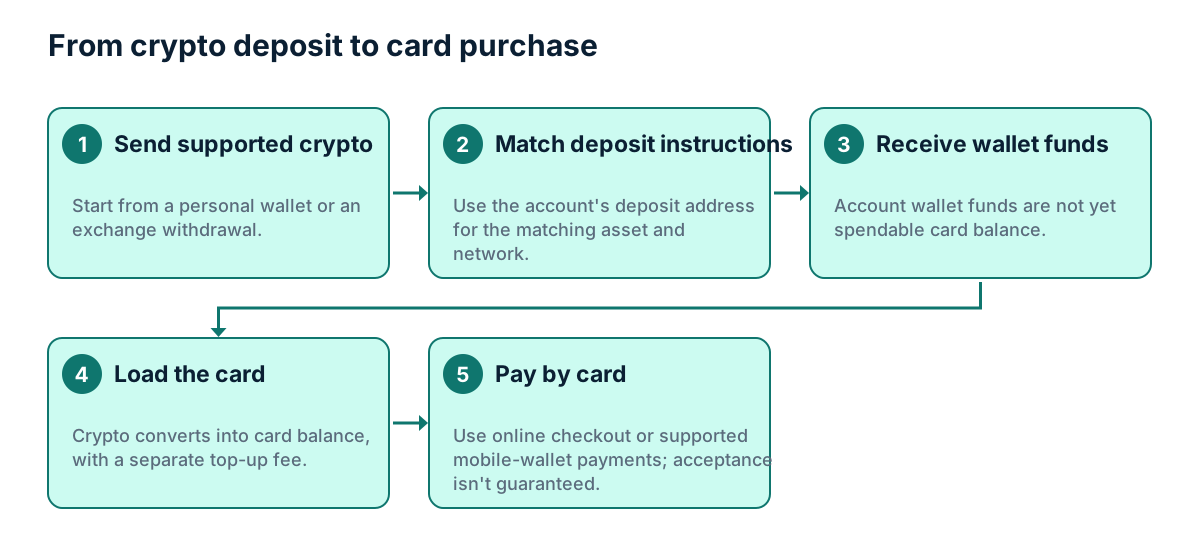
A blockchain deposit, a card load, and a merchant purchase are different events. Following them separately makes it easier to locate funds and understand why an account wallet balance shouldn't automatically be treated as a spendable card balance.
Deposit: crypto arrives through a supported network
Each account wallet has unique deposit addresses per supported network. The sender selects the asset and network supported for that deposit, obtains the corresponding address, and sends funds from a personal wallet or exchange. A token's name alone isn't enough to establish that the destination is correct; the sending network must match the receiving network.
For example, an address selected for a supported Ethereum-network deposit shouldn't be treated as interchangeable with an address provided for a TRON-network deposit. The account's current deposit instructions govern the choice. Familiar-looking address formats aren't a substitute for checking those instructions.
Blockchain submission is only the beginning of delivery. A transaction appearing in the sending wallet doesn't, by itself, establish that the account has credited it or that the card has been loaded. No fixed confirmation count or deposit-crediting deadline should be assumed from the card's instant issuance wording.
Load: crypto becomes card spending value
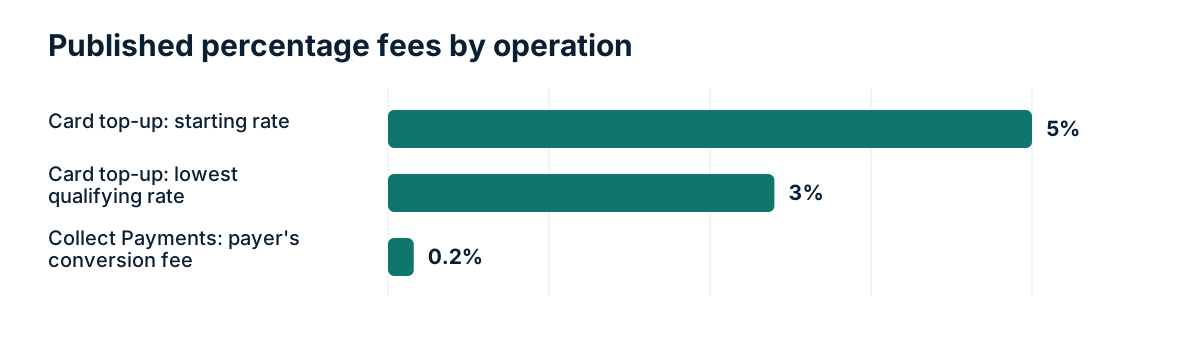
At loading time, cryptocurrency converts into card balance. The published top-up fee starts at 5% and falls automatically with qualifying rolling 30-day card spend, down to 3%. The $10 one-time card issue fee is a separate cost associated with creating the card.
This is the point where continued ownership of the original crypto stops being the right description of the loaded amount.
BTC and stablecoins follow the same conceptual path, but their values before loading can behave differently. A stablecoin is designed to track a reference asset or value; that design doesn't guarantee a permanent peg. BTC can change in value while a transfer is pending. A sender's estimate at dispatch therefore shouldn't be treated as a promise of the eventual loaded amount.
For the waldenpay virtual crypto card, the useful checkpoint is the displayed card balance after loading, not an earlier estimate from the sending wallet.
Purchase: the card network carries the payment
At checkout, the merchant processes a card transaction rather than receiving the original cryptocurrency. Online entry uses the card details; supported in-store contactless payments use the added card through Apple Pay or Google Pay. Neither action requires the merchant to accept the deposited coin.
But available balance and merchant acceptance are separate checks. Funding a card sufficiently doesn't guarantee that a merchant permits prepaid cards or approves the transaction.
Internal transfers follow a separate path
Send to Friend moves balance between WaldenPay users by email. It's an internal ledger transfer, with no blockchain transaction, arriving in seconds at zero transfer fee. The limits are $1 minimum, $10,000 per transfer, and $20,000 per rolling 24 hours. A recipient name preview and password confirmation help users check the destination before sending.
- Deposit: incoming crypto sent to a supported network-specific address.
- Load: funding the card, when crypto becomes card balance.
- Balance: value shown in a particular account area; wallet and card balances aren't interchangeable labels.
- Purchase: a merchant payment processed through card rails.
Getting Started With a WaldenPay Crypto Card
Registration starts with an email address. Standard use requires no identity documents, but the service remains subject to AML and regulatory requirements; email-only signup isn't a promise that compliance checks can never apply. Before sending funds, the prospective cardholder should confirm current eligibility and availability, then select a supported cryptocurrency and its matching deposit network. The destination address should come from the account wallet's instructions for that network, not from an old message or an assumed match based only on the asset name.
Funding and card ordering follow the service's current instructions, with the Telegram bot also available for ordering and recharging cards. The relevant published costs are the $10 one-time issue fee and top-up fee starting at 5%, with automatic volume discounts down to 3%; the minimum top-up is $50. Card issuance is instant after funding, while the complete process takes minutes without a guaranteed deadline. The step-by-step WaldenPay setup guide adds procedural detail for registration, funding, and card setup.
Once issued and funded, the card can typically be used by entering its details at an eligible online checkout or adding it to Apple Pay or Google Pay for supported payments. The cardholder should verify the available card balance before spending and check the merchant's prepaid-card policy when relevant. Telegram can then support balance checks, recharges, and transaction alerts. Neither successful issuance nor mobile-wallet addition guarantees that an individual purchase will be approved.
Supported Cryptocurrencies, Networks, and Deposit Addresses
The waldenpay virtual crypto card supports funding with 135+ cryptocurrencies across 35+ networks, including BTC, ETH, USDT, USDC, SOL, TRX, and LTC. Those examples aren't an exhaustive directory. For any particular deposit, the account wallet's current asset and network options should determine what gets sent and where.
The asset name alone isn't enough.
An asset and its network are different choices
An asset is the cryptocurrency being transferred; the network is the blockchain carrying that transfer. USDT, for example, exists on multiple networks. USDT sent over Tron and USDT sent over Ethereum require matching deposit instructions, even though both transfers involve the same asset. On Ethereum, ERC-20 is a token standard rather than a separate blockchain. Similar-looking labels in a withdrawal menu shouldn't be treated as interchangeable destinations.
WaldenPay's account wallet provides unique deposit addresses per supported network. Someone holding USDT on Tron can select that supported funding route rather than first moving the tokens to Ethereum. The important condition is that the receiving account displays the matching asset and network combination. An address copied from a previous deposit isn't a substitute for checking the current instructions.
And a network-specific deposit address doesn't establish that every token on that network is supported.
A pre-deposit checklist
- Match the asset: The cryptocurrency selected in the sending wallet or exchange should match the receiving option in WaldenPay.
- Match the network: Both sides should show the same blockchain. A familiar ticker doesn't establish compatibility.
- Use the displayed destination: The sender should copy the address from the selected network's account-wallet instructions and compare the pasted destination before confirming.
- Check any additional instructions: If the receiving screen specifies extra destination information, the sender should include it exactly as displayed.
- Review the outgoing amount: The sending service's withdrawal conditions and any network charges should be checked separately. The minimum card top-up is $50; that isn't a published minimum for every blockchain deposit.
- Wait for credited funds: A transaction appearing in a sending wallet doesn't by itself establish that funds are available to load onto the card.
If the labels don't match, the sensible next step is clarification before sending. An unsupported route can leave funds uncredited or difficult to recover; recovery shouldn't be assumed.
Stablecoins versus other supported crypto
USDT and USDC are designed to track the U.S. dollar, which can make a dollar-denominated funding budget easier to estimate. That design isn't a guarantee of value or redemption. BTC, ETH, SOL, TRX, and LTC can change in dollar value while a holder prepares and sends a deposit. The practical distinction is the amount available when funds are loaded, not a recommendation to hold one asset over another.
Everything converts to card balance at loading time. The resulting balance doesn't remain a position in the cryptocurrency used to fund it.
Network selection should therefore follow compatibility first, followed by the sender's actual withdrawal conditions. There isn't a universal confirmation time across all supported assets and networks. A freelancer receiving different tokens from clients should verify each route independently rather than assuming a previously successful deposit proves another route will work.
WaldenPay Virtual Card Fees: Published Costs and Worked Examples
The published costs for the waldenpay virtual crypto card are a $10 one-time card issue fee, a top-up fee starting at 5% and falling automatically to 3% with qualifying spend, and $0 monthly maintenance. The minimum card top-up is $50. Registration, balance checks, and support are free.
The top-up percentage is the main recurring card cost to model.
Issuance, maintenance, and feature-specific charges
The $10 issue fee is separate from the top-up fee. It shouldn't be folded into the loading percentage or treated as a monthly subscription. A cardholder comparing an initial funding operation with a later recharge should account for issuance separately and review the displayed totals before confirmation. Current published pricing is available on the pricing page.
| Action or requirement | Published cost or amount | Scope |
|---|---|---|
| Card issuance | $10 one time | Card creation |
| Card top-up | 5% down to 3% | Automatic volume tiers based on rolling 30-day card spend |
| Minimum card top-up | $50 | Funding requirement, not a fee |
| Monthly maintenance | $0 | No monthly maintenance charge |
| Registration, balance checks, and support | Free | These account services |
| Send to Friend | Zero fee | Balance transfers between WaldenPay users |
| Collect Payments | 0.2% conversion fee, paid by the payer | Payment requests; the creator receives the exact requested USD amount |
A zero-fee internal transfer doesn't make a subsequent card load free. Likewise, receiving the exact requested amount through Collect Payments doesn't remove the top-up fee if the recipient later loads those funds onto a card. These are separate operations with separate published terms.
The complete automatic discount schedule
Qualifying card spend over a rolling 30-day period determines the top-up tier. Deposit size alone doesn't. Loading a large balance and leaving it unused isn't the same as reaching the corresponding spending threshold. Discounts apply automatically and instantly when the account qualifies, without an application.
| Rolling 30-day card spend | Top-up fee |
|---|---|
| Below $2,000 | 5% |
| $2,000 to below $5,000 | 4.75% |
| $5,000 to below $10,000 | 4.5% |
| $10,000 to below $25,000 | 4.25% |
| $25,000 to below $50,000 | 4% |
| $50,000 to below $100,000 | 3.5% |
| $100,000 and above | 3% |
| $250,000+ per month | Individual pricing |
The dashboard shows the current fee, rolling 30-day spend, and progress toward the next level. Individual pricing at $250,000+ per month doesn't establish another public percentage, so calculations at that level require the actual quoted terms.
But a previously reached tier shouldn't be treated as permanent. As older purchases leave the rolling window, the qualifying total can change. The displayed fee before a recharge is more useful than a percentage remembered from an earlier load.
Worked top-up calculations
The following hypothetical examples apply the fee to a gross top-up amount and deduct it to show the resulting card balance. They isolate the loading calculation; the separate $10 issue fee isn't included.
| Gross top-up | Applicable fee | Top-up cost | Card balance added |
|---|---|---|---|
| $500 | 5% | $25 | $475 |
| $500 | 4.75% | $23.75 | $476.25 |
| $500 | 3% | $15 | $485 |
| $1,000 | 5% | $50 | $950 |
| $1,000 | 4% | $40 | $960 |
For the same $500 gross load, moving from 5% to 3% reduces the top-up cost by $10. That lower rate requires at least $100,000 in qualifying rolling 30-day card spend under the published schedule. A $500 deposit doesn't qualify for it simply because a cardholder chooses that percentage for a budget.
For a waldenpay virtual crypto card holder needing a particular spendable balance, gross funding and net card balance shouldn't be confused. At 5%, a $500 gross top-up leaves $475, so it doesn't fund a $500 purchase by itself. The transaction preview should be checked against the intended purchase amount before loading.
Loading less frequently may suit someone's budgeting habits, but it isn't an automatic fee-saving strategy. A different cost outcome requires a different applicable percentage, not merely a larger individual load. Separate sending-wallet or blockchain charges shouldn't be mistaken for WaldenPay's published card charges.
So the practical comparison starts with expected spending, the fee currently displayed, and the balance actually needed. Spending extra solely to reach a discount threshold can cost far more than the loading savings. Normal purchasing needs should drive the funding plan, with any earned discount reflected in subsequent calculations.
Published Limits, Eligibility, and Availability Checks
The published limits cover three different activities: card top-ups, transfers between users, and payment requests. They don't establish a universal account limit. The $50 minimum applies to card loading, while the $10,000 ceilings below apply to specific transfer and request features.
| Activity | Published minimum | Published maximum or window |
|---|---|---|
| Card top-up | $50 | Maximum not established by the supplied product facts |
| Send to Friend transfer | $1 | $10,000 per transfer; $20,000 per rolling 24 hours |
| Collect Payments request | $1 | $10,000 per request |
Rolling windows don't imply a midnight reset
A rolling 24-hour window looks backward over the preceding 24 hours rather than starting a new allowance at midnight. For example, two $10,000 Send to Friend transfers within that window would reach the published $20,000 limit. Another transfer would require sufficient capacity to become available as earlier activity falls outside the window.
The fee schedule uses a different window: rolling 30-day card spend. Neither window should be replaced with an assumed calendar-day or calendar-month reset. The published per-request Collect Payments range also doesn't establish a daily collection allowance; no such aggregate limit is supplied.
Account access and purchase acceptance are separate
Signup requires an email only, with no identity documents for standard use. That describes the standard registration process, not an exemption from compliance checks. Know Your Customer checks concern identifying and verifying customers; WaldenPay use remains subject to AML and regulatory requirements. Privacy-focused registration doesn't make spending anonymous or untraceable.
And merchant reach doesn't establish country eligibility.
The platform states acceptance at 150M+ merchants worldwide on Visa/Mastercard rails and supports Apple Pay and Google Pay. Those facts don't guarantee that every applicant can obtain a card, every device can add it, or every merchant will approve it. WaldenPay is a prepaid virtual card, so a merchant's prepaid-card restrictions remain relevant.
Information that still requires confirmation
For a prospective waldenpay virtual crypto card holder, the supplied facts don't establish the following:
- Card-level ceilings: Maximum card balance, maximum individual top-up, purchase limits, and any daily or monthly card-spending caps.
- Geographic eligibility: A definitive supported-country list, residency requirements, or eligibility for a particular U.S. applicant.
- Other application conditions: Minimum age and circumstances that could require additional verification.
- Mobile-wallet availability: Compatibility for a particular account, region, and device combination.
- Merchant approval: Acceptance for a particular purchase or merchant category.
Before committing funds, an applicant should check the current account terms and ask support about any condition material to the intended use. A planned purchase above an unconfirmed limit calls for confirmation, not an assumption based on the Send to Friend ceiling. Likewise, successful registration doesn't prove that every later funding operation or purchase will be permitted.
Online Checkout, Apple Pay, and Google Pay in Everyday Use
A funded card supports two everyday payment routes: entering its details at an online checkout or adding it to a compatible mobile wallet for contactless purchases. Neither route requires the merchant to accept cryptocurrency. The purchase runs through the card network, using balance that was converted when the card was loaded.
The waldenpay virtual crypto card remains a prepaid card in both settings.
That distinction matters because prepaid and stored-value cards rely on previously loaded funds rather than a credit line. WaldenPay operates on Visa/Mastercard rails with access to 150M+ merchants worldwide, but that reach isn't a promise that every transaction will succeed. A merchant's prepaid-card policy, the available balance, and payment authorization can all affect the result. A checkout displaying the relevant network logo doesn't settle every acceptance question.
Card details online versus a wallet at the terminal
Online, the cardholder enters the requested card details into the merchant's payment form. As of July 2026, WaldenPay supports adding its cards to Apple Pay and Google Pay; enrollment involves entering the card details and completing the applicable verification steps. At a compatible in-store contactless terminal, the cardholder can then use the supported wallet payment flow. Device and checkout compatibility still matter.
| Consideration | Online card entry | Mobile-wallet payment |
|---|---|---|
| Payment setup | The merchant receives the requested card details through its checkout. | The card is added to a supported wallet before payment. |
| Checkout requirement | The merchant must accept the card and prepaid funding type. | The checkout must support the wallet payment method and accept the card. |
| Funding source | The purchase draws on loaded card balance. | The purchase draws on the same loaded card balance. |
| Approval | Authorization remains conditional. | Wallet enrollment doesn't guarantee purchase authorization. |
The merchant processes a card payment, not a direct Bitcoin or stablecoin transfer. That removes the need for a crypto-specific checkout, but it doesn't make the transaction anonymous or prevent ordinary payment checks.
Balances, subscriptions, and authorization
Before a purchase, the useful number is the available card balance, not the amount held elsewhere in the WaldenPay account or in an external crypto wallet. Funds intended for spending need to reach the card through the loading process. A successful deposit elsewhere in the account shouldn't be treated as proof that a particular card has enough available balance.
Recurring payments need an additional check: whether the merchant accepts prepaid cards for that arrangement. A successful first purchase doesn't establish that later subscription charges will succeed. Renewal dates, available funds, and the merchant's rules remain relevant each time a charge is attempted.
- If a purchase involves a deposit or authorization hold, the cardholder should establish the merchant's prepaid-card requirements before committing.
- If the intended use is an advertising account, recurring bill, or restricted category, support confirmation and merchant terms matter more than general network reach.
- If a payment fails, checking balance, entered details, and the stated decline information is more useful than assuming the mobile wallet will change the outcome.
And adding the card to a wallet doesn't override a merchant's rules. An alternative permitted payment method may be necessary when prepaid cards aren't accepted.
Managing Orders, Recharges, Balances, and Alerts in Telegram
WaldenPay's Telegram bot supports four confirmed tasks: ordering cards, recharging cards, checking balances, and receiving transaction alerts. For someone who already uses Telegram to coordinate crypto-related work, that puts routine card operations inside an existing workflow rather than requiring a separate dashboard visit for every check.
Convenience doesn't change the underlying funding process or fees.
A recharge initiated through the bot still loads a prepaid card. It shouldn't be mistaken for a direct crypto payment to a merchant, and the bot isn't a separate card product with its own published pricing. The same distinction between account funds and spendable card balance remains important when a user is preparing for a purchase.
Routine operations versus dashboard oversight
- Ordering: The bot provides a route to order a card without changing the product's eligibility requirements.
- Recharging: An existing card can be recharged through the bot when additional spending balance is needed.
- Balance checks: A user can check the balance while coordinating a purchase or reviewing recent activity.
- Transaction alerts: Notifications help users notice activity, although no specific delivery-time guarantee is published.
The account dashboard serves a different monitoring role. It shows the current top-up fee, rolling 30-day card spend, and progress toward the next volume-discount tier. A user planning a larger recharge should consult those figures rather than infer a fee tier from a recent chat notification.
The account wallet also provides unique deposit addresses per supported network. The bot's confirmed task list doesn't establish that every deposit-address or account-management function is available in Telegram. For the waldenpay virtual crypto card, the dashboard and bot are complementary tools, not interchangeable interfaces.
Keeping the chat workflow safe
Product tools should be reached through official WaldenPay channels, rather than an unsolicited message, forwarded handle, or search result that merely copies the branding. No official bot handle is specified here, so a guessed username would create an unnecessary risk.
Passwords and full card credentials don't belong in ordinary chats, group conversations, or messages to someone claiming to provide support. Screenshots can expose sensitive details too.
And alerts deserve verification. An unexpected notification is a reason to inspect account activity through an official interface and contact support if needed, not a reason to share credentials with the sender. Notification text alone shouldn't be treated as proof that a recharge or purchase completed successfully.
Send to Friend: Email-Based Transfers Between WaldenPay Users
Two WaldenPay users can move balance between their accounts using the recipient's email address. Send to Friend is an instant, zero-fee internal ledger transfer that arrives in seconds. It doesn't send cryptocurrency to an external wallet, require a blockchain address, or create a blockchain transaction for that transfer.
Both parties must already be WaldenPay users.
The email address identifies the recipient inside the service. Before confirmation, the sender sees a preview of the recipient's name, and every transfer requires password confirmation. Those checks give the sender an opportunity to catch an incorrect recipient before funds move. A familiar-looking email address isn't a substitute for checking the name preview and the intended amount.
Published limits and the rolling window
- Minimum transfer: $1.
- Maximum per transfer: $10,000.
- Maximum across a rolling 24-hour period: $20,000.
The rolling limit isn't simply a calendar-day allowance that resets at midnight. A sender planning another payment needs to consider transfers within the preceding 24 hours. The per-transfer ceiling also remains separate: an amount within the rolling allowance may still be too large for a single transfer.
These are Send to Friend limits. They don't establish a card-purchase ceiling, a crypto-deposit limit, or a maximum card balance.
A hypothetical reimbursement
Suppose two freelancers both use WaldenPay, and one owes the other $100 for a shared business expense. The sender enters the recipient's registered email address, checks the displayed name, reviews the $100 amount, and confirms with the required password. Send to Friend moves that balance internally without a transfer fee or a blockchain gas fee.
The recipient now has account balance, not a new crypto deposit at an external wallet address. If the recipient intends to spend that money through the waldenpay virtual crypto card, loading the card is a separate operation subject to the applicable top-up fee and minimum. The internal transfer doesn't itself perform that card load.
But if the intended recipient only has an external crypto wallet and isn't a WaldenPay user, this feature doesn't fit the transaction. Entering an email address doesn't turn Send to Friend into a general-purpose blockchain withdrawal service.
What the zero-fee claim covers
Zero-fee describes the balance transfer between WaldenPay users. It doesn't mean card creation, later card loading, or every other action surrounding the payment is free. Keeping those operations separate prevents a reimbursement from being confused with fee-free card funding.
Nor does an internal ledger transfer mean unrecorded activity. WaldenPay is privacy-focused, not anonymous or untraceable, and use remains subject to AML and regulatory requirements. Avoiding a blockchain transaction for this particular movement doesn't remove those obligations.
Before sending, the practical checks are narrow: the correct registered email, a matching recipient-name preview, the intended amount, and sufficient room under both transfer limits. If the preview doesn't match expectations, the sender should resolve the discrepancy through a trusted contact channel before confirming.
No reversal or cancellation policy is established by the published feature description. A sender shouldn't assume that an incorrect transfer can be recalled; an error calls for prompt contact with official support rather than a promise of recovery.
Collect Payments: Fixed-USD Requests Paid in Crypto
A freelancer or seller can request a fixed dollar amount without asking the payer to open a WaldenPay account. Collect Payments creates a request for $1-$10,000, with a description, that the creator shares as a payment link or QR code. The payer can use any supported cryptocurrency across the service's 135+ cryptocurrencies and 35+ networks.
The creator receives the exact requested USD amount in the account wallet.
The payer covers the 0.2% Collect Payments conversion fee. That division is important for pricing: the creator sets the amount due in dollars rather than requesting a fixed quantity of crypto and hoping it matches the invoice. The payer follows the request's payment instructions for the chosen supported asset and network.
The creator sets the price in dollars. The payer chooses supported crypto. The completed request credits the specified USD amount to the creator's account wallet.
Creating a request that is easy to reconcile
The description should identify what the payment covers without including unnecessary personal or confidential information. An invoice reference, service description, or order identifier can help the creator associate the completed payment with the right obligation. The shareable link suits remote billing; a displayed QR code can suit a market vendor accepting payment at the till.
A practical workflow separates request creation from payment confirmation:
- The creator sets a USD amount within the $1-$10,000 request range and adds a description.
- The creator shares the generated link or QR code with the intended payer.
- The payer selects a supported cryptocurrency and network and follows the displayed payment instructions.
- The creator checks the request's completion and account-wallet credit before treating the obligation as paid.
A shared link, a scanned QR code, or a payer's screenshot isn't by itself evidence that the full request has completed.
A hypothetical $1,000 request
For a $1,000 request, the 0.2% payer-side fee component is $2: $1,000 multiplied by 0.002. The creator receives $1,000 when the request completes. The $2 calculation explains that published fee component only; it doesn't specify a crypto quantity or replace the actual payment instructions.
The creator's credit lands in the account wallet, not automatically on the waldenpay virtual crypto card. Later card loading is a separate step with its own published top-up fee. This distinction matters for a freelancer budgeting both incoming revenue and subsequent card spending.
Underpayments and incomplete requests
Collect Payments tracks underpayments. If the payer sends less than required, the system generates a fresh address for the remaining amount. The payer should follow those updated instructions rather than assume the original address remains the correct destination for completing the request.
Incomplete payments are automatically refunded to the payer's wallet.
That is a specific incomplete-payment safeguard, not a general promise about merchant refunds, billing disputes, or chargebacks. The published facts don't establish a refund deadline or the precise processing conditions. Neither party should invent a waiting period or assume an underpaid request counts as settled while the remaining amount is outstanding.
Where the workflow fits
International freelancers can keep the amount due denominated in USD while allowing clients to pay in supported crypto. Market vendors can display a QR code instead of transcribing wallet addresses, and P2P sellers can attach a description to a request for easier reconciliation. None of those uses requires the payer to become a WaldenPay user.
And a payment request remains a collection tool, not a complete accounting system. Sellers should retain the request description, amount, completion record, and corresponding invoice where relevant. The IRS provides digital-asset tax guidance for U.S. taxpayers; a qualified tax professional can help determine the appropriate reporting and recordkeeping for a particular business.
Practical Workflows for Freelancers, Sellers, and Crypto Holders
The waldenpay virtual crypto card connects crypto funding and payment collection with prepaid spending, but each workflow has a different starting point. The following examples are hypothetical operating scenarios, not customer testimonials or evidence of tested transaction speeds.
A freelancer requesting an international client payment
A designer needs to collect a $1,000 invoice from a client holding USDT. Rather than sending a personal deposit address and calculating the amount due manually, the designer creates a Collect Payments request with a fixed USD amount and an invoice description.
- The designer shares the payment link with the client.
- The client selects a supported cryptocurrency and network from the payment flow. No WaldenPay account is required.
- The client covers the 0.2% conversion fee: $2 on a $1,000 request.
- Once payment is complete, the designer receives exactly $1,000 in the account wallet. The $2 isn't deducted from that receipt.
- The designer can subsequently allocate wallet funds to a card top-up, reviewing the displayed fee and resulting card balance before confirming.
At the starting tier, the card top-up fee is 5%; qualifying rolling 30-day card spend reduces it automatically, down to 3%. A first card also carries the one-time $10 issue fee, and the minimum top-up is $50. Receiving the invoice payment doesn't itself count as card spending or qualify the designer for a lower tier.
Before paying for software, the designer still needs to check whether the merchant accepts prepaid virtual cards. A completed client payment doesn't guarantee a subsequent card purchase will be approved.
A market vendor presenting a payment QR code
A hypothetical vendor creates a $50 request with a description identifying the sale and displays its QR code. The customer pays using a supported asset and network; the published payer-side conversion fee is $0.10, while the vendor receives the full $50 in the account wallet after completion.
The vendor checks the request's completion status before releasing the goods. A scanned QR code, customer screenshot, or partially funded request isn't proof of completed payment. Underpayments are tracked with a fresh address for the remainder, and incomplete payments are automatically refunded to the payer's wallet.
And that receipt remains wallet funds until a separate card load takes place. Applicable business recordkeeping and regulatory obligations remain relevant regardless of whether the customer pays through a link or at a physical stall.
An existing crypto holder funding purchases
A holder starting with BTC, ETH, or USDC checks the supported asset-network combination and corresponding deposit instructions, then funds the account wallet. Loading the card converts the funding into card balance at that point. The published issue and top-up charges apply; monthly maintenance is $0.
Card details can support online purchases, while Apple Pay or Google Pay can support eligible in-store payments. Neither route overrides merchant restrictions or guarantees acceptance.
For moving existing balance to another WaldenPay user, Send to Friend serves a different purpose: an instant, zero-fee internal ledger transfer using the recipient's email. It doesn't require a blockchain transaction. Its $1 minimum, $10,000 per-transfer maximum, and $20,000 rolling 24-hour limit apply. Collect Payments instead requests new payment from a payer who needn't have an account.
Privacy, Legitimacy, and the Regulatory Context
WaldenPay identifies its operator as BlueHouse Software B.V., Rotterdam, Netherlands, operating through a licensed partner model. That identifies the business behind the service; it doesn't establish that WaldenPay itself holds an unspecified financial license or certify every transaction as safe. The WaldenPay trust and safety review provides a dedicated framework for examining the operator, product disclosures, and remaining checks. A legitimacy assessment should distinguish those published details from independently verified operational performance.
Signup requires an email only, with no identity documents for standard use. But a waldenpay virtual crypto card remains subject to AML and regulatory requirements; lighter initial onboarding doesn't remove lawful obligations or promise that additional checks can never arise. The explanation of WaldenPay's standard verification requirements adds context to "no-KYC" language without treating it as a legal exemption. Eligibility and use must remain within applicable rules, including any requirements presented during account activity.
Privacy-focused doesn't mean anonymous or untraceable. Card purchases use loaded card balance rather than requiring a fresh crypto payment to each merchant, but account and payment records can still exist. Send to Friend avoids sharing wallet addresses and includes a recipient-name preview and password confirmation on every transfer. These are specific safeguards, not guarantees against mistakes or fraud. The discussion of WaldenPay's actual privacy protections helps separate reduced data-sharing friction from claims of invisibility. Users should assess those protections alongside the records and access needed to operate the service.
Common Mistakes, Payment Problems, and Sensible Precautions
Most useful troubleshooting starts by locating the problem: blockchain deposit, account wallet, internal transfer, payment request, card load, or merchant checkout. Treating those as one continuous balance can lead to repeated payments or incorrect assumptions about missing funds.
| Symptom or assumption | First check | Sensible next step |
|---|---|---|
| A crypto deposit isn't reflected in the wallet. | Compare the asset, network, destination address, and blockchain transaction status with the deposit instructions. | Preserve the transaction hash and network details. Contact official support if the records don't explain the issue; recovery of an incorrect deposit isn't guaranteed. |
| The wallet has funds, but a card purchase fails. | Check the card's own available balance and whether a card top-up completed. | Review the load record before submitting another top-up. Account wallet funds and card balance aren't interchangeable at checkout. |
| A large account deposit hasn't lowered the top-up fee. | Check rolling 30-day card spend, not deposit volume or wallet balance. | Use the dashboard's current fee and progress indicator. For example, the 4.75% tier starts at $2,000 in qualifying card spend. |
| A Send to Friend transfer may target the wrong person. | Compare the recipient's email and displayed name before password confirmation. | Stop if either detail is unexpected. For an already completed transfer, retain its record and contact official support without assuming reversal is possible. |
| A payment link exists, but the seller hasn't received the full amount. | Inspect the request status, amount received, and any outstanding remainder. | Follow the request's current instructions. Don't treat link creation or partial payment as completion. |
| A merchant declines a funded card. | Check prepaid-card eligibility, entered details, billing information, and any authentication prompt. | Ask the merchant about its payment requirements or use another permitted payment method. Don't attempt to bypass its checks. |
Preserve evidence before retrying
A useful support record identifies the affected stage and includes the relevant transaction or request identifier, amount, asset, network, timestamp, displayed status, and exact error message. Screenshots should exclude sensitive credentials and unrelated personal information. For card issues, users should supply only the limited identifying details requested through an official support channel.
Repeated retries aren't a diagnosis.
For a waldenpay virtual crypto card purchase, a merchant decline and an incomplete card load require different checks. A user should first establish whether the card balance changed and whether an earlier attempt appears in transaction history. That prevents an unnecessary second load from obscuring the original problem.
Keep authentication and support separate
As of July 2026, EMVCo describes 3-D Secure authentication as a way to authenticate consumers during e-commerce payments. An authentication prompt isn't itself proof that a purchase has completed, and successful authentication doesn't guarantee merchant approval.
Passwords belong in the legitimate confirmation flow, not in messages to support. Users shouldn't share full card credentials, wallet recovery phrases, or authentication codes with someone offering to repair a payment.
Official support can investigate records and explain the available next steps. That doesn't establish a recovery entitlement for an incorrect blockchain deposit, a reversal right for an internal transfer, or a guaranteed resolution date for a declined purchase. When instructions appear inconsistent, pausing is safer than improvising another network, recipient address, or payment attempt.
How to Evaluate Product Claims and Consider Other Payment Methods
Published specifications describe what a product offers; independently demonstrated performance requires evidence. Support for 135+ cryptocurrencies across 35+ networks, issuance in minutes, and published fees are product facts, not proof that every deposit or checkout finishes within a particular time. A useful review identifies its date, funding asset and network, relevant account conditions, merchant setting, and observed outcome. It also separates successful tests from untested capabilities. The WaldenPay fees and features review is a supporting article whose evidence should be assessed on those terms, rather than treating its title as proof of hands-on testing.
This guide reports confirmed features and explicitly hypothetical workflows; it doesn't claim independent transaction tests. Readers assessing another "WaldenPay review" should look for transaction evidence with sensitive details removed, an explanation of costs, and candid limitations. A successful purchase demonstrates that particular purchase, not universal merchant acceptance. Similarly, published issuance timing doesn't establish a guaranteed end-to-end timetable for every funding route. Undated screenshots and unexplained totals make a review harder to evaluate.
Alternatives are best considered by function. Retaining crypto in a wallet serves holding and on-chain transfer needs without creating card spending capacity. Paying a willing merchant directly in crypto avoids a card purchase but requires agreement on the asset, network, amount, and refund process. An existing conventional payment method may fit a merchant that doesn't accept prepaid cards. The relevant choice depends on the payment task, custody preferences, documented costs, and merchant requirements, rather than a universal "best card" ranking.
Partner API, White-Label Telegram Bot, and Referrals
Businesses can participate through a partner API, a white-label Telegram bot, or referral links. The bot supports a configurable 0-20% partner markup, and partner commissions are paid in USDT. Those are confirmed program features; they don't establish a commission percentage for every model, a payout timetable, or expected earnings.
Which model matches the business's role?
The partner API is the path to evaluate when a business wants an integration within its own product. Before committing development resources, the business should obtain current documentation and establish which operations, permissions, and support arrangements are actually available. The existence of an API doesn't establish particular endpoints, implementation effort, or approval criteria.
A white-label Telegram bot is relevant when the business wants a branded bot-based offering. Its configurable markup requires a commercial decision as well as a customer-communication plan. Referral links are the alternative to assess when the business wants to introduce prospective users rather than commission a product integration. Attribution rules and commercial terms still need confirmation.
What will customers see and pay?
Partner-program economics must remain separate from the consumer card schedule. The waldenpay virtual crypto card has a $10 one-time issue fee, a top-up fee starting at 5% and falling as low as 3% with qualifying volume, and no monthly maintenance fee. The white-label bot's 0-20% partner markup is a separate program setting, not another consumer discount tier.
A prospective partner should resolve these points before publishing prices:
- Which amount the configurable markup applies to and how the final charge is displayed.
- How any partner-added charge is distinguished from WaldenPay's published card costs.
- Which party answers billing questions and handles product-support escalation.
- How customers receive notices when applicable terms or charges change.
No calculation should assume an unspecified commission base.
Who owns communication, compliance, and records?
A branded interface shouldn't obscure the underlying prepaid-card product or imply that a partner is a bank or licensed issuer. Customer communications should identify the relevant service relationships accurately, preserve acceptance caveats, and avoid promises of anonymity, guaranteed approval, or regulatory exemptions.
Before selecting a model, the business should establish its responsibilities for customer data, consent, access controls, transaction records, and incident escalation. Applicable requirements need professional review where appropriate; a white-label presentation doesn't remove them.
Finally, USDT commission payment describes the payout asset, not the timing or certainty of payment. Businesses should request written confirmation of commission calculation, attribution, payout conditions, supported payout network, and any adjustments before forecasting revenue. Tax and accounting treatment should be discussed with a qualified professional rather than inferred from the use of cryptocurrency.
What May Change: Product Updates and Trends to Monitor
An older guide can explain the mechanics, but funding decisions should depend on the product's current terms and account screens.
Before another deposit, cardholders should confirm that the intended asset and network remain supported and retrieve the matching deposit details from their account. Published pricing deserves the same check: the applicable loading tier depends on rolling 30-day card spend, so a previously earned discount shouldn't be treated as permanent. Eligibility, availability, and regulatory requirements also need rechecking before the card becomes part of a recurring business workflow.
Mobile-wallet support and merchant policies deserve separate attention. A supported wallet doesn't guarantee that a particular merchant will accept a virtual prepaid card. If a planned purchase depends on either, the cardholder should verify the current requirements before loading funds.
And existing capabilities are more useful than roadmap speculation. Collect Payments already illustrates fixed-USD payment requests shared through links or QR codes. Wallet-based card spending already connects a funded card with mobile checkout. The partner API and white-label Telegram bot illustrate embedded distribution through another business's interface. These are product capabilities, not evidence of quantified market growth or promises of future releases.
For US regulatory context, FinCEN's guidance on Bank Secrecy Act obligations provides a reference for applicable financial-services requirements. It doesn't establish an individual user's eligibility or guarantee a product's regulatory status. Questions about obligations should go to a qualified professional; product-specific conditions should be checked with WaldenPay before funds are committed.
Bottom Line: What to Check Before Ordering
The waldenpay virtual crypto card fits someone who already holds crypto and needs card spending or associated payment tools. Its value depends on the intended use and published costs, not crypto ownership alone.
- Merchant use: Confirm the intended merchant's prepaid-card policy; acceptance isn't guaranteed.
- Card format: A virtual prepaid card must suit the purchase. It doesn't provide credit.
- Funding route: Confirm the supported asset, network, and matching deposit address.
- Initial costs: Account for the $50 minimum top-up and $10 one-time issue fee.
- Loading tier: Check the applicable top-up fee, from 5% down to 3%, based on rolling 30-day card spend. There's no monthly maintenance fee.
- Compliance: Accept AML and regulatory obligations. Privacy-focused use isn't anonymous or untraceable.
Anyone requiring anonymity, credit, or guaranteed merchant approval needs a different solution. That doesn't mean another payment method can promise anonymity or approval. And a cardholder whose essential merchant rejects prepaid cards shouldn't load funds expecting WaldenPay to bypass that rule.
Related reading
- Agentic Payment Card: How AI Agents Pay in 2026 - Agentic payment cards are virtual cards provisioned for AI agents to autonomously pay for API calls, SaaS subscriptions, and cloud compute—w
- Crypto AI Explained: Tokens, Agents, and Spending Gains 2026 - A practical guide to crypto AI in 2026 - trading bots, autonomous agents, and tokenized projects - plus how to spend AI-earned stablecoins w
- Embedding Virtual Cards via Partner API: A 2026 Guide - A technical breakdown of how platforms embed virtual cards via partner API in 2026 - covering AML liability, funding vs settlement currency,
- How to Accept Crypto Payments in 2026: A Practical Guide - A practical 2026 guide to accepting crypto payments without a merchant account, using payment links and QR codes that skip wallet-address ha
- How to Set Up a WaldenPay Card: Step-by-Step Guide (2026) - A complete setup tutorial for the WaldenPay crypto card: ordering through the Telegram bot, funding with USDT or other coins, adding to Appl
- Is WaldenPay Legit? 2026 Trust & Safety Review - A deep dive into whether WaldenPay is legit in 2026, examining trust signals, transfer safeguards, and AML/privacy realities.
- WaldenPay Review 2026: Fees, Features & Real Test Results - A hands-on WaldenPay review testing real fee tiers, Send to Friend, and Collect Payments to see if this crypto card lives up to the marketin
Frequently Asked Questions
Is the waldenpay virtual crypto card a debit card or a prepaid card?
The WaldenPay virtual crypto card is a virtual prepaid card on Visa/Mastercard rails, not a traditional bank debit card. It spends a balance loaded from cryptocurrency rather than drawing from a checking account. The phrase "WaldenPay crypto debit card" shouldn't be taken to mean it provides a bank account or credit line.
How long does it take to get a WaldenPay virtual card?
The card is issued instantly after funding, with the overall setup typically taking minutes. Signup requires an email address, and standard use doesn't require identity documents. Crypto deposit timing can vary, so issuance after funding isn't a guarantee of a fixed signup-to-checkout time.
What does a WaldenPay crypto card cost?
WaldenPay charges a $10 one-time card issue fee and a top-up fee starting at 5%, with automatic volume discounts down to 3%. There's no monthly maintenance fee, and registration, balance checks, and support are free. The minimum card top-up is $50.
How do WaldenPay's top-up fee discounts work?
Top-up discounts depend on rolling 30-day card spend, not the amount deposited. The fee starts at 5%, then drops to 4.75% at $2,000 in spend, 4.5% at $5,000, 4.25% at $10,000, and 4% at $25,000. It falls to 3.5% at $50,000 and 3% at $100,000, with individual pricing at $250,000 or more per month. Discounts apply automatically without an application, and the dashboard shows the current fee and progress toward the next level.
Which cryptocurrencies can fund a WaldenPay card?
WaldenPay supports 135+ cryptocurrencies across 35+ networks, including USDT, USDC, BTC, ETH, SOL, TRX, and LTC. The account wallet provides unique deposit addresses per supported network, so the sending network must match the selected deposit network. Stablecoins aren't risk-free, and no cryptocurrency guarantees instant deposit confirmation.
Does a WaldenPay card balance change when crypto prices move?
Once cryptocurrency is loaded onto the card, it becomes card balance rather than remaining a crypto holding. Later price movements in the original cryptocurrency don't change that loaded balance. But this doesn't eliminate price movement risk before loading is completed.
Does the WaldenPay virtual card work with Apple Pay and Google Pay?
As of July 2026, WaldenPay supports adding its virtual cards to Apple Pay and Google Pay for supported online and in-store payments. Card details can also be used directly at online checkout. Wallet compatibility doesn't guarantee that a particular merchant will accept the prepaid card.
Is the WaldenPay virtual card anonymous or available without ID?
WaldenPay is privacy-focused, but it isn't anonymous or untraceable. Signup requires only an email address, with no identity documents required for standard use. Use remains subject to AML and regulatory requirements, so no-document onboarding shouldn't be interpreted as an exemption from compliance checks.
Is WaldenPay legit, and who operates it?
WaldenPay is operated by BlueHouse Software B.V. in Rotterdam, Netherlands, through a licensed partner model. It's a crypto-funded prepaid card platform, not a bank. A useful WaldenPay review should distinguish those verifiable operating details from claims about guaranteed approval, availability, or risk-free use.
What's the difference between Send to Friend and Collect Payments?
Send to Friend moves balance between WaldenPay users by recipient email, while Collect Payments lets anyone pay a fixed-USD request in supported crypto without a WaldenPay account. Send to Friend is an instant, zero-fee internal ledger transfer, with a $1 minimum, a $10,000 per-transfer maximum, and a $20,000 rolling 24-hour limit. Collect Payments supports requests from $1 to $10,000 through a link or QR code; the creator receives the exact requested USD amount, and the payer covers a 0.2% conversion fee.
What happens if someone underpays a Collect Payments request?
WaldenPay tracks the shortfall and generates a fresh deposit address for the remaining amount. The payer can complete the request by paying that remainder. Incomplete payments are automatically refunded to the payer's wallet.
Why might a WaldenPay prepaid crypto card payment be declined?
A payment can be declined if the available balance is insufficient or the merchant doesn't accept that prepaid card transaction. Card-network acceptance doesn't guarantee approval at every checkout. The cardholder should check the balance, entered card details, and merchant payment rules, then contact support if the cause remains unclear.
In this section
- Agentic Payment Card: How AI Agents Pay in 2026
- Crypto AI Explained: Tokens, Agents, and Spending Gains 2026
- Embedding Virtual Cards via Partner API: A 2026 Guide
- How to Accept Crypto Payments in 2026: A Practical Guide
- Is WaldenPay Legit? 2026 Trust & Safety Review
- How to Set Up a WaldenPay Card: Step-by-Step Guide (2026)
- WaldenPay Review 2026: Fees, Features & Real Test Results