Crypto Card No Bank Account: How to Get One in 2026
By Elena Petrova, Blockchain Researcher · Updated September 21, 2026
Crypto Card No Bank Account: How to Get One in 2026
TL;DR A crypto card no bank account setup works by converting crypto to a card balance at loading time, not by linking to a checking account. It's not anonymous - providers still verify identity per AML rules - but it skips traditional banking entirely. Expect email/ID verification, a top-up fee (often 5% down to 3% with volume), and a card ready to add to Apple Pay or Google Pay within minutes.A lot of people look for a crypto card no bank account solution for a simple reason: they don't have one, don't want one, or live somewhere their local bank just can't keep up with how they earn or spend. Freelancers paid in USDT, digital nomads hopping between countries, and privacy-minded crypto holders all end up in the same place - wanting to spend crypto in the real world without a checking account sitting in the middle.
The good news is that this is genuinely doable in 2026. The confusing part is that a lot of content out there mixes up "no bank account" with "no verification at all," and that mix-up is exactly what leads people into frozen cards and failed sign-ups. This guide walks through how a no bank account crypto card actually works behind the scenes, what identity checks to expect, and how to read the fee structure before putting any funds in.
How a Crypto Card No Bank Account Actually Works
Here's the part most listicles skip.
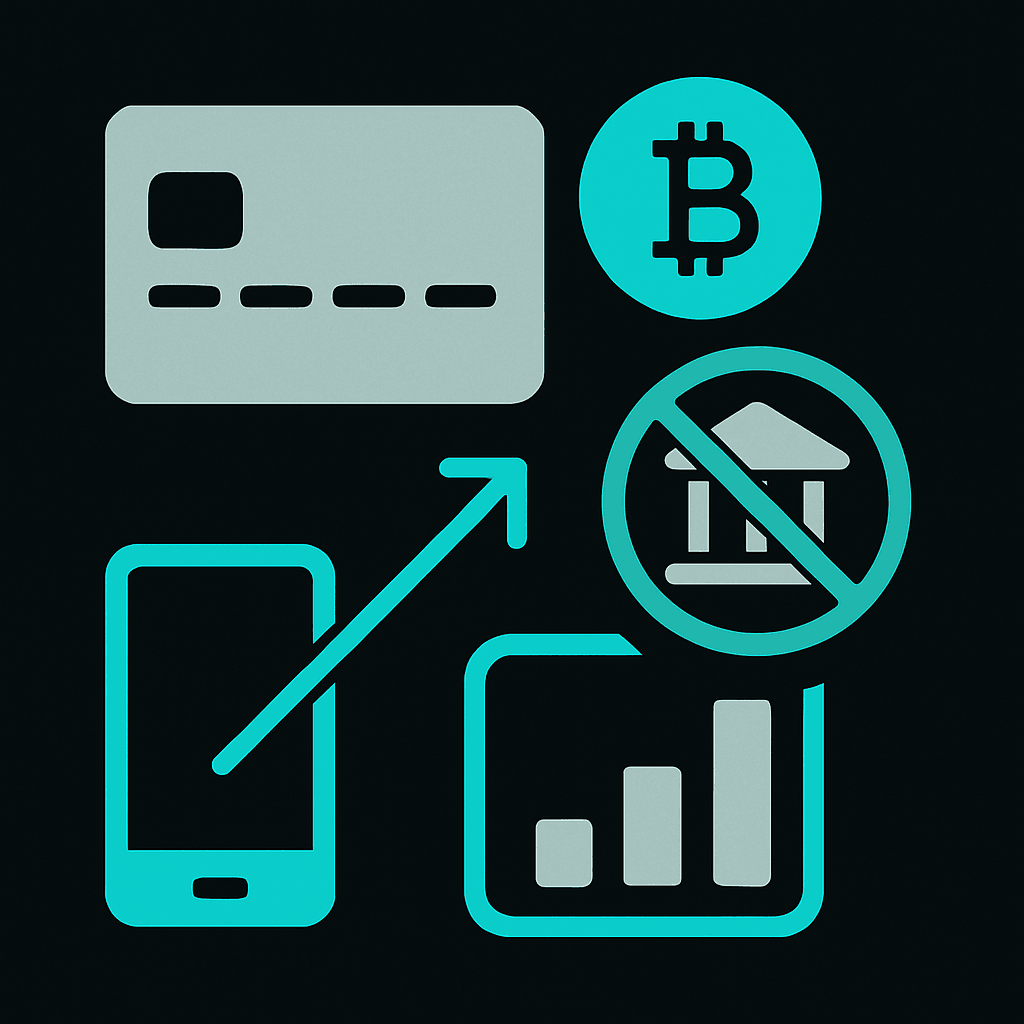
A crypto debit card without a bank works because the card itself isn't tied to a traditional deposit account at all. Instead, the provider gives the user a wallet with deposit addresses across supported blockchains. Once crypto lands in that wallet - Bitcoin, USDT, ETH, SOL, or dozens of other assets - it gets converted into a card balance, usually right at the moment it's loaded. From there, the card behaves like any prepaid card: it has a spendable balance, it works at checkout, and it can be added to a phone wallet.
No checking account, no routing number, no bank sitting in the loop. That's the "no bank account" part. But there's still a compliance layer, because card networks like Visa and Mastercard require issuers to follow AML and KYC rules whether the funding source is crypto or fiat.
So a virtual crypto card no bank account setup typically looks like this on the backend: crypto in, identity check on file, fiat-equivalent balance out. The blockchain transaction happens once, at funding. After that, every swipe is just a card balance transaction, same as a regular prepaid card.
A card with no linked bank account is not the same thing as a card with no identity check - and mixing those up is how people end up with frozen balances.

Crypto Card KYC Requirements: What to Actually Expect
This is the part that trips people up. Truly anonymous crypto cards on the Visa or Mastercard networks are rare in 2026, and any provider promising full anonymity while still routing through a major card network should raise a flag.
That said, verification tiers vary quite a bit by provider. Some no-KYC crypto cards let users spend USDT, Bitcoin, or ETH via Apple Pay or Google Pay with just an email address and no documents at the lowest tier, though usually with tight spending limits. Others want a photo ID and a selfie before a card ships. A few low-fee providers, like Kripicard, issue instant virtual cards funded with USDT with minimal verification at the basic tier and no credit check, sometimes starting with as little as $10 loaded.
Common crypto card sign up requirements across mainstream providers include:
- A valid email address (used for account access and alerts)
- Government-issued ID for higher limits or physical cards
- A selfie or liveness check in many cases
- Proof of address for some higher-tier accounts
- Agreement to the provider's AML policy, which applies regardless of funding method
None of this means the card is "connected" to a bank. It just means the issuer is following the same rules that apply to any regulated payment product. For a closer look at what's realistic versus risky on the no-KYC side, the pillar guide on what's real vs. risky with no-KYC crypto cards is worth reading before signing up anywhere.
Step-by-Step: Getting a Crypto Card Without a Bank
The actual sign-up flow for a crypto card no bank account is quicker than most people expect. Here's the general shape of it:
- Create an account. Email and password, sometimes a phone number.
- Verify identity. Basic tiers may need almost nothing; full-limit cards usually need an ID upload.
- Order the card. Virtual cards are typically issued in minutes; physical cards ship separately.
- Fund it with crypto. Send BTC, USDT, ETH, or another supported asset to a unique wallet address for that network.
- Balance converts automatically. The crypto is converted to card balance at loading time, minus the top-up fee.
- Add to Apple Pay or Google Pay, or use the card number directly online and in-store.
WaldenPay follows this same pattern: an account wallet with per-network deposit addresses, a card issued in minutes once identity is verified, and a Telegram bot for recharging balances and checking spend without opening a separate app. It's a useful reference point for how the mechanics work in practice, not a shortcut around verification. Details on the full flow are on the how it works page.
A note on privacy: A crypto card no bank account setup can be more private than a card tied to a checking account, since there's no bank statement listing every merchant. But it's not anonymous or untraceable. Transactions are still subject to AML monitoring and regulatory reporting, and identity verification applies to spending limits and dispute protections alike.Fee Structures to Watch (Most Guides Skip This)
Fees are where a lot of "best crypto card no bank account 2026" roundups get vague. There are usually three cost layers worth checking before picking a provider:
- Top-up fee - charged when crypto converts to card balance. This can range widely by provider.
- Issuance fee - a one-time cost to create the card.
- Maintenance or hidden fees - monthly charges, inactivity fees, or ATM withdrawal markups.
WaldenPay's structure, as one example of how volume discounts can work, starts top-up fees at 5% and steps them down automatically based on rolling 30-day card spend, with no application process required:
| 30-day card spend | Top-up fee |
|---|---|
| Up to $2,000 | 5% |
| $2,000+ | 4.75% |
| $5,000+ | 4.5% |
| $10,000+ | 4.25% |
| $25,000+ | 4% |
| $50,000+ | 3.5% |
| $100,000+ | 3% |
Accounts spending $250,000 or more per month typically move to individual pricing arrangements with the provider. The point isn't that every provider offers this exact structure - it's that anyone comparing prepaid crypto card no bank account options should ask specifically how the top-up fee changes with volume, since flat-fee cards can get expensive fast for heavy spenders. Full pricing tiers are listed on the pricing page.
Who a No Bank Account Crypto Card Actually Fits
This isn't a niche product anymore. A few groups get real, practical value from an unbanked crypto card setup:
Digital nomads. Someone earning in USDT while moving between three countries a year doesn't want to open and close local bank accounts. Loading crypto onto a card and spending anywhere the card network is accepted - across 150M+ merchants worldwide - solves that without paperwork at every border.
Freelancers paid in crypto. Clients pay in ETH or USDT, and rather than routing through an exchange, converting to fiat, and waiting on a bank transfer, the freelancer can load crypto onto a card directly and spend it the same day.
People without access to traditional banking. A crypto card for unbanked users - whether by choice or by circumstance, such as thin credit history or no local bank branch - offers a path to spend crypto without a bank acting as gatekeeper.
Entrepreneurs funding ad accounts. Some platforms are picky about card issuers or reject accounts tied to volatile payment history; a crypto-funded virtual card gives more predictable control over available balance. There's a dedicated breakdown of that scenario in the guide on fixing a declined Facebook Ads card with a crypto card.
And for anyone still weighing anonymity claims against what's realistic, the related pieces on anonymous crypto cards in 2026 and no-KYC virtual cards cover that ground in more depth.
Choosing the Best Crypto Card No Bank Account Option in 2026
A short checklist does more good here than a long comparison table:
- Does it support the specific crypto and network already held (BTC, USDT-TRC20, USDT-ERC20, SOL, etc.)?
- Can it be added to Apple Pay or Google Pay for daily spending?
- Is the top-up fee flat, or does it drop with volume?
- What's the issuance fee, and are there recurring monthly charges?
- What KYC tier is required for the limits actually needed?
- Is there a way to check balances and get transaction alerts without digging through an app - a Telegram bot or push notifications, for instance?
Security matters just as much as fees. A card that's cheap but poorly secured, or a provider vague about how funds are custodied between top-up and spend, isn't a good trade-off. It's worth reviewing how a provider handles wallet security and transaction monitoring - see the security page for an example of what that should look like - before loading meaningful amounts of crypto onto any card.
FAQ
Can I really get a crypto card without a bank account in 2026?
Yes. A crypto card no bank account setup works by funding a card wallet with crypto and converting it to card balance at loading time, with no checking account involved. Identity verification is still typically required for compliance with AML rules, even though no bank is in the loop.
Is a no bank account crypto card the same as an anonymous card?
No. Skipping the bank doesn't mean skipping identity checks. Card issuers on major networks still verify users and monitor transactions under AML regulations, so "no bank account" and "anonymous" are two different things.
What documents are needed to sign up?
It depends on the provider and tier. Basic accounts may only need an email address, while higher limits usually require a government ID and sometimes a selfie or proof of address. Crypto card sign up requirements vary, so it's worth checking a provider's verification tiers before assuming a fully instant, document-free process.
How much does it cost to load crypto onto a card?
Top-up fees commonly range from around 5% down to 3% depending on the provider and how much is spent, plus a one-time card issuance fee (often around $10). Ongoing maintenance, registration, and balance checks are frequently free, but it's smart to confirm this before funding a card.
Can these cards be used with Apple Pay or Google Pay?
Many crypto card providers support adding the virtual card to Apple Pay or Google Pay, letting the card be used for tap-to-pay purchases and online checkout without carrying a physical card at all.
Ready to spend crypto without a bank account?
WaldenPay converts 135+ cryptocurrencies across 35+ networks into a spendable card balance, ready in minutes and usable anywhere the card network is accepted - no checking account required, with fees that drop automatically as spend grows.
Get your WaldenPay card