Google Ads Payment Crypto Card: Fund Ad Accounts in 2026
By James Whitfield, Payments Specialist · Updated September 24, 2026
Google Ads Payment Crypto Card: Fund Ad Accounts in 2026
Media buyers sitting on profits in USDT or BTC keep hitting the same wall: Google Ads won't take crypto. No wallet address in billing, no stablecoin option, nothing. So the workaround that's grown fast in 2026 is a crypto-funded virtual card - load it with digital assets, then use it exactly like a normal debit card in the Billing section.
This guide walks through how a google ads payment crypto card actually gets verified, what usually trips up ad accounts (it's rarely the crypto itself), and a realistic cost breakdown so marketers can decide if it fits their budget before campaigns go live.

Why Google Ads Needs a Workaround for Crypto
Google Ads does not accept cryptocurrency - not USDT, not BTC, not anything else - as a direct payment method. That's not a policy quirk, it's just how their billing infrastructure works. Google Ads takes debit cards carrying the Visa, Mastercard, or China UnionPay logo, along with certain credit cards, and in some regions QR code-based bank payments where a user scans a code from their banking app.
None of those options touch crypto rails. So the practical fix is converting crypto into card balance before it reaches Google, rather than trying to get Google to accept crypto directly.
That's exactly what a crypto card for Google Ads does. It's typically a USDT-funded virtual Visa card added as the payment method on the Google Ads account, same as any employee credit card or agency debit card would be. Google's billing system never knows the funding source was crypto - it just sees a Visa card with available balance.
Where This Fits Alongside Other Ad Platforms
The same logic applies whether someone is running Google Search campaigns, Performance Max, or paying for creative testing on other networks. For a broader comparison of options across ad platforms, the Best Crypto Card for Facebook Ads in 2026 (Guide) covers a lot of the same mechanics from the Meta side, and the two guides overlap more than most marketers expect.
How a Crypto Card Becomes a Valid Google Ads Payment Method
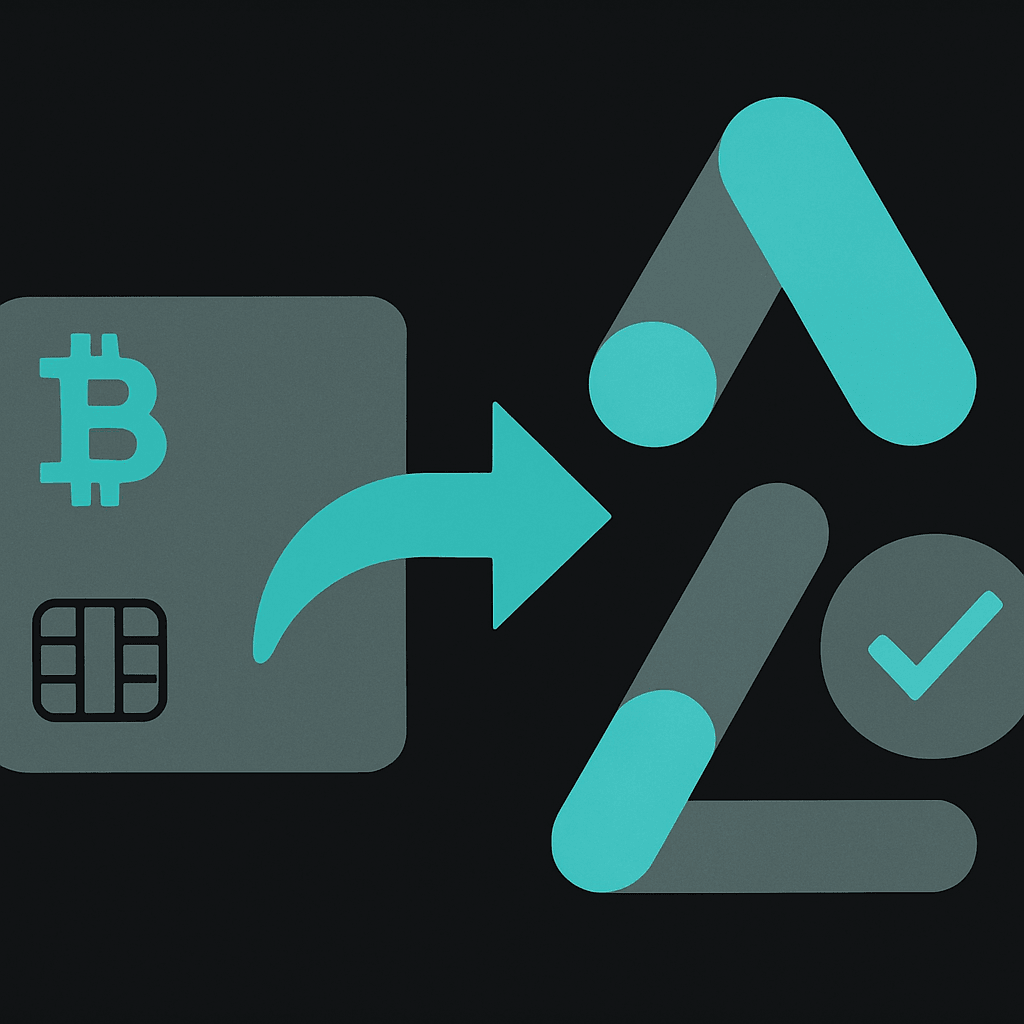
Google Ads billing doesn't distinguish between a bank-issued debit card and a crypto-funded virtual one - both carry a card number, expiry, CVV, and a Visa or Mastercard logo. As long as the card is active and has enough balance, Google Ads processes it like any other payment method.
Here's the general flow with a platform like WaldenPay:
- Create an account and get a virtual card issued - usually ready in about 5 minutes.
- Send crypto (USDT, BTC, ETH, SOL, or one of 135+ supported assets across 35+ networks) to the unique deposit address for that network.
- The deposit converts to card balance at loading time.
- Add the card details in Google Ads under Billing > Payment methods, exactly as you would any Visa or Mastercard.
- Set it as the primary payment method, or keep it as a backup alongside an existing card.
Some providers push this further. Bankera, for instance, allows funding via SEPA, SWIFT, and crypto, with balances split across multiple cards and adjustable spending limits per card - handy for agencies running several client accounts. Other services let users top up a balance via crypto, bank transfer, or cards, then move funds into a Google Ads agency account directly, which suits larger buying teams managing pooled budgets.
Card spending in these setups is always capped at whatever's preloaded - there's no credit line, no overdraft, so campaign pacing needs to account for that.
Google's billing system doesn't ask where the money came from. It asks whether the card is valid and funded. That distinction is what makes a crypto-funded virtual card work at all.
What Actually Triggers Google Ads Account Holds (It's Usually Not the Card)
This is the part most "anonymous ad spend" content skips entirely. A crypto virtual card for advertising doesn't make an account invisible to Google, and it shouldn't be sold that way.
Google Ads suspensions tied to billing almost always come down to a handful of predictable triggers:
- Mismatched billing details. If the cardholder name, billing address, or country doesn't line up with the advertiser's business information, expect a verification request.
- Frequent card swaps. Changing payment methods every few days looks like evasive behavior to automated risk systems, even when it's just balance management.
- Declined charges from insufficient balance. Since card spending is capped at whatever's preloaded, a card running dry mid-cycle causes failed charges, which Google flags faster than almost anything else.
- New card with no transaction history attached to an account that's already had policy strikes - this combination draws extra scrutiny regardless of card type.
None of these are crypto-specific problems. They're standard payment-method risk signals that apply to any prepaid or virtual card, crypto-funded or not. The fix isn't secrecy - it's consistency: keep billing info aligned, keep the balance topped up ahead of charges, and avoid unnecessary card changes.
Realistic Cost Breakdown
Before committing ad budget to this method, it helps to know exactly what it costs on top of the campaign spend itself.
WaldenPay charges a standard 5% top-up fee whenever crypto is loaded onto the card, plus a one-time card issue fee when the card is first created. There's no monthly maintenance charge - registration, balance checks, and support are free. So the real cost of running $2,000/month through a card like this is roughly $100 in top-up fees, plus the issue fee once, not recurring.
For agencies moving five- or six-figure monthly budgets, that 5% adds up, so it's worth weighing against wire fees, FX spreads on bank transfers, or the opportunity cost of holding funds in fiat versus crypto until spend is actually needed.
| Cost Item | When It Applies | Typical Impact |
|---|---|---|
| Top-up fee (standard 5%) | Every time crypto is loaded to card balance | Scales with total ad spend funded |
| Card issue fee | One-time, at card creation | Fixed cost, doesn't recur |
| Monthly maintenance | Not charged | No ongoing overhead |
| Google Ads processing | Standard, same as any Visa/Mastercard | No extra crypto-related surcharge from Google |
Comparing Approaches: Direct Card Load vs. Crypto Wallet Cards vs. Marketplace Services
There are a few different models worth knowing about, since not every "crypto card for marketers" solution works the same way.
Some crypto wallet apps offer a card that tops up directly from the wallet balance to pay for Google Ads without linking a bank account at all - convenient for someone who already lives in a single wallet ecosystem. Other services position themselves as a bridge specifically for buying a Visa card or branded gift card using Bitcoin or other crypto, precisely because Google Ads doesn't accept crypto directly. And some crypto-to-card platforms simply load a card balance from crypto holdings, which then gets used to fund Google Ads campaigns through the standard Billing section - no different, mechanically, from topping up any prepaid card.
WaldenPay sits in that last category: a virtual card funded across 135+ cryptocurrencies and 35+ networks, addable to Apple Pay or Google Pay, or used directly online. For marketers managing multiple ad accounts, the appeal is less about novelty and more about pulling crypto-denominated revenue into a spendable, trackable balance without routing everything through a traditional bank account first. Details on supported networks and card mechanics are on the features page and how it works page.
There's active discussion in the Google Ads Community forum about whether a corporate card funded via stablecoin or crypto-origin deposits can be used for Google Ads payment at all - which tells you this is still a gray area some advertisers are actively testing, not a fully settled practice. The technical answer is yes, since Google only sees the card network, but advertisers should still expect the same verification standards applied to any new payment method.
Practical Tips for Recurring Ad Spend
- Top up before the balance hits zero, not after a charge fails. Declined charges are one of the fastest routes to a billing review.
- Match billing name to business name where the platform allows it, cutting down on mismatch flags.
- Avoid switching cards weekly. Pick one funding rhythm - weekly or bi-weekly top-ups - and stick with it.
- Keep a small buffer above expected daily spend to absorb Google's auto-charge timing, which doesn't always line up perfectly with campaign budgets.
- Use the Telegram bot or dashboard to check balance before major campaign launches rather than assuming the last top-up covered it.
For a wider view of card options across platforms beyond Google, the Best Card for Digital Marketing Ads in 2026: Crypto Guide compares several use cases side by side, and the Ad Account Payment Crypto Card guide goes deeper into avoiding suspension triggers across networks generally.
What This Method Is Not
Worth being direct about this: a google ads payment crypto card is not an anonymity tool, and it shouldn't be marketed or used as one. WaldenPay is privacy-focused in the sense that it lets holders spend crypto without first converting to a bank account balance - but it is not anonymous or untraceable, and card issuance is subject to standard AML and regulatory checks. Google Ads separately requires accurate advertiser identity and business information under its own policies, independent of what payment method is used.
Readers looking for more on where privacy claims around ad payment cards hold up - and where they don't - can check Anonymous Ads Payment Card: What's Possible in 2026, which addresses this same tension directly.
Multi-Account Budget Segregation: The Real Operational Win
Agencies managing five, ten, or fifty ad accounts run into a specific headache: one card on file across everything means one dispute, one fraud flag, or one expired card can take down a lot more than it should.
Issuing a separate virtual card per client account changes that math. If a client's account gets flagged for something unrelated, the card tied to it doesn't touch billing on the other 49 accounts. Each card can be topped up independently from the same USDT or USDC balance, so treasury stays centralized even while spending is spread out.
This is also where "preventing Google Ads account suspension" gets realistic. A crypto card won't stop a suspension caused by policy violations, misleading landing pages, or trademark issues. What it can cut down is the secondary risk - suspensions or holds triggered by payment disputes, chargebacks, or a bank flagging unusual activity across too many merchant accounts at once.
Separating spend by account isn't a loophole. It's basic budget hygiene most agencies were already doing with prepaid cards long before crypto entered the picture.
The Fee Math: What a 5% Top-Up Fee Does to ROAS
This is the part most "best crypto cards" roundups skip, and it's the part that actually hits a media buyer's margins. A standard 5% top-up fee, like the one WaldenPay charges when loading a card, isn't trivial once real ad budgets are moving through it.
On $10,000 in monthly spend, that's $500 gone before a single impression runs. For an agency working on a 15-20% margin, a 5% funding fee can eat a quarter of that margin if it's not priced into client contracts.
The fix isn't dodging the fee - it's building it into how spend gets quoted. Agencies that treat the 5% as a cost of doing business, the same way they'd account for merchant processing fees, tend to price retainers accordingly. The ones that don't often find the fee has quietly eaten into their ROAS numbers after the fact.
It's worth weighing against the alternative too. A declined bank card mid-campaign can pause delivery for hours while support gets it sorted - and lost delivery time carries its own cost, often bigger than 5%. A stablecoin card for marketers that stays funded and doesn't get randomly flagged has a value that never shows up on an invoice.
FAQ
Does Google Ads accept crypto payments directly?
No. Google Ads does not accept cryptocurrency as a direct payment method. It accepts debit and credit cards carrying Visa, Mastercard, or China UnionPay logos, and in some regions, QR code bank payments. A crypto-funded virtual card works because it's a standard card on the back end, not because Google processes crypto.
Will using a crypto-funded card get my Google Ads account flagged?
Not inherently. Google Ads' billing system doesn't detect the funding origin of a card. Flags usually come from mismatched billing details, frequent payment method changes, or declined charges from an underfunded card - the same triggers that hit any prepaid card, crypto or not.
How much does it cost to fund Google Ads with a crypto card like WaldenPay?
Expect a standard 5% top-up fee each time crypto is loaded onto the card, plus a one-time card issue fee when the card is created. There's no monthly maintenance fee, and registration, balance checks, and support are free.
Can I use the same crypto card for Facebook Ads and Google Ads?
Yes. Crypto-funded virtual cards are generally usable across ad platforms including Google Ads, Facebook Ads, and TikTok Ads, since they function as standard Visa or Mastercard cards wherever they're added. See the Facebook Ads Payment Crypto Card guide for platform-specific notes.
What happens if my card balance runs out mid-campaign?
The charge will decline, since card spending is limited to whatever's preloaded - there's no overdraft. This is one of the most common causes of billing-related account reviews, so it's worth topping up ahead of expected spend rather than reacting after the fact.
Ready to fund your Google Ads account with crypto?
Get a WaldenPay virtual card issued in minutes, load it from 135+ cryptocurrencies, and add it to Google Ads billing like any other Visa card. Check pricing or read more on security before you start.
Get your WaldenPay card