ECB Pontes: Tokenized Asset Settlement vs Card Spending
By James Whitfield, Payments Specialist · Updated September 23, 2026

ECB Pontes: Tokenized Asset Settlement vs Card Spending
The tokenized bond has a buyer; the remaining problem is making its delivery and payment settle together. As of July 2026, ecb pontes addresses that institutional settlement problem by connecting distributed-ledger platforms with Eurosystem infrastructure so eligible transactions can settle in central-bank money. It's wholesale infrastructure, not a consumer crypto payment service, a card network, or a route to spending tokens at stores.
For readers whose actual goal is everyday spending, the no-KYC crypto card guide covers that separate subject. Consumer card access doesn't imply access to central-bank settlement infrastructure.
Which settlement problem does ecb pontes address?
A trade agreement isn't the same thing as completed settlement.
After a securities trade, the seller must deliver the asset and the buyer must deliver payment. Putting the security on a distributed ledger changes where ownership is recorded, but it doesn't automatically connect that record to the infrastructure holding the buyer's money. Separate systems still need coordinated instructions, status updates, and completion rules.
As of July 2026, the reported wholesale use case includes stocks, bonds, and other financial instruments recorded as digital tokens. For ecb pontes, the distinguishing feature is settlement in central-bank money rather than a private stablecoin. The settlement asset is described as reserves held at the central bank itself.
That distinction concerns the money used to discharge the payment obligation. It doesn't establish that the security is a good investment, that its issuer cannot default, or that every operational risk disappears. Tokenized asset settlement still requires valid assets, authorized participants, and dependable processes.
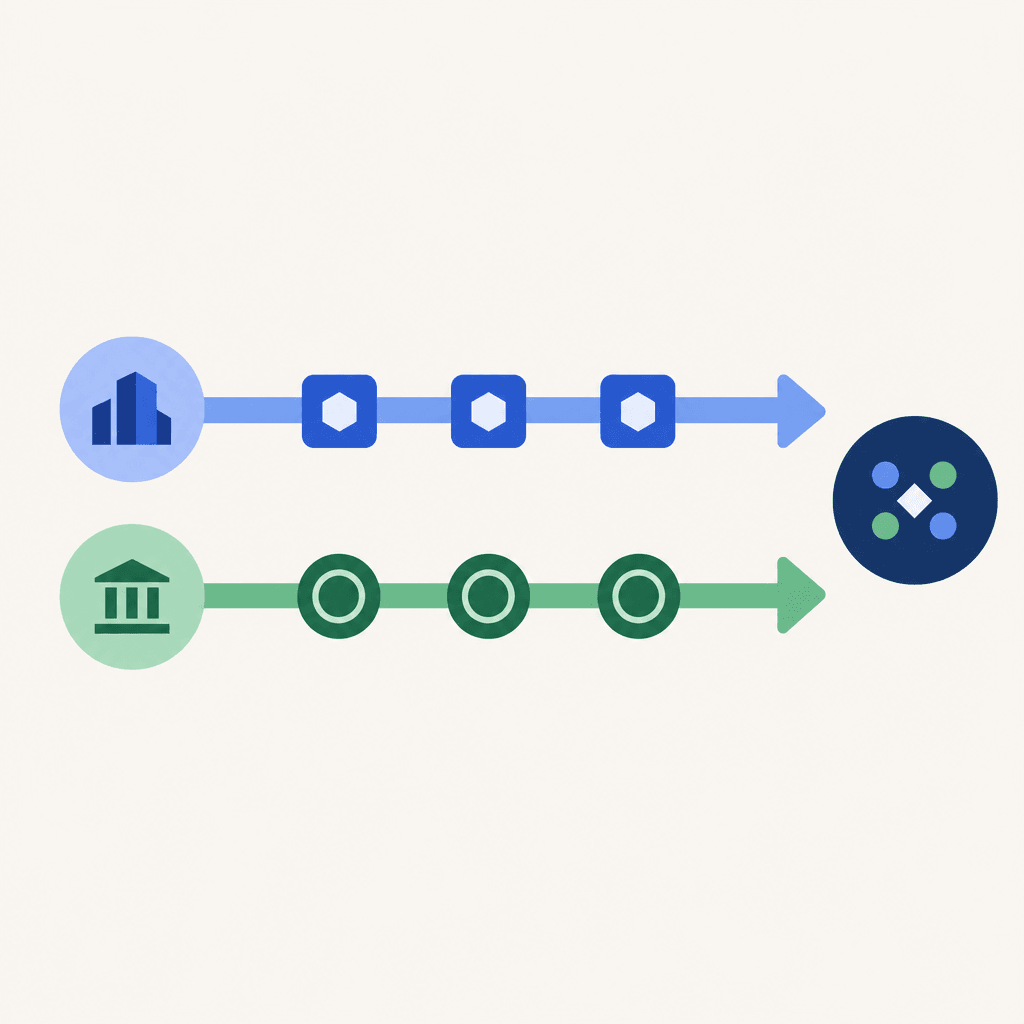
A conceptual ecb pontes transaction: three separate pieces
Conceptual example, not a confirmed production workflow: an eligible institution buys a tokenized bond from another institution. The example separates the economic components without assuming a particular technical architecture, transaction size, processing speed, or launch date.
The tokenized asset
The bond is represented on a distributed ledger. Its transfer changes the recorded holding according to the platform's rules and the instrument's legal arrangements. The token represents the security; it isn't necessarily the money used to buy that security.
A blockchain label alone doesn't identify the transaction's purpose. For comparison, the Base-funded prepaid card guide concerns cryptocurrency funding for consumer spending, not the settlement of institutional securities trades.
The payment leg
The buyer also owes payment. In the central-bank-money model described for Pontes as of July 2026, the relevant settlement asset is reserves at the central bank, rather than a privately issued stablecoin moving between ordinary crypto wallets.
So the asset record and the payment obligation are distinct, even when the transaction coordinates both.
The coordinated completion
The settlement objective is to connect delivery of the security with completion of payment. In securities markets, this is commonly described through delivery-versus-payment principles: delivery should depend on the corresponding payment, rather than leaving one party exposed after handing over its side.
This explains the problem, not every Pontes implementation detail. It doesn't establish that reserves become freely transferable public-chain tokens, or that a consumer wallet can connect directly. Those conclusions require specific access and technical provisions.

How the connection to TARGET changes the workflow
As of July 2026, ecb pontes connects DLT platforms used by banks and market operators to the Eurosystem's existing TARGET Services. The ECB specifically describes end-to-end processing and interaction with T2, improving operational efficiency and reducing the need for manual intervention.
The practical issue is communication between systems. A ledger holding securities records and a system processing central-bank payments need instructions and results that each can use. Otherwise, participants may face separate reconciliation tasks or manual handling between the asset and payment sides.
But TARGET services interoperability shouldn't be read as universal blockchain compatibility. An institutional connection doesn't mean every network, wallet, smart contract, or token qualifies.
Nor does a central-bank connection establish anything about a consumer product's controls. Readers assessing card-account protection should examine the separate WaldenPay security information, rather than borrowing assurances from an unrelated infrastructure project.
Who can participate, and what should institutions check?
As of July 2026, the Eurosystem has defined eligibility criteria for assets, market participants, and market DLT operators. The ECB states that entities with access to T2 under Article 4 of Annex 1, Part I of the TARGET Guideline are eligible for Pontes' initial launch.
Eligibility for ecb pontes therefore starts with institutional access rules, not possession of cryptocurrency.
An institution assessing participation should separate three checks:
- Entity eligibility: whether the relevant legal entity meets the applicable T2 access requirements.
- Asset and operator eligibility: whether the instrument and market DLT operator satisfy their respective criteria.
- Operational readiness: which testing, onboarding, and technical requirements apply before transactions can proceed.
These checks shouldn't be replaced by assumptions about a bank's brand, a token's popularity, or a platform's blockchain support. Retail readers face a different access question; the guide to cards without a bank account explains consumer funding mechanics rather than wholesale participation.
What changes when the transaction is card spending?
A card purchase pays a merchant for goods or services. A securities settlement completes a financial-asset trade. Both involve payment, but their participants, records, and access arrangements differ.
| Question | Pontes wholesale settlement | Consumer card spending |
|---|---|---|
| Who participates? | Eligible institutions and market infrastructure participants, under the July 2026 scope. | A cardholder, merchant, and payment-service participants. |
| What is being delivered? | A tokenized financial instrument against its payment leg. | Goods or services against a card payment. |
| What does access depend on? | Institutional, asset, operator, and onboarding requirements. | Provider eligibility, available balance, limits, and merchant rules. |
| What can't be inferred? | Public wallet access or retail merchant acceptance. | Direct access to central-bank reserves or wholesale securities infrastructure. |
As a separate consumer example, WaldenPay's crypto virtual card is a prepaid product: cryptocurrency converts to card balance at loading time, and spending uses Visa/Mastercard rails. That description doesn't imply Pontes participation, integration, or endorsement.
Merchant acceptance isn't guaranteed, and a prepaid card doesn't bypass merchant restrictions. Consumer spending also has its own balance and transaction constraints; the virtual card spending limits guide addresses those checks without conflating them with institutional settlement capacity.
What the July 2026 milestones actually establish
The Pontes project timeline needs careful reading because preparation, testing, announced use, and confirmed operations are different milestones.
As of July 2026, the ECB's July 22, 2026 focus session addressed preparatory steps for user testing and onboarding. That is a concrete preparation milestone. It shouldn't be restated as proof that every eligible institution was already settling live transactions.
Also as of July 2026, the ECB announced plans to invest part of its own funds in tokenized securities, with purchases settled in central-bank money through Pontes. It said these investments would provide first-hand experience across trade execution, settlement, systems, and portfolio management.
For ecb pontes, that announcement identifies an intended institutional use case. A plan to purchase securities isn't confirmation that a particular purchase has settled. Readers assessing readiness should distinguish an announcement's publication date from its proposed execution date and look for explicit confirmation of operational activity.
No retail launch follows automatically from either milestone.
Pontes versus digital euro: a different intended user
As of July 2026, Pontes is separate from the retail digital-euro project. Its focus is wholesale financial-market settlement, rather than a payment instrument intended for everyday retail use.
For crypto users watching consumer payment policy, digital-euro developments are the more relevant subject to follow. But a Pontes announcement doesn't establish digital-euro availability, wallet features, privacy arrangements, or merchant acceptance.
FAQ
Does ecb pontes let an individual settle a tokenized bond directly?
Individual token ownership doesn't establish access. As of July 2026, the initial-launch eligibility described by the ECB is tied to qualifying T2 access, alongside criteria for assets, participants, and market DLT operators.
Does central-bank settlement remove a bond's investment risk?
No. The settlement asset and the investment are separate. Central-bank-money settlement doesn't guarantee the bond issuer's repayment, protect its market value, or turn the security into a risk-free holding.
Does Pontes establish privacy rules for crypto-funded cards?
No. Wholesale infrastructure doesn't determine retail account privacy. The guide to realistic crypto card privacy covers that distinction. WaldenPay is privacy-focused, not anonymous or untraceable, and use remains subject to AML and regulatory requirements.
Does the ECB's investment announcement confirm live settlement?
The July 2026 announcement describes planned investments and their intended settlement route. Confirmation of completed transactions requires a separate operational statement; intent and execution shouldn't be treated as interchangeable.
Consumer spending is a separate choice
ecb pontes isn't a consumer spending service.
Get started with WaldenPay