WaldenPay Crypto Debit Card: How It Works & What It Costs
By James Whitfield, Payments Specialist · Updated August 8, 2026
WaldenPay Crypto Debit Card: How It Works & What It Costs
Anyone holding USDT, Bitcoin, or a handful of altcoins eventually hits the same wall: merchants don't take crypto directly. A landlord wants fiat. A subscription service wants a card number. An ad platform wants a Visa or Mastercard, not a wallet address.
That's the gap the WaldenPay crypto debit card is built to close. Instead of moving funds to an exchange, cashing out to a bank, and waiting days for a wire, the card turns crypto into a spendable balance in minutes. This guide walks through the actual mechanics - funding, conversion, spending, and fees - so a reader can decide if it fits before signing up.
For a deeper walkthrough of setup steps and account structure, the WaldenPay Crypto Card: How It Works, Fees & Setup (2026) pillar guide covers the full journey end to end. This article sticks to the debit card mechanics and cost math.
What the WaldenPay Crypto Debit Card Actually Is
It's a prepaid virtual card, not a bank account and not a credit line. A user funds it with crypto, that crypto converts to a card balance, and the balance gets spent like any other Visa or Mastercard-network card. There's no lending involved and no credit check, because there's nothing to lend - the card only spends what's already been loaded.
Cards are typically ready in about 5 minutes, a sharp contrast to traditional banking onboarding that can stretch into weeks of document review. That speed comes from the card skipping the standard identity-verification pipeline that legacy card issuers require - WaldenPay runs as a no-KYC crypto card. That doesn't mean transactions vanish into thin air, though. It means the sign-up friction is lower, not that oversight disappears. Card networks, payment processors, and applicable AML rules still govern how the card can be used.
A prepaid crypto card only spends what's already loaded - there's no credit, no lending, and no bank account behind it.
Step by Step: How the WaldenPay Crypto Debit Card Works
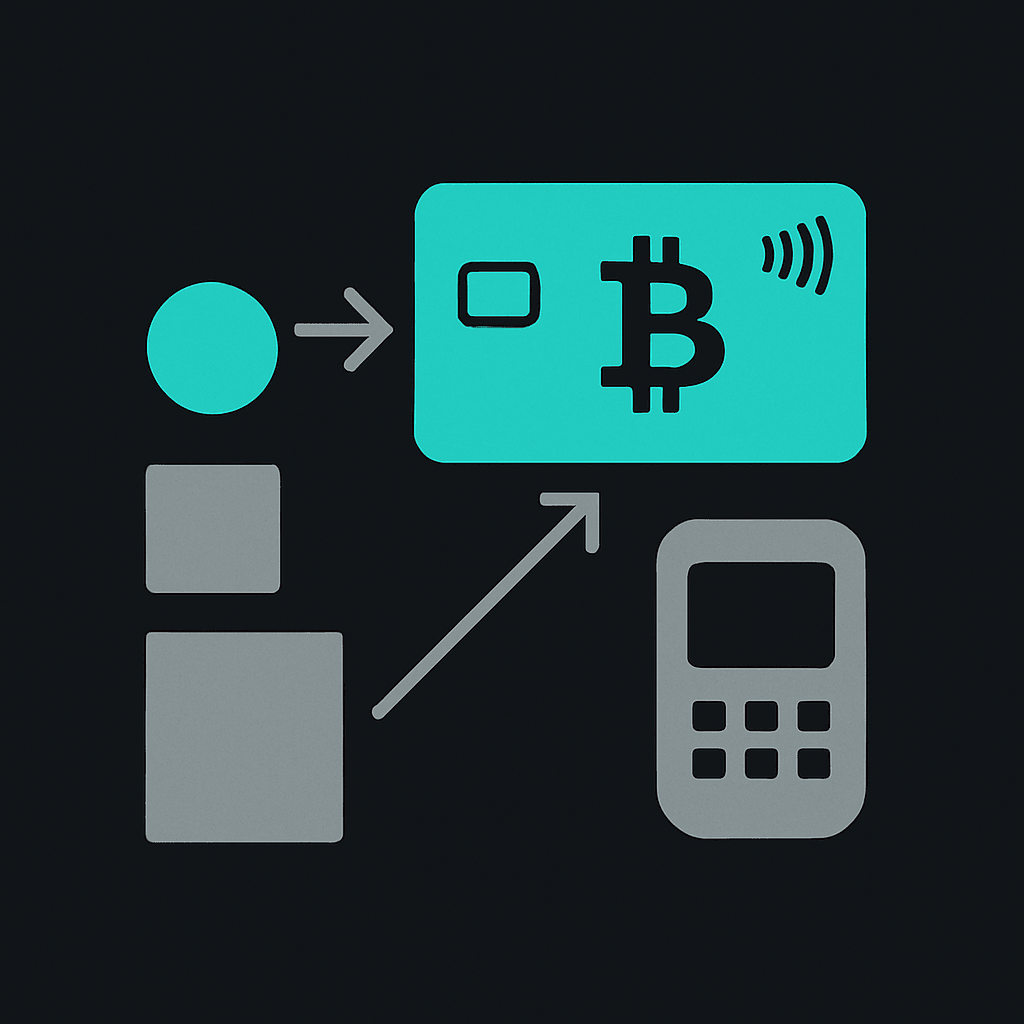
The full loop - from wallet to checkout - breaks down into four stages. None of them require moving funds through a traditional bank first.
- Get the card. Sign up on the WaldenPay site or through the Telegram bot. A virtual card is issued in minutes, ready for online use immediately and addable to a mobile wallet.
- Fund the wallet. Each supported network gets its own deposit address inside the WaldenPay account wallet - USDT on TRC20, BTC on its native chain, ETH, SOL, TRX, LTC, and more, spanning 135+ cryptocurrencies and 35+ networks.
- Load the card. Send crypto to the deposit address, and it converts to card balance. This is the point where the standard 5% top-up fee applies, calculated on the amount being loaded.
- Spend it. Use the card in Apple Pay, Google Pay, or manually entered card details, anywhere the card network is accepted - roughly 150M+ merchants worldwide, online and in-store.
Each network having its own address matters more than it sounds. Sending USDT on the wrong chain to a generic address is one of the most common ways crypto gets stuck or lost. WaldenPay's per-network wallet structure removes that guesswork - pick the network, use the matching address, done.
Funding With USDT and Other Crypto
USDT tends to be the most practical funding option for a lot of users, mostly because of speed and low network fees on chains like TRC20. Someone paid in USDT as a freelancer or running an e-commerce store can move straight from wallet to card balance without touching a bank at all.
But USDT isn't the only path. Bitcoin, Ethereum, and dozens of other assets across 35+ networks are supported too, which matters for holders who'd rather not swap their BTC or ETH into a stablecoin just to load a card. Everything converts to card balance the moment it's loaded, so the card itself always holds a single spendable balance regardless of which coin funded it.
Spending: Apple Pay, Google Pay, or Card Details
Once loaded, the WaldenPay crypto debit card behaves like any other card at checkout. Add it to Apple Pay or Google Pay for tap-to-pay in stores, or use the card number, expiry, and CVV for online purchases. That flexibility means it works for grocery runs and for funding an ad account that only accepts manually entered card details.
This is also where the "spend crypto anywhere" pitch actually holds up, rather than just being a marketing line. Because the card rides on standard card network rails, it isn't limited to crypto-friendly merchants. It works anywhere Visa or Mastercard is accepted, full stop.
The Telegram Crypto Card Bot
WaldenPay also runs a Telegram bot for people who'd rather manage everything from a chat interface instead of a web dashboard. Through the bot, users can:
- Order a new virtual card
- Recharge an existing card balance
- Check current balance and recent transactions
- Get alerts when a transaction posts
For frequent top-ups - say, a freelancer loading the card every time a client pays out - the Telegram bot cuts a few steps out of the process. No need to open a browser and log in; a couple of taps in the chat handles it.
What the WaldenPay Crypto Debit Card Costs
This is where most comparison articles get vague. They'll say "low fees" and move on. Here's the actual structure, in plain terms.
There are exactly two costs to plan for: a standard 5% fee charged when crypto converts into card balance, and a one-time card issuance fee paid when the card is first created. After that, there's no recurring subscription and no monthly maintenance charge sitting in the background whether the card gets used or not.
Registration is free. Checking the balance is free. Contacting support is free. The only money moving is the top-up fee (paid each time crypto gets loaded) and the one-time issuance cost (paid once, at setup).
Why Flat Fees Beat Subscription Models
Plenty of crypto card competitors run on a subscription tier system - pay $10, $20, or more per month regardless of spending, sometimes with a separate top-up fee stacked on top. That model punishes low-volume users. Someone loading $200 a month still pays the same flat subscription as someone loading $5,000.
A standard 5% top-up fee scales with actual usage instead. Load less, pay less. Load more, pay more, but there's never a fixed charge sitting there whether the card gets touched or not. For anyone who tops up occasionally rather than constantly, that structure tends to work out cheaper over a year, even if the percentage looks higher on a single transaction.
| Cost Type | WaldenPay Crypto Debit Card | Typical Subscription-Model Card |
|---|---|---|
| Top-up fee | standard 5% per load | Often 1-3% plus monthly tier fee |
| Monthly maintenance | None | Commonly $5-$20/month |
| Card issuance | One-time fee | Often bundled or waived, offset by higher tiers |
| Registration / balance checks | Free | Varies, sometimes gated behind paid tiers |
Before assuming one model is universally cheaper, it's worth running the actual numbers against personal spending habits. Someone reloading a card weekly with large sums might find a subscription model's lower percentage fee wins out over time, despite the monthly charge. The math depends on volume and frequency, not just headline percentages.
Privacy: What It Really Means Here
WaldenPay markets itself around privacy and speed, not around anonymity. That distinction matters, and it's worth being direct about it.
The card can be issued without the multi-week identity verification pipeline that traditional banks require, which is why setup can be done in minutes instead of weeks. That's a genuine convenience and privacy advantage - fewer documents handed over, less personal data sitting in a bank's file. But it doesn't mean transactions are untraceable or that the card sits outside regulatory oversight. Card network rules, payment processor requirements, and applicable AML regulations still apply to how the card can be funded and used.
Framed correctly, this is about financial sovereignty and reduced friction, not about evading scrutiny. Readers who want the full detail on what privacy protections actually exist - and what limits apply - should read WaldenPay "Anonymous" Card: What Privacy It Really Offers, which unpacks the topic in depth.
Who Actually Uses a Crypto Debit Card Like This
A few recurring patterns show up among people who adopt a virtual crypto card instead of routing everything through a bank:
- Freelancers paid in crypto who want to spend directly without a bank account acting as a middleman step.
- Digital nomads moving between countries who need a card that works regardless of local banking access.
- E-commerce sellers holding crypto revenue who need to cover business expenses without a full cash-out cycle.
- Entrepreneurs funding ad accounts on platforms that require a standard card number rather than a crypto wallet connection - see Google Ads Payment Crypto Card: Fund Ad Accounts in 2026 and Media Buying Crypto Card: Best Options for Ad Accounts 2026 for more on that use case.
Ad buyers specifically tend to value the load-crypto-onto-card flow because ad accounts get flagged and frozen for all sorts of reasons - a dedicated virtual crypto card that's easy to reissue keeps a campaign running instead of stalling out over a payment dispute. The broader Media Buying Virtual Cards: A 2026 Guide for Ad Buyers guide goes further into that angle.
A Quick Reality Check Before Signing Up
The WaldenPay crypto debit card isn't a bank account replacement and it isn't a savings product. There's no interest earned on balance, no overdraft, and no credit line. It's a spending tool - crypto in, card balance out, purchase made. Anyone expecting banking features beyond spending will be disappointed.
And it's worth remembering that a 5% top-up fee, while flat and predictable, isn't nothing. Someone loading $1,000 a month is paying $50 just to convert that balance, before the one-time issuance fee. That's a real cost that needs to be weighed against the convenience and speed being purchased.
For a full setup walkthrough, including account creation and Telegram bot commands in more detail, see WaldenPay Explained: How This Crypto Virtual Card Works. Details on card mechanics, network coverage, and security practices also live on the how it works and security pages.
FAQ
What does the WaldenPay crypto debit card actually cost?
Two costs: a standard 5% top-up fee applied whenever crypto converts into card balance, and a one-time card issuance fee paid at setup. There's no monthly maintenance fee, and registration and balance checks are free.
Which cryptocurrencies can fund the WaldenPay crypto debit card?
WaldenPay supports 135+ cryptocurrencies across 35+ networks, including USDT (commonly via TRC20), Bitcoin, Ethereum, Solana, Tron, Litecoin, and more. Each network has its own deposit address inside the account wallet.
Can the WaldenPay card be used with Apple Pay and Google Pay?
Yes. Once funded, the card can be added to Apple Pay or Google Pay for tap-to-pay purchases, or the card number, expiry, and CVV can be entered manually for online checkout.
Is the WaldenPay crypto debit card anonymous?
No. WaldenPay is privacy-focused and skips the lengthy identity verification pipeline of traditional banks, but it isn't anonymous or untraceable. Use is still subject to AML and applicable regulatory requirements.
How fast can someone get a WaldenPay crypto debit card?
Cards are typically issued in about 5 minutes, since the process avoids the multi-week document review common with traditional bank card applications.
Ready to load crypto onto a spendable card?
Set up a WaldenPay crypto debit card in minutes, fund it with 135+ cryptocurrencies, and spend at 150M+ merchants worldwide via Apple Pay, Google Pay, or card details.
Get your WaldenPay card