Crypto Prepaid Card 2026: How They Work & How to Choose
By James Whitfield, Payments Specialist · Updated September 24, 2026
Most articles about a crypto prepaid card read like shopping lists. Ten logos, ten "top features," and zero explanation of what's actually happening to your money. That's a problem, because the mechanics matter more than the branding: whether a card converts your crypto at load time or spend time changes your exposure to price swings, your fees, and even your tax bookkeeping.
This guide skips the roundup format and gets into how a crypto prepaid card actually works, what the real cost structure looks like once tiered top-up fees and network fees are factored in, and how to spot a genuinely useful provider versus one that's just good at marketing. It also clears up a mix-up that trips up a lot of new users: the difference between privacy and anonymity.
What a Crypto Prepaid Card Actually Is
A crypto prepaid card works the same way a standard prepaid gift card does. You choose which cryptocurrency to sell, the fiat proceeds land on the card, and you spend that balance down until it's gone. There's no line of credit and no bank account behind it - the card only spends what's already been loaded.
That's different from a crypto debit card, which is usually tied to an exchange account and pulls from a live crypto balance at the point of sale, and different again from a crypto credit card, which lets you spend now and settle up later, often earning crypto-denominated rewards or cashback along the way.
Prepaid cards typically come in two forms: a virtual card that's ready in minutes and works with digital wallets, and a physical card that ships to your address (often with a delivery fee depending on region). Most people loading crypto onto a card for everyday spending start with the virtual version - it's instant and works fine for Apple Pay, Google Pay, and online checkout. If you'd rather skip straight to getting one, the prepaid crypto card page covers issuance, funding options and limits.
How Do Crypto Cards Work, Step by Step
Here's the part most guides skip. When someone asks how crypto cards work, the honest answer is: it depends on when the conversion happens.
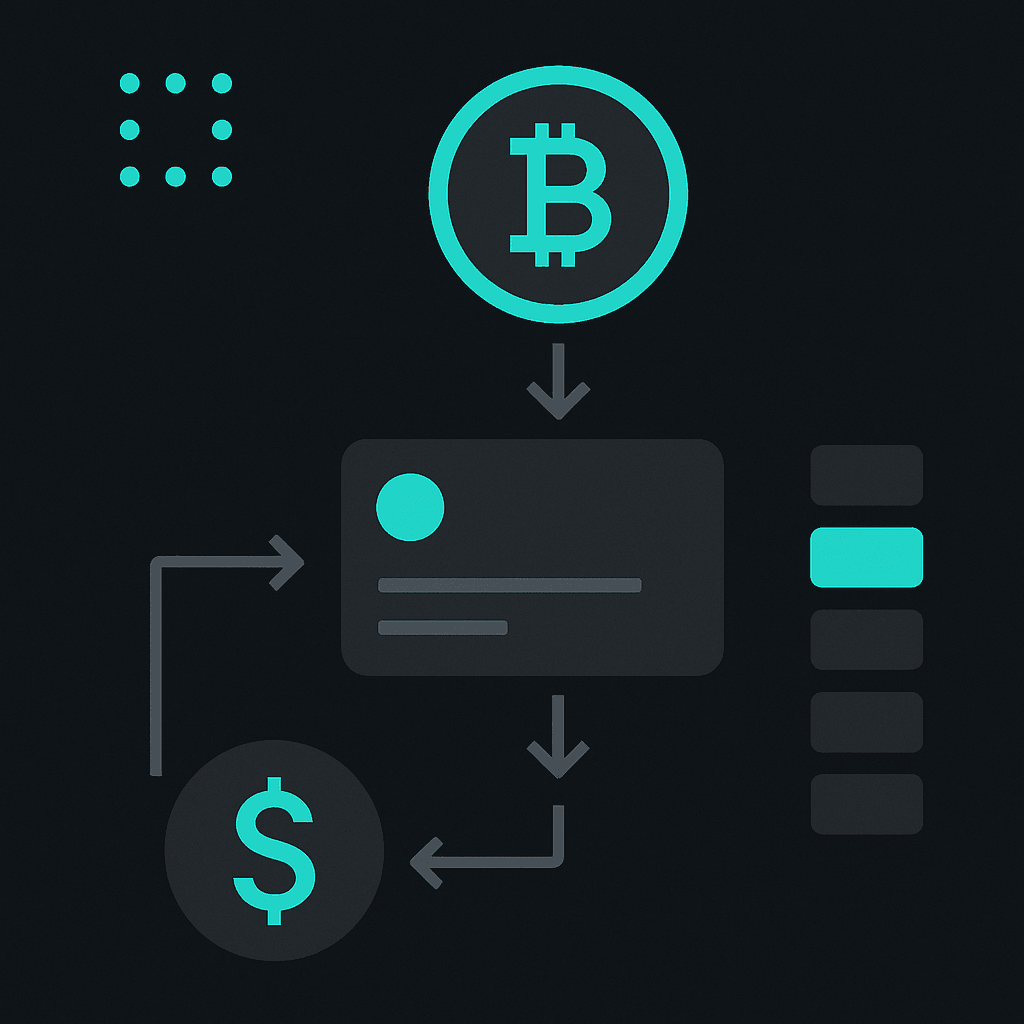
With a true crypto prepaid card, conversion happens at load time. You send BTC, ETH, USDT, or another supported asset to a deposit address, the provider converts it into a card balance denominated in fiat, and that balance sits static until you spend it. The exchange rate gets locked in the moment you load - not the moment you tap your card at a coffee shop three weeks later.
That matters for two reasons. First, it takes day-to-day price volatility out of your spending money; a $200 load stays $200 whether the market moves or not. Second, it means the crypto card exchange rate you actually need to care about is the one applied during top-up, not some floating rate tracked in real time. Any provider that's vague about when conversion happens is worth double-checking.
- Open an account and get a virtual card issued (usually a one-time issuance fee, often around $10).
- Send supported crypto to your unique deposit address for that network.
- The provider converts the deposit to card balance, minus the top-up fee and any network fee.
- Spend the balance online, in-store, or through Apple Pay/Google Pay - anywhere the card network is accepted.
- Reload whenever the balance runs low; there's usually a minimum top-up amount (WaldenPay's is $25).
Some providers also support crypto vouchers - a prepaid digital card exchanged for cryptocurrency, similar to a gift card, that adds funds to a wallet rather than routing through an exchange at all. It's a related idea, but not the same product as a reloadable prepaid card.
Crypto Prepaid Card vs Debit Card vs Credit Card
These three get lumped together constantly, but they behave differently in ways that affect fees, limits, and risk.
| Feature | Prepaid Card | Debit Card | Credit Card |
|---|---|---|---|
| Funding source | Pre-loaded balance, converted from crypto at load time | Linked crypto/exchange balance, often converted at spend time | Line of credit, paid off later |
| Price volatility exposure | Low once loaded | Higher, since conversion happens at swipe | N/A (settled in fiat) |
| Daily spending limits | Usually higher | Typically lower | Depends on credit line |
| Rewards | Rare, sometimes token-flexible | Common, often in native token | Cashback or crypto rewards common |
| Best for | Everyday spending, travel, ad accounts | Active traders spending from an exchange | Users comfortable with revolving credit |
Debit cards generally carry lower daily spending or withdrawal limits than prepaid crypto cards, which matters if you're funding ad accounts or paying vendors in bulk. Credit cards add a rewards layer but come with the usual credit-product tradeoffs: interest, credit checks, revolving balances.
For a deeper side-by-side across specific providers, WaldenPay's guide to choosing the right crypto card in 2026 goes further into feature comparisons beyond just the card type.
The Real Cost Structure: What a Crypto Prepaid Card Actually Costs
This is where most reviews stop at "low fees" and move on. That's not much use. A crypto prepaid card's real cost has at least three layers, and they don't always show up in the same place.
- Issuance fee. A one-time cost to get the card itself, commonly around $10, separate from anything you spend afterward.
- Top-up fee. Charged each time you load crypto onto the card, usually a percentage of the amount converted. This is where crypto card top-up fees vary the most between providers, and where volume tiers make a real difference.
- Network fee. The blockchain fee for the transaction itself, which depends on which network you're sending from - a TRC-20 USDT transfer costs very differently than an on-chain BTC transfer during a busy period.
WaldenPay is a decent example of how tiered top-up pricing works in practice, since its fee structure is based on rolling 30-day card spend rather than a flat rate for everyone. The top-up fee starts at 5% and steps down automatically as spend increases: 4.75% once 30-day spend passes $2,000, 4.5% past $5,000, 4.25% past $10,000, 4% past $25,000, 3.5% past $50,000, and 3% past $100,000. Anyone spending $250,000 or more a month gets individual pricing. There's no application process for any of this - the dashboard just shows the current fee, the trailing 30-day spend, and how much more volume unlocks the next tier.
Do the math before assuming "low fees" advertising applies to you. A card offering a flat 3% might beat a tiered 5% card for someone loading $200 a month, but the tiered structure wins for anyone loading crypto regularly at higher volumes - which is common among freelancers paid in crypto or entrepreneurs funding ad accounts. For a fuller breakdown across multiple providers, see WaldenPay's Crypto Card Fee Index for 2026.
Beyond the top-up fee, check whether there's a monthly maintenance charge. Plenty of providers still charge one; WaldenPay doesn't - registration, balance checks, and support are free, and the only recurring cost tied to actually using the card is the top-up fee itself. Full current pricing is on the pricing page.
Crypto Card No KYC: What That Really Means
Searches for a crypto card no KYC option are common, and it's worth being precise about what exists versus what's just being sold.
A prepaid card can be bought with crypto and no identity check in some cases - through cash vouchers, certain regional reloadable cards, or peer channels that convert tokens into spendable money without going through an exchange or bank. That's a real category of product. But it's narrow, often comes with lower limits, and isn't the same thing as a mainstream reloadable card tied to a network like Visa or Mastercard, which almost universally requires some level of identity verification to comply with anti-money-laundering rules.
For a realistic look at what's genuinely available in this space without overselling it, WaldenPay's guide on no-KYC crypto cards that actually work in 2026 is worth reading before assuming a card will let you skip verification entirely.
Privacy-focused isn't the same as untraceable. A compliant crypto prepaid card protects how much of your financial life you expose day to day - it doesn't remove you from the system.
How to Choose a Crypto Prepaid Card: A Practical Checklist
Marketing copy tends to lean on the same three lines - "instant," "low fees," "spend anywhere" - regardless of whether they're actually true for your use case. Here's what to check instead.
- Supported assets and networks. If you hold SOL or TRX and the provider only supports BTC and ETH, that's a dealbreaker before fees even matter. Providers supporting 100+ cryptocurrencies across dozens of networks give more flexibility for loading crypto onto a card without extra conversion hops.
- Fee structure, not just the headline number. Look for the issuance fee, the top-up fee (and whether it drops with volume), and any monthly charge. Model it against your actual usage.
- Country availability. Verify the card actually works where you live and where you plan to spend before applying - availability varies more than most sites admit.
- Spending limits. Prepaid cards typically allow higher daily limits than debit cards tied to exchange balances, which matters for larger purchases or business use.
- Wallet integration. Confirm Apple Pay and Google Pay support if you want to spend crypto anywhere without carrying a physical card.
- Underpayment and refund handling. If the provider also supports receiving payments (not just spending), check what happens when someone pays the wrong amount. A well-built system tracks it and issues a fresh address or refund rather than losing the difference.
- Regulatory posture. A provider that's upfront about AML requirements is more trustworthy than one implying total anonymity.
WaldenPay's own prepaid crypto card page lays out how these pieces fit together for its specific setup - 135+ cryptocurrencies across 35+ networks, Apple Pay and Google Pay support, and the tiered top-up structure covered above - alongside features like free Send to Friend transfers between users and free crypto payment collection for people getting paid by clients or customers. Details on the underlying mechanics live on the how it works page and security page.
Everyday Use Cases That Actually Matter
A crypto prepaid card isn't just for people who want to say they "spend crypto." A few use cases show up again and again:
Everyday spending and subscriptions. Load once, spend gradually, avoid re-entering a bank card every time a subscription renews.
Freelancers paid in crypto. Someone invoicing clients internationally can collect payment in crypto and load a portion straight onto a card for spending, skipping a separate off-ramp step.
Funding ad accounts. Entrepreneurs running ad campaigns often need a card that can absorb variable spend without hitting low debit-style limits - a place where prepaid cards' typically higher limits help.
Travel. A virtual card usable through Apple Pay or Google Pay means spending crypto anywhere the card network is accepted, without carrying multiple physical cards across borders.
For anyone regularly receiving crypto payments rather than just spending them, it's worth reading about how accepting crypto payments works in 2026 and how instant peer transfers - like sending crypto to a friend without a wallet address - fit alongside card spending as part of a broader crypto-to-fiat workflow.
FAQ
Is a crypto prepaid card the same as a crypto debit card?
No. A crypto prepaid card converts your cryptocurrency into a fiat balance at load time, and you spend from that fixed balance. A crypto debit card typically stays linked to a live exchange balance and converts at the moment you spend, which exposes you to price movement between top-ups.
What exchange rate applies when I load a crypto prepaid card?
The rate applied at the moment of conversion during the top-up, not a rate tracked in real time afterward. Once the balance lands on the card, it's fixed in fiat terms regardless of what the market does next.
Do crypto prepaid cards charge a monthly fee?
It varies by provider. Some charge ongoing maintenance fees; others, including WaldenPay, charge no monthly fee and only apply a top-up fee when crypto is loaded, plus a one-time issuance fee for the card.
Can I get a crypto card with no KYC?
Some narrow products - cash vouchers, certain regional reloadable cards - can be obtained with minimal identity checks. But cards issued on major networks like Visa or Mastercard almost always require verification to meet AML requirements, and any provider claiming full anonymity should be treated with caution.
Are crypto prepaid cards private?
They can offer more privacy than routing every purchase through a personal bank account, since spending is separated from your main financial accounts. But they aren't anonymous - providers operate under AML and regulatory obligations, and transactions remain traceable within compliance systems.
Related guides
These pages answer the questions that usually come next:
- WaldenPay pricing — the $10 issuance fee and how volume discounts take top-ups from 5% down to 3%
- How it works — from sign-up to spending in about 10 minutes
- Fee calculator — see exactly what lands on your card for any top-up amount
- WaldenPay vs Crypto.com Visa Card — prepaid simplicity vs staking-tier rewards
- WaldenPay vs Coinbase Card — how the two approaches to spending crypto differ
- WaldenPay vs Wirex Card — fees, onboarding and supported assets side by side
- USDT card — load with Tether on TRC20 for sub-$1 network fees
- Bitcoin card — spend BTC anywhere Visa and Mastercard are accepted
Ready to see tiered fees in action?
WaldenPay's virtual card supports 135+ cryptocurrencies across 35+ networks, with top-up fees that start at 5% and drop automatically to as low as 3% as spend grows - no applications, no monthly fee.
Get your WaldenPay card